Estrogen helps maintain bone density, and its decline around menopause causes many women to lose up to 20% of bone density within five to seven years. Weight-bearing and resistance exercise are among the few interventions shown to slow that loss.
Why it's different
Why training changes meaningfully after 50
The drop in estrogen around menopause accelerates several things at once — bone loss, muscle loss and fat redistribution — and training needs to answer all three.
Up to 20% bone density many women lose in the 5–7 years after menopause, their fastest rate ever
3–5%/10y the typical rate of muscle mass loss after 50, which resistance training directly slows
2–3×/week strength sessions weekly is the range most guidelines recommend for women over 50
Muscle mass decline of roughly 3–5% per decade accelerates after 50, and less muscle means less support for joints and a lower resting metabolism. Resistance training is the most direct way to slow it.
Hormonal shifts around menopause often move fat storage toward the midsection even without a change in total weight. Strength training and overall activity help manage this better than cardio-only approaches.
Joint stiffness and minor aches are common in this decade, but the answer is usually a longer warm-up and smart exercise selection, not avoiding resistance training — which is exactly what protects the joints long term.
What it looks like
A sample week on a workout plan for women over 50
Strength training three times a week with impact work layered in safely, plus cardio and recovery. This is a common shape Burnplate builds for this stage.
Example week
4 Days/week40–50 min Session lengthBeginner–intermediate LevelDumbbells + bodyweight Equipment
Monday Strength + impact Squat 3×10 · Step-up 3×10 each side · Push-up 3×10 · Impact hops or marching in place 2×20s
Tuesday Cardio 25–30 min moderate cardio
Wednesday Strength Romanian deadlift 3×10 · Row 3×10 · Shoulder press 3×10 · Plank 3×30s
Thursday Rest or mobility 20 min gentle stretching or yoga
Friday Strength + balance Goblet squat 3×10 · Lunge 3×10 each side · Single-leg stand 3×20s each side
Saturday Cardio + walk 20–25 min walk or light cardio
Sunday Rest Full rest
How Burnplate handles it
How Burnplate builds a workout plan for women over 50
Burnplate builds the plan around your level and keeps a clear log of it, which helps you and your care team track what's working.
A plan built around your level and goals
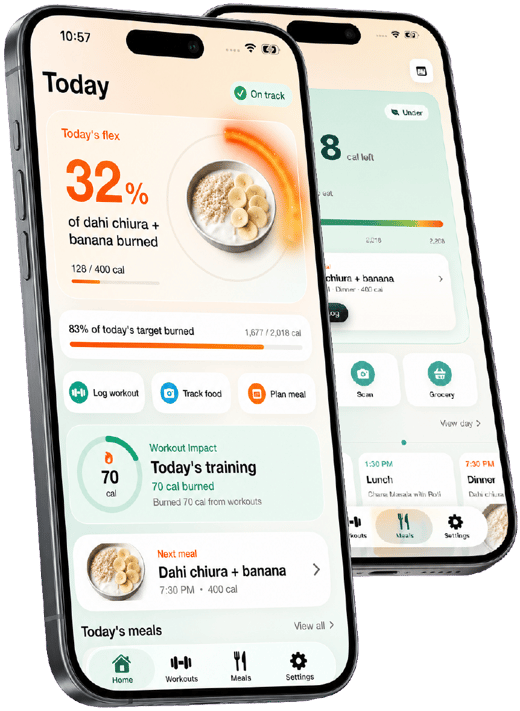
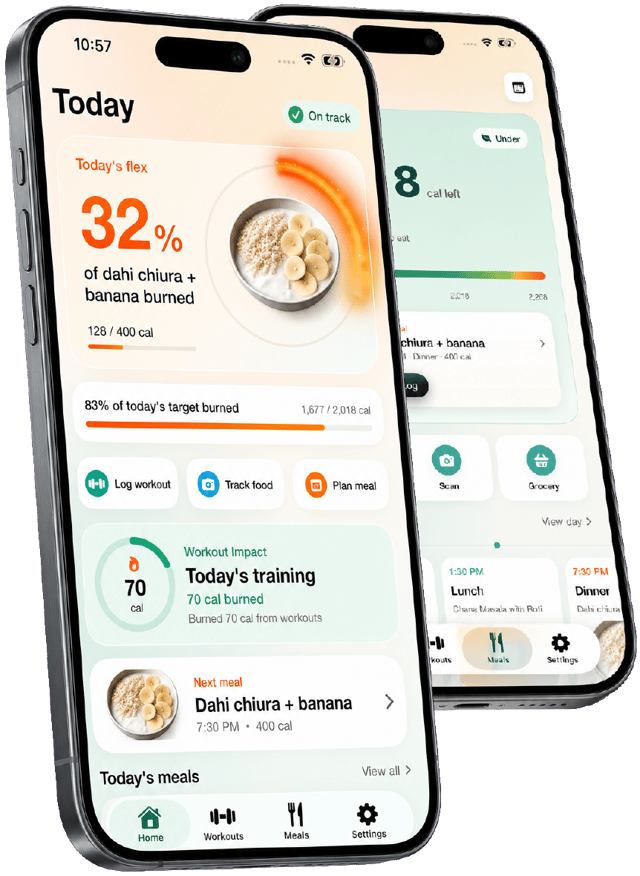
Burnplate's workout planner builds a strength-focused plan around your days per week, equipment and level, adjusting the exercises as you progress.
Every session logged and tracked over time
Log workouts and Burnplate keeps a full history, making it easy to see strength gains and share progress with your doctor if useful.
Protein and calorie targets for muscle
Burnplate sets protein and calorie targets from your body and goal, supporting the muscle- and bone-protective effect of your training rather than undercutting it.
Steps and daily activity counted
Walks and daily movement count toward your day alongside structured strength sessions, reflecting all the activity that supports bone and heart health.
Practical guidance
Tips for a stronger, bone-protective plan after 50
Adjustments that make training after 50 both safer and more effective for bone and muscle.
- 01 Prioritize weight-bearing exercise
Both weight-bearing and resistance work are shown to slow bone loss; cardio alone, like swimming or cycling, doesn't provide the same bone benefit.
- 02 Add impact carefully, if appropriate
Marching, light hops or jumping (when appropriate for your bone health) provide a bone-loading stimulus resistance training alone doesn't.
- 03 Increase protein intake
Higher protein intake supports the muscle-preserving effect of strength training during a decade of accelerated muscle loss.
- 04 Warm up longer on stiffer days
A longer, more thorough warm-up protects joints without requiring you to train less.
- 05 Get a recent bone density check
Knowing your bone density helps tailor how much impact and resistance work makes sense for you.
- 06 Track strength, not just the scale
Weight can hold steady or even rise as muscle replaces fat — strength and how clothes fit are better indicators of progress.

Build the plan around your week
Build my workout plan Tell Burnplate your days, equipment and level and it builds a progressive workout plan, logs every session, and connects what you burn to what you eat.
Questions
Workout planner for women over 50: FAQ
What is the best workout routine for women over 50?
A plan combining resistance training two to three times a week with some weight-bearing impact work and regular cardio best addresses the bone loss, muscle loss and fat redistribution common after 50. Strength training should be the priority, not an add-on to cardio.
Does exercise help with bone loss after menopause?
Yes. Weight-bearing and resistance exercise are among the few interventions shown to slow postmenopausal bone loss, which can reach up to 20% within five to seven years of menopause. Impact exercise, done appropriately, adds further benefit.
Can women over 50 still build muscle?
Yes, resistance training reliably builds and preserves muscle at any age, including well past 50. The rate may be somewhat slower than in younger decades, but consistent training with adequate protein still produces real strength gains.
Is walking enough exercise for women over 50?
Walking supports cardiovascular health and is valuable daily movement, but it doesn't provide the bone- and muscle-protective stimulus that resistance training does. Pairing regular walks with two to three strength sessions a week covers more of what this decade needs.
How does a workout plan for women over 50 differ from one in their 40s?
The core structure — strength training a few times a week plus cardio — stays similar, but bone density and impact exercise usually get more direct attention after menopause, since bone loss accelerates faster in this decade than the one before it.
Should women with osteoporosis avoid certain exercises?
Some high-impact or spine-flexion movements may need modifying depending on bone density and history, which is worth discussing with a doctor or physical therapist. Resistance training itself remains recommended and beneficial, just tailored to the individual.
