Training the quads, hamstrings, glutes and calves recruits more total muscle mass than any upper-body session, which means a bigger calorie burn and a bigger hormonal training response per session.
Why it's different
Why legs deserve their own dedicated plan
Upper-body movements dominate a lot of default gym habits. Legs need deliberate programming precisely because they're the group most likely to get shortchanged.
8–12 reps per set is a solid hypertrophy range for building leg size and strength
48–72 hrs of recovery between heavy leg sessions lets the largest muscle group in your body actually adapt
2×/week minimum frequency per leg muscle group is a reasonable target for steady strength and size gains
A squat pattern is quad-dominant; a deadlift or hip hinge is hamstring-and-glute-dominant. Training only one leaves the other side underdeveloped and can create a strength imbalance that raises injury risk.
Because leg training is demanding and doesn't show in a mirror the way upper-body work does, it's the most commonly neglected session — which compounds into both a weaker lower body and an unbalanced physique over time.
Bodyweight and dumbbell variations — split squats, step-ups, Romanian deadlifts, glute bridges — can build real leg strength at home, though a barbell allows heavier loading as you progress.
What it looks like
A sample leg-focused week
Two dedicated leg sessions a week, one quad-dominant and one hip-dominant, that can be done with dumbbells at home or a barbell at the gym.
Example week
2 dedicated leg days Days/week40–50 min Session lengthBeginner–intermediate LevelDumbbells or barbell Equipment
Monday Legs A (quad focus) Squat 4x8–10 · Walking lunge 3x10/leg · Leg press or step-up 3x12 · Calf raise 3x15
Tuesday Upper body or rest Upper-body strength session or full rest
Wednesday Cardio or rest 20–30 min easy cardio or full rest
Thursday Legs B (hinge focus) Romanian deadlift 4x8–10 · Hip thrust 3x10 · Bulgarian split squat 3x10/leg · Calf raise 3x15
Friday Upper body or rest Upper-body strength session or full rest
Saturday Optional cardio 20–30 min bike, walk or swim
Sunday Rest Full rest
How Burnplate handles it
How Burnplate supports leg training
Burnplate builds leg-specific sessions around whatever equipment you actually have, and tracks whether the loads are climbing.
Leg days programmed around your equipment
Burnplate's workout builder creates dedicated leg sessions whether you're training at home with dumbbells or at the gym with a barbell, covering both squat and hinge patterns.
Loads tracked across sessions
Workout history logs the weight and reps on every leg exercise, so you can see whether your squat or Romanian deadlift is actually progressing over weeks.
Calorie and protein targets that support recovery
Since leg sessions are demanding on the biggest muscle group in the body, Burnplate's calorie and protein targets help make sure recovery isn't the limiting factor.
The burn bar shows the payoff
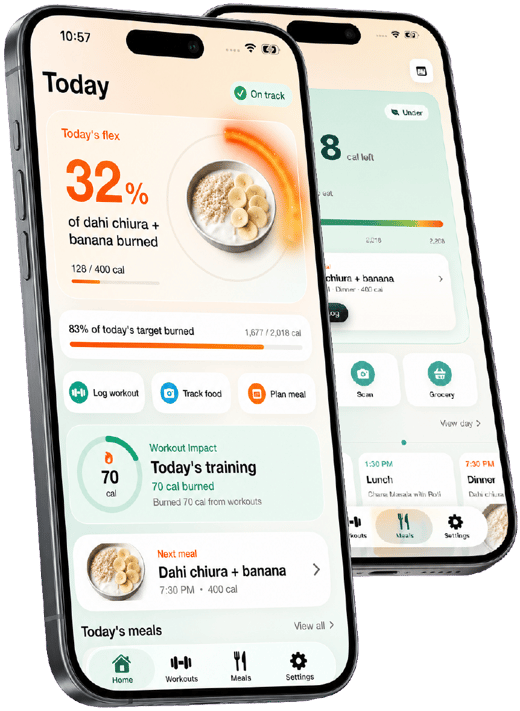
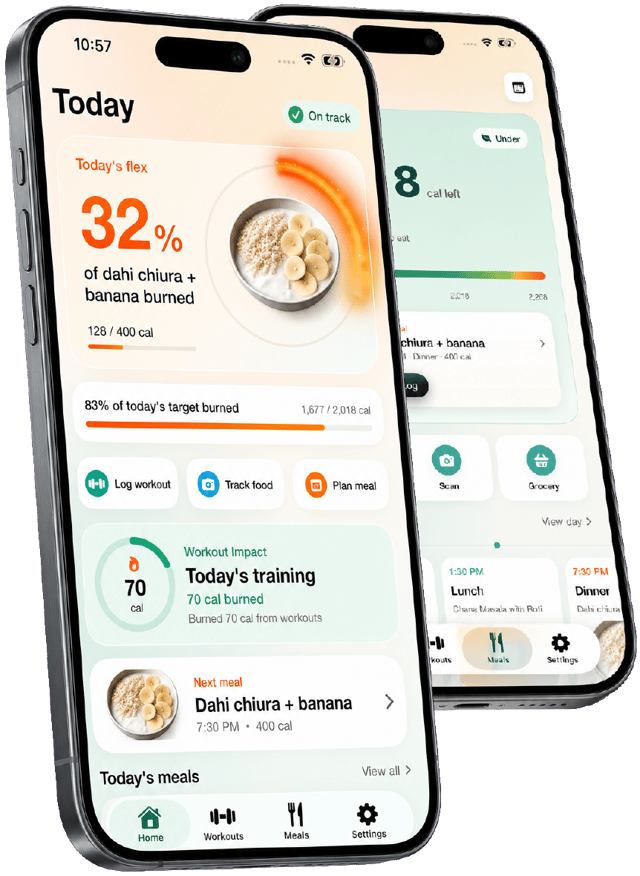
After a heavy leg session, Burnplate shows what percentage of a meal that workout burned off — leg day typically shows the biggest number of any session.
Practical guidance
Tips for training legs well
Details that matter for the muscle group most likely to get rushed or skipped.
- 01 Warm up knees and hips first
A few minutes of bodyweight squats, lunges and hip circles before loading up reduces injury risk on the heavier sets.
- 02 Don't skip the hinge pattern
Hamstrings and glutes need deliberate training too — a program that's all squats and no hinges leaves half the leg undertrained.
- 03 Use a full range of motion
Partial-range squats and lunges limit the strength and size benefit — go as deep as mobility comfortably allows.
- 04 Respect the 48–72 hour recovery window
Training the same heavy leg pattern on back-to-back days rarely allows full recovery — space hard sessions out.
- 05 Fuel the session
Leg training burns more calories than most other sessions — make sure intake supports it rather than under-fueling the hardest workout of the week.
- 06 Progress unilateral work slowly
Single-leg movements like split squats expose imbalances — increase load gradually to avoid overloading a weaker side.

Build the plan around your week
Build my workout plan Tell Burnplate your days, equipment and level and it builds a progressive workout plan, logs every session, and connects what you burn to what you eat.
Questions
Workout planner for legs: FAQ
How often should you train legs?
Twice a week per leg muscle group is a solid target for most people — enough frequency to build strength and size steadily while allowing the 48–72 hours of recovery a demanding muscle group like this needs.
Can you do a leg workout at home?
Yes. Bodyweight and dumbbell exercises — squats, lunges, step-ups, Romanian deadlifts, glute bridges — build real leg strength without a gym. A barbell eventually allows heavier loading, but it's not required to get started or to make progress for a while.
How many exercises should a leg day have?
Four exercises covering a squat pattern, a hinge pattern, a single-leg movement and a calf exercise is a solid, time-efficient structure. More than that tends to push sessions long without adding much extra benefit.
Why is leg day important?
Legs are the body's largest muscle group, so training them drives more total calorie burn and a bigger hormonal training response than upper-body sessions. Skipping them also creates strength imbalances that can affect posture and increase injury risk elsewhere.
How long should a leg workout take?
40 to 50 minutes is typically enough to cover 4 well-chosen leg exercises at a working intensity, including warm-up sets for the heavier compound movements.
