Elevating your feet for a push-up, moving from a bent-knee to a straight-leg leg raise, or shifting from a two-hand to a one-arm row all increase difficulty the same way a heavier barbell does.
Why it's different
Why calisthenics needs progressions, not just more reps
Bodyweight training doesn't have a barbell to add plates to, so progress has to come from a different lever: harder variations of the same movement pattern.
8–15 reps a common working range per set before it's time to progress to a harder variation
3–4×/week a frequency that lets each movement pattern be trained twice weekly with recovery between
4–8 wks a typical time to master one progression level before advancing to the next
Once a movement is easy for 20+ reps, more reps mostly builds muscular endurance. Progressing to a harder variation is what keeps building strength, which is what unlocks skills like pull-ups and pistols.
It's common to focus on push-ups and squats while pulling strength lags behind — pull-ups and rows need just as deliberate a progression plan, since there's no machine to lean on for assistance.
Movements like pull-ups, dips and pistols are partly a skill, not just strength. Practicing them a bit more often at a manageable difficulty beats occasional all-out attempts.
What it looks like
A sample calisthenics workout plan for beginners
Four movement patterns trained across the week with a clear progression path for each — no equipment needed beyond a sturdy bar for pulling work.
Example week
4 Days/week30–45 min Session lengthBeginner LevelBodyweight + pull-up bar Equipment
Monday Push + core Incline push-up 4×10 · Pike push-up 3×8 · Hollow body hold 3×20s
Tuesday Pull Negative pull-up 4×5 · Inverted row 4×10 · Dead hang 3× max time
Thursday Legs Bodyweight squat 4×15 · Split squat 3×10/leg · Glute bridge 3×15
Friday Full body + skill Push-up 3×12 · Row 3×12 · Pistol squat progression 3×5/leg · Plank 3×40s
How Burnplate handles it
How Burnplate handles calisthenics training
Burnplate builds a bodyweight-first plan and tracks progressions the same way it tracks any other lift.
A plan built for bodyweight progressions
Tell Burnplate you're training calisthenics and your available equipment, and it builds a plan around push, pull, leg and core progressions instead of assuming a barbell.
Session logging tracks variation and reps
Log which variation you did and how many reps, so your history shows the actual progression path — not just a rep count with no context.
Protein targets that support strength gains
Bodyweight strength training still needs adequate protein to build and recover. Burnplate sets a daily protein target from your body and goal so the eating side matches the training side.
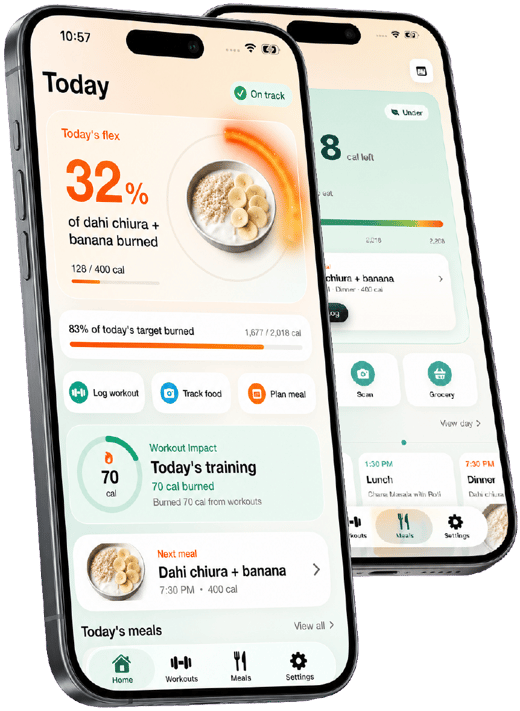
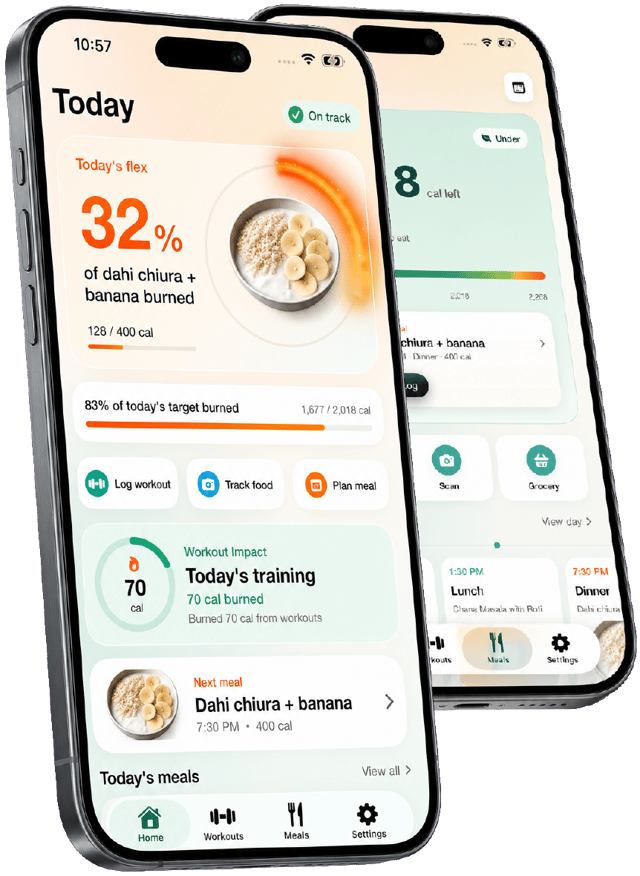
The burn bar shows a bodyweight session counts too
A calisthenics workout burns real calories even without weights — Burnplate reflects that against your day's food instead of undercounting bodyweight training.
Practical guidance
Tips for progressing a calisthenics workout plan
Practical guidance for making steady progress without a barbell to add weight to.
- 01 Film your form occasionally
It's easy to shortchange range of motion as reps get harder — a quick video check keeps push-ups and squats honest.
- 02 Don't neglect pulling work
Pull-ups and rows are harder to train without equipment, which means they're the pattern most likely to fall behind — prioritize a pull-up bar if you can get access to one.
- 03 Add tempo before adding load
A 3-second lowering phase on any push-up or squat variation makes it noticeably harder without needing a new variation.
- 04 Rest 2–3 minutes between hard sets
Strength-focused bodyweight work benefits from the same rest periods as weight training — rushing sets favors endurance over strength.
- 05 Warm up wrists and shoulders
Push-ups, dips and handstand work load the wrists more than most people expect — a short mobility warm-up reduces nagging soreness.
- 06 Track total volume when reps get high
Once a movement is easy for 20+ reps, track total reps across sets so you can see if you're still progressing or plateauing.

Build the plan around your week
Build my workout plan Tell Burnplate your days, equipment and level and it builds a progressive workout plan, logs every session, and connects what you burn to what you eat.
Questions
Workout planner for calisthenics: FAQ
What's a good calisthenics workout plan for beginners?
A four-day plan covering push, pull, legs and core with beginner-friendly progressions — incline push-ups, negative pull-ups, bodyweight squats and hollow holds — builds a foundation before advancing to harder variations like full pull-ups or pistol squats.
Can calisthenics build muscle like weightlifting?
Yes, when progressions are hard enough to challenge the muscle — advanced bodyweight variations like one-arm push-up progressions or weighted dips can be just as demanding as barbell training. The key is progressing difficulty, not just doing more reps.
How often should I do a calisthenics workout plan?
Three to four sessions a week, giving each movement pattern about 48 hours of recovery, is a common and effective frequency for building strength without overtraining any one pattern.
Do I need any equipment for calisthenics?
A pull-up bar makes pulling progressions far easier to train properly, but push, leg and core work can be done with no equipment at all. It's one of the most accessible ways to start strength training.
How do I get my first pull-up with a calisthenics workout plan?
Combine negative pull-ups (slow lowers from the top), inverted rows, and dead hangs to build the specific pulling strength a full pull-up requires. Most beginners see their first rep within a few months of consistent, progressive training.
Is calisthenics enough for weight loss too?
Calisthenics burns real calories and builds strength that raises your resting metabolism over time, but weight loss ultimately depends on your overall calorie balance — the training supports it, but food intake is the bigger lever.
