A barbell squat or deadlift can keep adding weight for years in a way a pair of adjustable dumbbells eventually can't — the gym is where that ceiling gets pushed back.
Why it's different
Why a gym routine should look different from a home one
The whole point of a gym membership is access to equipment that scales with you indefinitely — a rack that goes past your current squat, cables that isolate what dumbbells can't. A routine that ignores that is leaving the membership on the table.
2.5–5 lb typical weekly load increase on a compound lift once you're consistently hitting your rep targets
10–20 sets weekly working sets per muscle group is the range most hypertrophy research points to for steady growth
48–72 hrs recovery window most muscle groups need between heavy sessions to adapt and grow
Cable flies, lat pulldowns and leg extensions provide constant tension and joint-friendly isolation that's hard to replicate with only dumbbells and a bench.
With a full gym, you're not sharing one bench for every exercise — that makes an upper/lower or push/pull/legs split practical in a way it often isn't in a cramped home setup.
Small fixed-increment plates (1.25 kg / 2.5 lb) let you add load in the smallest useful steps, which matters once bodyweight and dumbbell progressions have plateaued.
What it looks like
A sample gym week — upper/lower split
Four sessions that rotate upper and lower body, built to use a rack, bench, cables and a couple of machines.
Example week
4 Days/week50–60 min Session lengthIntermediate LevelFull gym Equipment
Monday Upper (strength) Barbell bench press 4×6 · Lat pulldown 4×8 · Seated cable row 3×10 · Overhead press 3×8
Tuesday Lower (strength) Barbell back squat 4×6 · Romanian deadlift 3×8 · Leg press 3×10 · Standing calf raise 3×15
Wednesday Rest or cardio 20–25 min incline walk or bike, easy pace
Thursday Upper (volume) Incline dumbbell press 3×10 · Cable row 3×12 · Lateral raise 3×15 · Cable fly 3×12
Friday Lower (volume) Leg extension 3×12 · Leg curl 3×12 · Walking lunge 3×10/side · Hip thrust 3×10
Saturday Optional conditioning 20 min intervals or a sport/activity of choice
Sunday Rest Full rest
How Burnplate handles it
How Burnplate builds a gym routine
Burnplate's workout builder asks about your gym access and experience level before writing the plan, so a beginner and an intermediate lifter at the same gym get genuinely different routines.
A split built to your days and level
Choose full-body, upper/lower or push/pull/legs based on how many days you can train, and Burnplate fills it in with exercises that use standard gym equipment.
Set, rep and weight logging
Log exactly what you lifted each session, so week-over-week progression — the whole point of a gym membership — is visible instead of guessed at.
Nutrition sized for training volume
Calorie and protein targets adjust for how much and how hard you're training, so a heavier gym split gets the fuel it needs to recover.
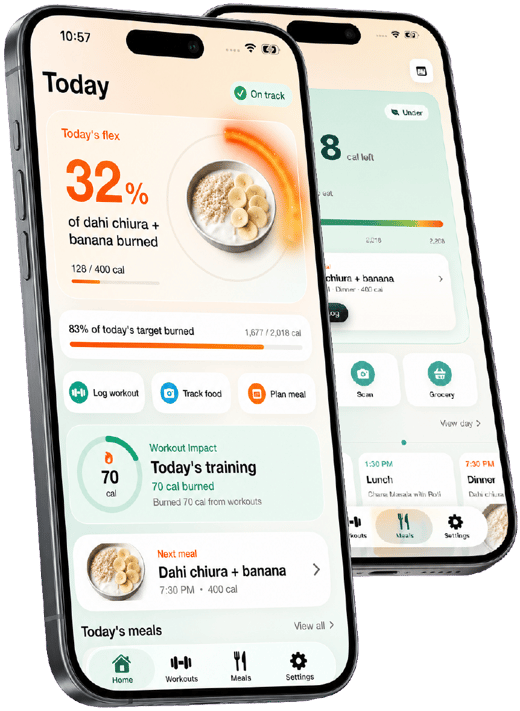
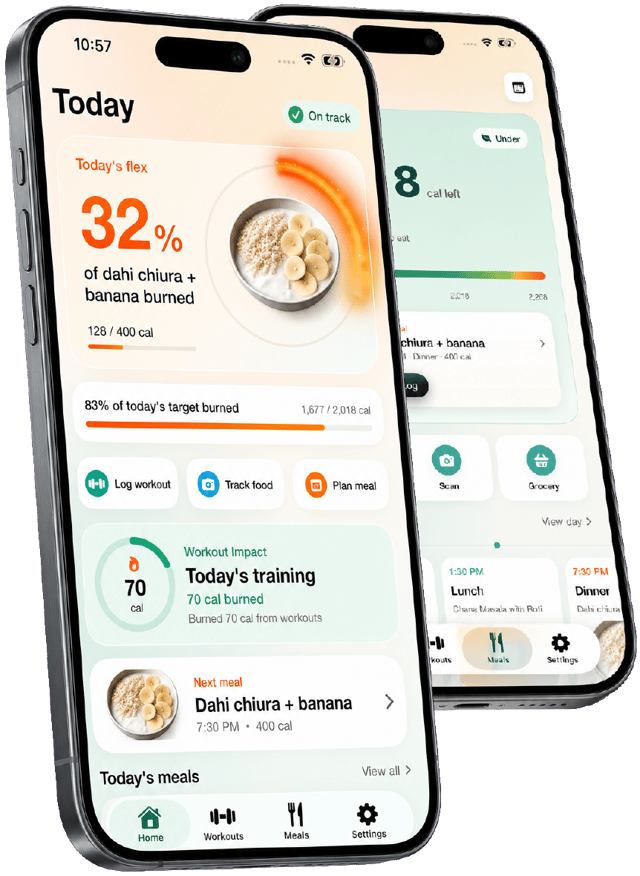
The burn bar after a session
See what percentage of a meal a gym session covered — a fast way to gauge whether today's training and today's food are actually matched up.
Practical guidance
Tips for getting more out of a gym routine
Practical habits that make a gym workout plan more effective, not just longer.
- 01 Warm up the specific lift
A couple of light ramp-up sets on the exact exercise (not just a treadmill jog) primes the right muscles and joints for the working weight.
- 02 Don't chase every machine in the gym
A focused 6–8 exercise session beats wandering through 15 machines — pick the ones that hit your target muscles hardest and repeat them.
- 03 Log the plate math, not just the total
Knowing you added one small plate a side each week is more motivating and more trackable than an abstract 'lift heavier' goal.
- 04 Rest enough between sets
60–90 seconds for isolation work and 2–3 minutes for heavy compounds lets you actually lift the weight the exercise is meant to use.
- 05 Book around peak hours
If your gym is packed 5–7 PM, an earlier or later session means less waiting for the equipment your plan actually calls for.
- 06 Deload every 6–8 weeks
A lighter week (roughly 50–60% of normal load) lets joints and connective tissue catch up with the muscle gains and keeps long-term progress on track.

Build the plan around your week
Build my workout plan Tell Burnplate your days, equipment and level and it builds a progressive workout plan, logs every session, and connects what you burn to what you eat.
Questions
Workout planner for the gym: FAQ
What is a good workout routine for the gym as a beginner?
A full-body routine 3 days a week using a handful of compound lifts — squat, bench or push-up, row, overhead press, hinge — is the standard starting workout plan for the gym. It lets you practice every major pattern often enough to build technique before moving to a split.
How many days a week should I go to the gym?
Three to five days is the range that works for most goals: three for a full-body routine, four to five for an upper/lower or push/pull/legs split. More isn't automatically better — recovery between sessions is what allows the growth to happen.
Should I do a full-body or split gym routine?
Full-body suits 2–3 gym days a week; a split (upper/lower or push/pull/legs) works better once you're training 4+ days, since it lets each muscle group get more total volume without every session running long.
How long should a gym workout be?
45–60 minutes is a realistic ceiling for most lifting sessions once warm-up and rest periods are included; going much longer usually means either too many exercises or too much rest, not more useful training stimulus.
Does Burnplate build a workout plan I can use at any gym?
Yes — Burnplate's plans are built around your days per week, equipment access and level, using standard gym movement patterns (barbell, dumbbell, cable and machine work) that translate across most commercial gyms.
How do I know if my gym routine is actually working?
The two clearest signals are the weight or reps on your main lifts trending up over weeks, and your body composition or the mirror slowly shifting in your goal direction. Logging sets and reps in Burnplate makes the first one easy to check at a glance.
