Muscle is metabolically active tissue your body will happily give up in a deficit unless you keep giving it a reason not to. Lifting — not cardio — is the primary signal that tells your body to protect muscle while fat gets used for fuel.
Why it's different
Why fat loss isn't the same target as weight loss
Two people can lose the same 15 pounds and end up looking completely different, depending on how much of that was fat versus muscle. Fat-loss training is built to control that split.
1.6–2.2g protein per kg of body weight helps preserve and build muscle while you're losing fat
20–25% below maintenance is a typical, sustainable calorie deficit range for fat loss without excessive muscle loss
10–15 min metabolic conditioning finisher added after a strength session adds burn without a separate cardio block
A 10–15 minute finisher of circuits or intervals after a lifting session adds meaningful calorie burn and an after-burn effect (elevated calorie use post-workout) without the time cost or recovery drag of a separate long cardio session.
Fat loss research consistently shows higher protein intake — well above the standard general-population recommendation — is one of the strongest predictors of preserving lean mass during a deficit.
Water retention, glycogen and food volume can swing the scale several pounds in either direction independent of actual fat loss. Waist measurements, photos and how clothes fit are more honest signals during this kind of training.
What it looks like
A sample fat-loss training week
An upper/lower strength split with short conditioning finishers, plus one dedicated conditioning day.
Example week
4–5 Days/week45–60 min Session lengthIntermediate LevelGym Equipment
Monday Lower body strength + finisher Squat 4x8 · Romanian deadlift 3x10 · Walking lunge 3x10/leg · 10-min kettlebell swing finisher
Tuesday Upper body strength Bench press 4x8 · Row 4x10 · Overhead press 3x10 · Lat pulldown 3x10
Wednesday Active recovery 20–30 min easy walk or light bike
Thursday Lower body strength + finisher Deadlift 4x6 · Leg press 3x10 · Hip thrust 3x10 · 10-min sled or bike finisher
Friday Upper body strength Incline press 4x8 · Pull-up or lat pulldown 4x8 · Face pull 3x15 · Curl/tricep superset 2x12
Saturday Conditioning circuit 20–25 min: 4 rounds of goblet squat, push-up, row, mountain climbers at a steady pace
Sunday Rest Full rest
How Burnplate handles it
How Burnplate supports a fat-loss training plan
Burnplate is built to keep the training and the deficit working together instead of guessing at both separately.
A plan that pairs strength with conditioning
Burnplate's workout builder creates a resistance-first plan around your days and equipment, with conditioning work layered in rather than treated as the whole program.
Higher-protein targets built for a cut
Burnplate sets calorie and protein targets from your body and goal, and skews protein higher during a fat-loss phase to support the muscle-preservation math.
Workout history shows if overload is happening
Logged sets and reps over time show whether you're actually progressing the lifts — the clearest sign the plan is preserving muscle, not just producing soreness.
The burn bar connects sessions to meals
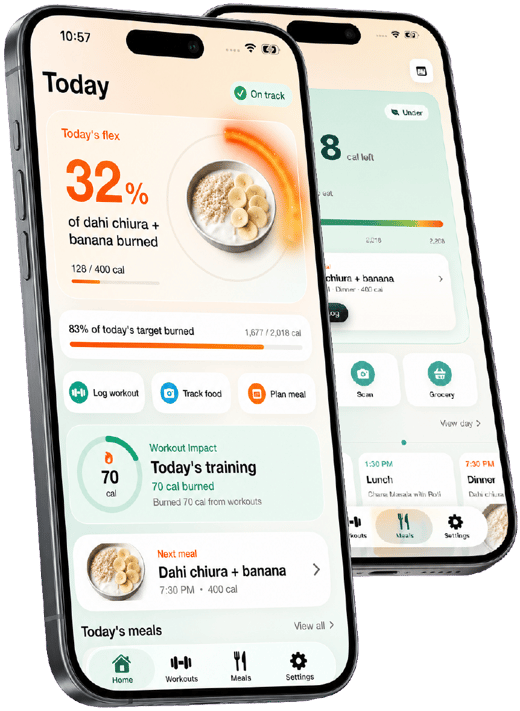
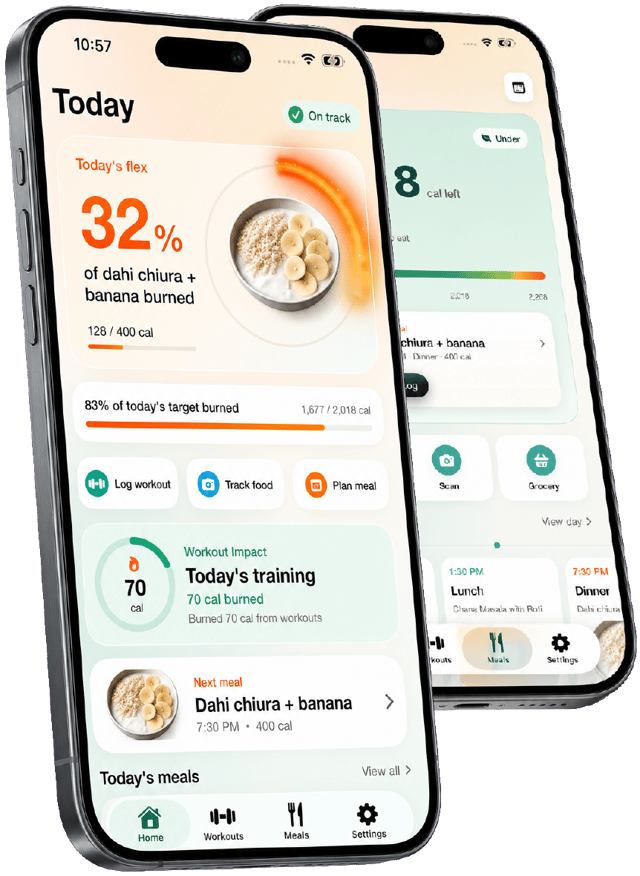
After a session, Burnplate shows what percentage of a meal that workout burned off, keeping the link between training and the deficit visible day to day.
Practical guidance
Tips for a fat-loss phase that actually works
The habits that keep the loss on the fat side of the ledger.
- 01 Protein at every meal, not just post-workout
Spreading protein across 3–4 meals a day supports muscle protein synthesis better than loading it all into one shake.
- 02 Track trend weight, not daily weight
Weigh in most days but judge progress by the 7-day average — daily swings from water and food are mostly noise.
- 03 Don't fear lifting heavy in a deficit
Heavier, lower-rep work in a deficit is one of the strongest signals to keep muscle — this isn't the phase to go light and high-rep across the board.
- 04 Add steps, not just cardio sessions
Daily walking adds burn without the recovery cost of more hard training, and it's easier to sustain over a long cut.
- 05 Protect your sleep
Poor sleep increases hunger and can blunt the muscle-preserving effect of training, undermining the whole point of the resistance work.
- 06 Give it 8–12 weeks before judging the approach
Body composition change is slower to show than scale weight — a strict multi-week check-in beats daily verdicts.

Build the plan around your week
Build my workout plan Tell Burnplate your days, equipment and level and it builds a progressive workout plan, logs every session, and connects what you burn to what you eat.
Questions
Workout planner for fat loss: FAQ
What is the best workout for fat loss?
A resistance-training-first plan — 4–5 days a week of strength work with short conditioning finishers added on — outperforms cardio-only plans for fat loss because it protects muscle while the deficit removes fat. Pure cardio can also produce fat loss, but usually at a higher cost to lean mass.
Is cardio or weights better for fat loss?
Weights matter more for what the loss is made of. A calorie deficit drives the weight loss regardless of the workout type, but resistance training is what determines whether that loss is mostly fat or a mix of fat and muscle. Most effective fat-loss plans use both, with lifting as the priority.
How many days does it take to see fat-loss results?
Scale movement can appear within 1–2 weeks, but visible changes in body composition — how clothes fit, waist measurements, photos — typically take 6–8 weeks of consistent training and a real deficit to become clearly noticeable.
Can you build muscle while losing fat?
It's possible, especially for beginners, people returning after a layoff, or those with higher body fat to lose — a phenomenon often called body recomposition. It's slower than a dedicated muscle-building phase, but resistance training and adequate protein make it achievable during a moderate deficit.
How much protein do I need for fat loss?
Most fat-loss guidance lands around 1.6–2.2 g of protein per kg of body weight, higher than general population recommendations, because it's one of the most reliable levers for preserving muscle while calories are reduced.
