Kettlebell swings and deadlifts are hip-hinge dominant, training the glutes and hamstrings through a fast, powerful pattern that most gym routines under-train compared to squatting.
Why it's different
Why kettlebell training is structured differently
A kettlebell isn't a dumbbell with a handle — its offset center of mass makes ballistic moves like swings and cleans possible, and those moves train the body in a way static lifting doesn't.
12–16 kg is a common starting kettlebell weight for women; 16–20 kg for men, adjusted to how the swing feels
15–20 min of kettlebell circuit work can produce a real conditioning effect similar to much longer traditional cardio
2–3×/week kettlebell sessions is plenty to build proficiency and strength without overloading the lower back before technique is solid
A set of 20 kettlebell swings elevates heart rate the way an equivalent set of dumbbell rows never would — that's what makes kettlebell circuits an efficient strength-and-cardio combination.
A poorly performed swing loads the lower back instead of the hips and glutes. Beginners get more from mastering form with a lighter bell than from grabbing the heaviest one that's available.
Carries, cleans and Turkish get-ups demand serious grip strength and anti-rotation core stability without a single dedicated ab or forearm exercise in the plan.
What it looks like
A sample beginner kettlebell week
Built around one kettlebell, starting with the hinge and swing before adding cleans, presses and carries.
Example week
3 Days/week30 min Session lengthTrue beginner Level1 kettlebell Equipment
Monday Hinge + swing Kettlebell deadlift 3×10 · Two-hand swing 5×10 · Goblet squat 3×10 · Plank 3×20 sec
Tuesday Rest or walk 20–30 min easy walk
Wednesday Press + carry Kettlebell clean (light) 3×6/side · Single-arm press 3×8/side · Farmer's carry 3×30 sec · Bird dog 3×8/side
Thursday Rest or mobility Hip flexor stretch, thoracic rotation, easy walk
Friday Full body + conditioning Swing 5×12 · Goblet squat 3×10 · Single-arm row 3×10/side · Turkish get-up (practice) 3/side
Saturday Optional conditioning 10-minute EMOM: 10 swings every minute
Sunday Rest Full rest
How Burnplate handles it
How Burnplate builds a kettlebell plan
Burnplate's workout builder can write a plan around kettlebell training specifically, sequencing swings and hinge work before more technical moves.
A plan sequenced around one bell
Set kettlebell as your equipment and Burnplate builds sessions around the swing, goblet squat, clean and carry — in an order that respects the technique curve.
Log sets, reps and bell weight
Track exactly which kettlebell weight and how many reps each session, so sizing up to the next bell is based on a real trend, not a guess.
Recovery-aware calorie targets
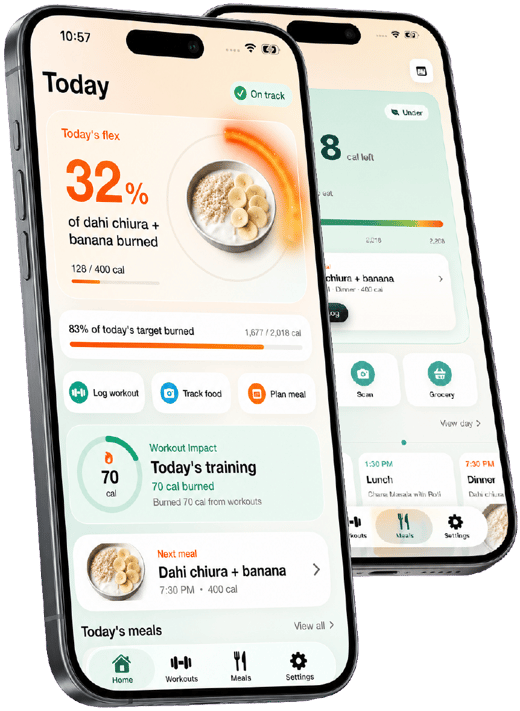
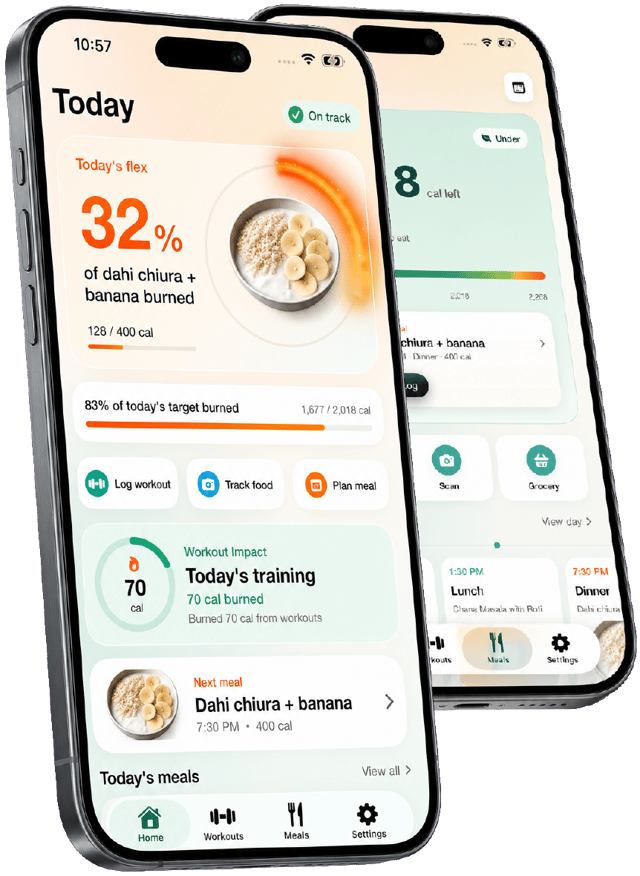
Kettlebell conditioning sessions burn real calories; your daily target and 'left to eat' balance account for that alongside your goal.
The burn bar after a swing session
See how much of a meal a hard kettlebell circuit burned off — a fast, visible payoff for a session that's genuinely demanding in a short amount of time.
Practical guidance
Tips for a kettlebell plan that stays safe and effective
The technique and programming habits that matter most with kettlebells specifically.
- 01 Learn the hip hinge on its own first
Practice a kettlebell deadlift with light or no weight until the hip-driven pattern feels automatic before adding the swing's momentum.
- 02 Keep the swing below shoulder height for beginners
A Russian-style swing to chest height is easier to control and just as effective as an American swing overhead while technique develops.
- 03 Don't grip the handle too tight
An overly tight grip on cleans and swings transfers unnecessary strain to the forearm and can bang up the wrist — let the bell float slightly.
- 04 One well-chosen bell beats a rack of them early on
A single kettlebell in the 12–20 kg range covers most beginner programming; add a second, heavier bell only once the first feels genuinely easy.
- 05 Chalk or a good grip surface helps sooner than expected
Sweaty hands on a ballistic move like the swing are a real safety issue — grip aids aren't just for advanced lifters.
- 06 Film your swing from the side occasionally
A side-view video quickly shows whether the movement is a hip hinge or has drifted into a squat, which is the most common form error.

Build the plan around your week
Build my workout plan Tell Burnplate your days, equipment and level and it builds a progressive workout plan, logs every session, and connects what you burn to what you eat.
Questions
Workout planner for kettlebell training: FAQ
What is a good beginner kettlebell workout?
A good beginner workout kettlebell routine starts with the deadlift and two-hand swing, adds a goblet squat and a carry, and trains 2–3 times a week with a lighter bell (roughly 12–16 kg) until the hip-hinge pattern is consistent.
What size kettlebell should a beginner buy?
Most beginner women start around 8–12 kg and most beginner men around 12–16 kg, sized to where a two-hand swing feels challenging but controlled for 10–15 reps. It's better to start lighter and progress than to fight a bell that's too heavy.
Can kettlebell training replace regular strength training?
For many goals, yes — kettlebells can build meaningful strength, especially in the hips, back and grip, while also improving conditioning. Very advanced strength goals (like maximal squat or bench numbers) are still usually better served by barbell training.
How many times a week should I do kettlebell workouts?
Two to three sessions a week is a sound starting frequency, giving the lower back and grip time to recover between hinge-dominant sessions while still building the pattern quickly.
Is the kettlebell swing bad for your back?
A properly performed swing — driven by the hips, not the lower back — is safe and even protective for most people's backs. A swing that turns into a squat-and-lift with a rounded spine is what causes the injuries kettlebells get blamed for.
Does Burnplate build kettlebell-specific workout plans?
Yes — choosing kettlebell as your equipment in Burnplate's workout builder generates sessions built around kettlebell movement patterns, scaled to your days per week and experience level.
