The abdominal muscles are already there on nearly everyone. What determines whether they show is the layer of fat over them, which responds to a calorie deficit and overall training — not to how many ab exercises you do.
Why it's different
Why ab training and visible abs are two different goals
Training the core well and having visible abs both matter, but they're solved by different levers — confusing the two is the most common reason ab-focused routines don't produce the expected result.
10–20% body fat is roughly where abdominal muscles start becoming visible, and it varies by individual and by sex
3×/week dedicated core work is a reasonable frequency layered on top of full-body training
8–12 reps or a matched hold time per set is a typical range for core exercises once basic strength is built
Real core strength shows up as resisting unwanted movement — anti-rotation, anti-extension, anti-lateral-flexion — during squats, presses and daily life, more than it shows up as crunching forward repeatedly.
A stable core lets force transfer efficiently during squats, deadlifts and presses, and it protects the lower back under load. Training it well pays off across your whole program, not just in how your stomach looks.
Muscle shape, ab segmentation and how fat distributes across the body vary by genetics — two people at the same body fat percentage can look noticeably different in the midsection.
What it looks like
A sample week: full training plus core work
Core training layered onto full-body strength and cardio sessions, inside a calorie deficit — the combination that actually produces visible abs over time.
Example week
5 Days/week40–50 min (+10–15 min core) Session lengthGeneral fitness LevelBodyweight + mat Equipment
Monday Full-body strength + core finisher Squat 3x10 · Push-up 3x10 · Row 3x10 · Plank 3x30–45s
Tuesday Cardio 30 min brisk walk, bike or run at moderate effort
Wednesday Core-focused circuit Hanging or lying knee raise 3x10 · Side plank 3x30s/side · Bird dog 3x10/side · Pallof press 3x10/side
Thursday Rest or easy walk 20–30 min easy walk
Friday Full-body strength + core finisher Deadlift (light) 3x10 · Overhead press 3x10 · Lat pulldown 3x10 · Weighted crunch 3x15
Saturday Cardio intervals 20–25 min alternating hard and easy efforts
Sunday Rest Full rest
How Burnplate handles it
How Burnplate supports ab and core training
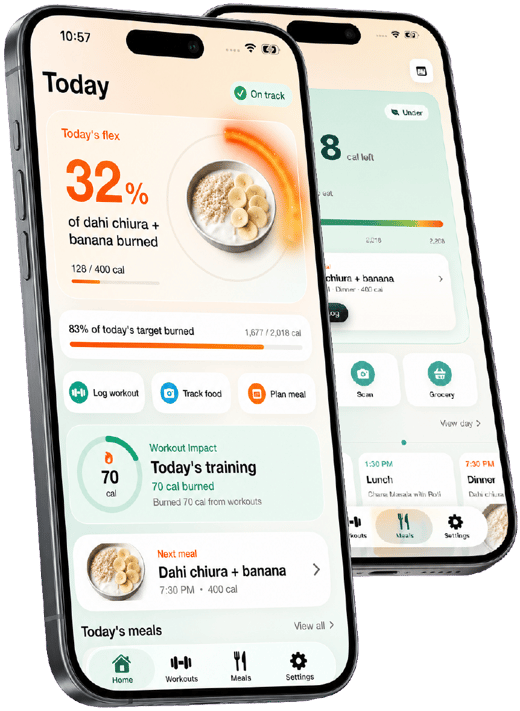
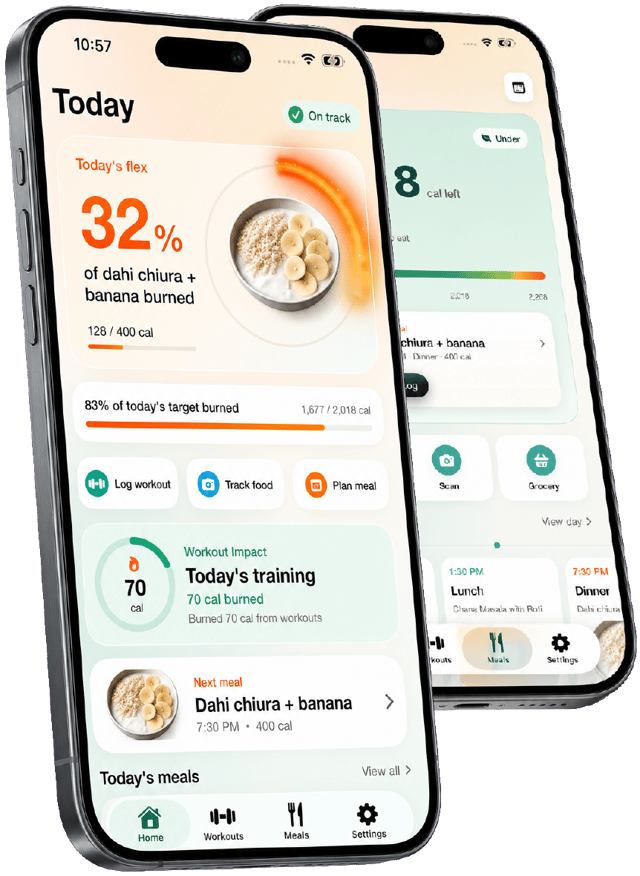
Burnplate handles both halves of the equation: the core-strength side and the body-fat side.
Core work built into your training plan
Burnplate's workout builder includes core-focused exercises alongside full-body training, matched to your days and equipment, rather than as an isolated separate routine.
Calorie targets sized for visible progress
Burnplate sets a calorie target from your body and goal, including a deficit if fat loss is part of the picture — the half of the equation ab exercises alone can't handle.
Photo logging keeps the deficit accurate
Logging meals from a photo makes it easy to stay consistent with the deficit day to day, which matters more for ab visibility than any single workout.
Workout history tracks core progressions
Logged sets show plank hold times and core exercise progress over sessions, so you can see the strength side of the plan improving alongside the body-fat side.
Practical guidance
Tips for training abs and core well
What actually moves the needle, and what to stop expecting from ab exercises alone.
- 01 Pair core work with a real deficit
If fat loss is the goal alongside visible abs, the calorie side has to be in place — no amount of core training substitutes for it.
- 02 Train anti-rotation and anti-extension
Moves like the Pallof press, dead bug and plank build functional core strength that crunches alone don't cover.
- 03 Protect your lower back
Avoid excessive repeated spinal flexion under load — a strong core should support your back, not strain it.
- 04 10–15 minutes is enough
Dedicated core work doesn't need to be long to be effective, especially layered onto full-body training that already engages the core.
- 05 Give it 8–12 weeks
Both the strength gains in the core and any visible change from a deficit take a couple of months of consistency to show clearly.
- 06 Accept what genetics set
Ab shape and segmentation vary by person — training and body fat determine visibility and strength, not the specific pattern your abs show.

Build the plan around your week
Build my workout plan Tell Burnplate your days, equipment and level and it builds a progressive workout plan, logs every session, and connects what you burn to what you eat.
Questions
Workout planner for abs and core: FAQ
What is the best exercise for abs?
There isn't one single best exercise — a mix that trains flexion (crunches, knee raises), anti-rotation (Pallof press) and anti-extension (plank) covers the core more completely than any single move. Visible abs still depend more on body fat than on the exercise choice.
How long does it take to get visible abs?
It depends heavily on starting body fat percentage, but for most people it takes several months of a consistent calorie deficit and regular training to reach the body-fat range where abs become visible, alongside core training to make sure the muscle is developed underneath.
Do ab exercises burn belly fat?
No — ab exercises strengthen the abdominal muscles but don't preferentially burn the fat covering them. Fat loss, including in the midsection, comes from an overall calorie deficit, not from targeting one muscle group with exercise.
How often should I train my core?
Two to three dedicated core sessions a week, on top of the core engagement that already happens during squats, deadlifts and presses, is a reasonable frequency for most people without becoming excessive.
Are crunches enough for a strong core?
Not by themselves. Crunches train spinal flexion, but a well-rounded core routine also includes anti-rotation and anti-extension work — moves like planks, dead bugs and Pallof presses — which better reflect what the core does during real lifts and daily movement.
