Training a muscle group two or three times a week, rather than once, means more total practice at the movement and more opportunities to progressively overload it — both of which matter more than session-by-session volume for most lifters.
Why it's different
Why full body works for most lifters
Body-part splits exist to handle very high per-muscle volume for advanced lifters. Below that level, full-body training's extra frequency usually wins.
2–3×/week is how often full-body training hits each muscle group, versus once a week on a typical split
45–60 min per session is enough time to cover 5–6 compound movements at a working intensity
5–6 compound exercises per session is the practical ceiling before session length or fatigue gets excessive
Three sessions a week covers everything a five- or six-day split does, just distributed differently. For people with real schedule constraints, that's often the difference between a plan that gets followed and one that doesn't.
Every session touches push, pull and legs, which makes it hard to accidentally over-train one movement pattern while neglecting another — a common problem with poorly structured splits.
Advanced lifters chasing very high weekly volume per muscle group (well above what fits in 2–3 full-body sessions) often do need a split to fit it all in without marathon workouts — but that's a later-stage problem, not a starting point.
What it looks like
A sample full-body week
Three sessions, each covering a squat, hinge, push and pull pattern, with the specific exercises rotating to manage fatigue and add variety.
Example week
3 Days/week45–60 min Session lengthBeginner–intermediate LevelGym or home Equipment
Monday Full body A Back squat 4x8 · Bench press 3x10 · Row 3x10 · Plank 3x30s
Tuesday Rest Full rest or light walk
Wednesday Full body B Deadlift 4x6 · Overhead press 3x10 · Lat pulldown 3x10 · Dead bug 3x10/side
Thursday Rest Full rest or light walk
Friday Full body C Front squat or lunge 4x8 · Incline press 3x10 · Cable row 3x10 · Side plank 2x30s/side
Saturday Optional cardio 20–30 min easy bike, walk or swim
Sunday Rest Full rest
How Burnplate handles it
How Burnplate builds a full-body plan
Burnplate handles the exercise rotation and the tracking so a full-body routine doesn't get stale or plateau unnoticed.
Rotating sessions instead of one generic template
Burnplate's workout builder varies exercise selection across your full-body sessions based on your equipment, so squat day doesn't mean the exact same squat every single time.
Every lift logged and tracked over time
Workout history shows each exercise's progress across sessions, so a plateau on one pattern is visible before it turns into weeks of stalled training.
Calorie and macro targets sized to your goal
Whether the goal alongside full-body training is fat loss, muscle gain or maintenance, Burnplate sets the calorie and protein targets to match.
The burn bar shows each session's payoff
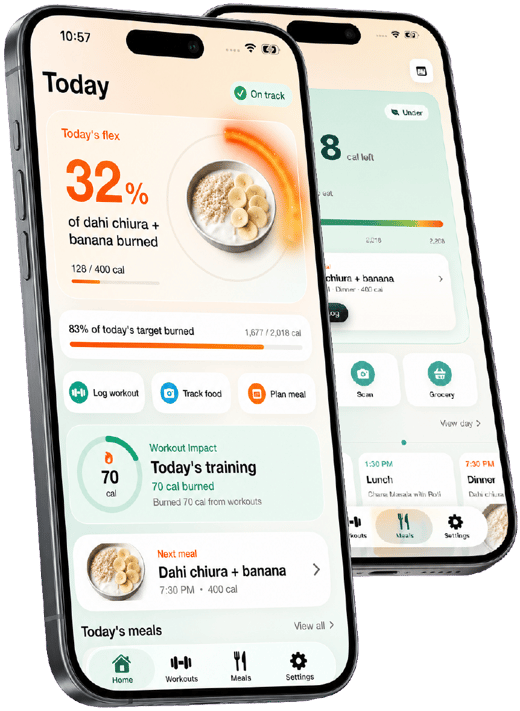
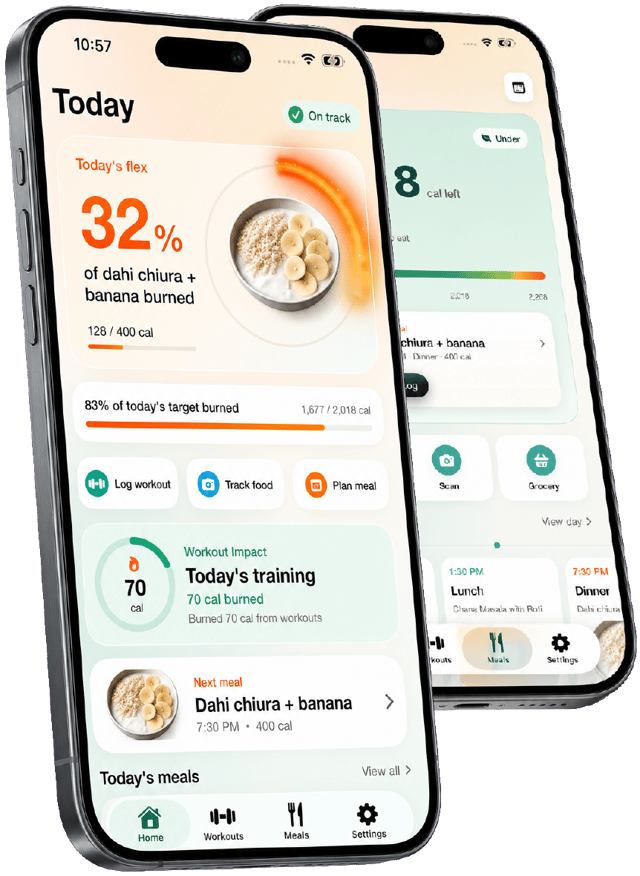
After a full-body workout, Burnplate shows what percentage of a meal that session burned off — a quick, visible link between training and food.
Practical guidance
Tips for full-body training
Details that keep three sessions a week productive instead of just tiring.
- 01 Pick one movement per pattern each session
A squat, a hinge, a push and a pull covers the essentials — resist the urge to add extra exercises just because you have time.
- 02 Leave a rep or two in the tank most sessions
Training close to failure on every set, three times a week, accumulates fatigue fast — save the hardest efforts for when you're fresh.
- 03 Rotate exercise variety weekly
Small variations in grip, stance or equipment across your A/B/C sessions reduce joint strain while still building the same muscles.
- 04 Warm up compound lifts properly
A couple of lighter ramp-up sets before your working sets matters more in full-body training since you're hitting heavy patterns every session.
- 05 Use rest days for steps, not more lifting
Full-body training's frequency is already high — let off days be genuinely easier, not another hard session.
- 06 Track total weekly volume, not just single sessions
Add up sets per muscle group across the whole week occasionally to confirm the rotation is actually balanced.

Build the plan around your week
Build my workout plan Tell Burnplate your days, equipment and level and it builds a progressive workout plan, logs every session, and connects what you burn to what you eat.
Questions
Workout planner for full-body training: FAQ
Is full body better than a split routine?
For most people below an advanced training level, full-body routines produce comparable or better results than splits, mainly because of the higher training frequency per muscle group. Splits become more useful once weekly volume per muscle is too high to fit into 2–3 full-body sessions.
How many times a week should I do full-body workouts?
Three sessions a week is the standard structure, spaced with a rest or light-activity day between each. This hits every major muscle group two to three times weekly while allowing enough recovery between sessions.
Can beginners do full body 3 times a week?
Yes — it's one of the most commonly recommended structures for beginners, since it maximizes practice on foundational movement patterns without requiring daily gym visits. Most standard beginner programs are built this way.
How long should a full-body workout be?
45 to 60 minutes covers 5–6 compound exercises at a working pace, including warm-up sets. Sessions that run much longer usually mean too many exercises are being packed into one day rather than spread across the week's rotation.
Is full body good for muscle gain?
Yes, particularly for beginner and intermediate lifters. The higher training frequency supports the volume and progressive overload muscle growth depends on; advanced lifters chasing very high per-muscle volume often eventually shift to a split to fit it all in.
