
Women on average carry less muscle mass than men at a similar weight, and muscle burns more calories at rest than fat. That's the main reason average maintenance calories for women land lower than for men — not a smaller appetite or willpower.
Why it's different
Why women's calorie needs aren't a smaller version of men's
Calorie needs track with muscle mass and body size more than with gender directly, but the average differences between women and men are real and worth building a target around rather than ignoring.
1.6–2k typical daily calorie range for moderately active women — yours may differ
18 mg iron most premenopausal women need daily, nearly double the amount for men
100–150 kcal the luteal phase of your cycle can add to appetite and burn
1,200 calories became a default for women's diets decades ago and isn't based on individual body size or activity. For many active women it's well below maintenance minus a reasonable deficit, which leads to excessive hunger, energy crashes and eventual rebound.
Premenstrual and menstrual blood loss means most women need close to 18 mg of iron a day, compared to about 8 mg for men — a gap that matters for energy levels and is easy to miss without deliberately tracking iron-rich foods.
Resting energy expenditure and appetite both tend to rise modestly in the luteal phase (the one to two weeks before a period). A calorie target that doesn't account for this can feel like it's 'failing' at exactly the same point every month.
What it looks like
A sample day for an active woman
Built for a moderately active woman with an estimated maintenance around 2,100 calories running a modest deficit for gradual weight loss.
Example day
Daily targets
Calories 1,800 kcal a moderate deficit that leaves room for training and daily life
Protein 110 g roughly 1.6 g/kg to protect muscle in a deficit
Carbs 190 g fuels workouts and everyday energy
Fat 60 g supports hormone health, which shouldn't be cut too low
Iron 18 mg built into meal choices, not left to chance
A logged day
7:00 AM Greek yogurt, berries, chiaprotein and fiber to start, plus a little iron from the chia 320 kcal
12:00 PM Spinach salad, chicken, lentilsspinach and lentils both contribute meaningfully to the iron target 480 kcal
3:00 PM Apple and almondsa planned snack that fits without crowding dinner 180 kcal
6:30 PM Beef stir-fry, brown rice, broccolired meat covers a large share of daily iron in one meal 560 kcal
8:30 PM Dark chocolate squarerounds the day out without going over 80 kcal
How Burnplate handles it
How Burnplate builds a target for women
The starting point is your actual body and activity, not a number borrowed from a decades-old diet chart.
A calorie and macro target from your body, not a chart
Burnplate calculates your target from your stats, goal and activity level, so it isn't anchored to a generic '1,200 calorie' default that has nothing to do with your body.
Photo logging fast enough for a busy day
Snap a photo of a meal and it's logged in seconds — built for fitting tracking around a full schedule, not the other way around.
The burn bar shows what your training actually did
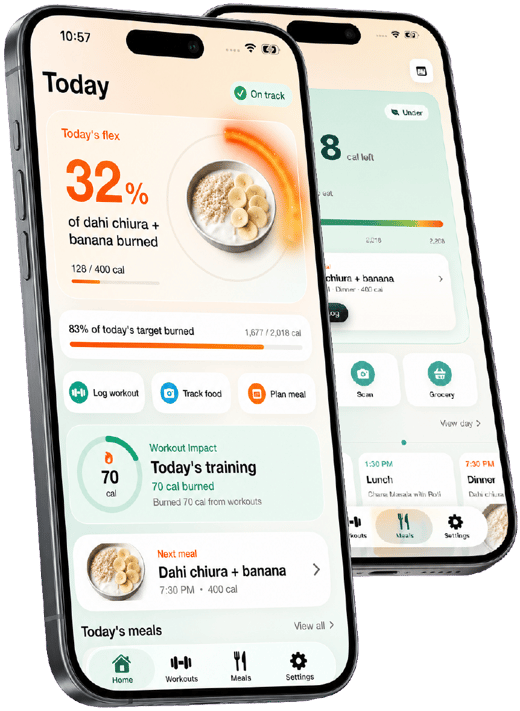
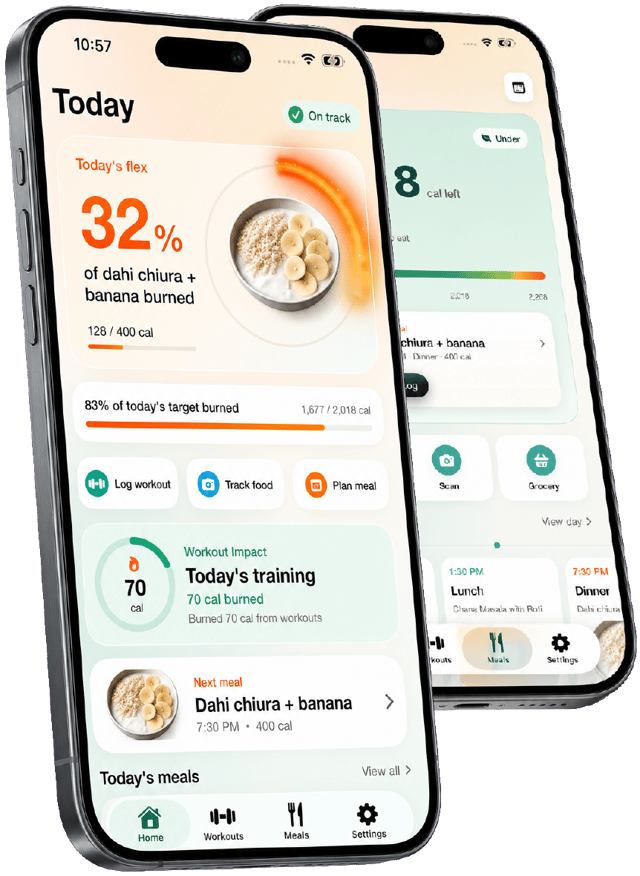
See how much of today's target your workout and steps have covered, instead of guessing whether a hard session earned extra food.
An AI meal plan that adapts to your preferences
Burnplate's 7-day meal plan builds around your calorie and protein targets and food preferences, with a grocery list included — useful for keeping iron- and fiber-rich foods actually on the weekly menu.
Practical guidance
Tips for tracking calories as a woman
Small adjustments that account for physiology most generic calorie advice ignores.
- 01 Don't default to 1,200 calories
Calculate your own maintenance and deficit from your body and activity level — 1,200 is far too low for most active women and leads to unsustainable hunger.
- 02 Build meals around iron sources
Red meat, lentils, spinach and fortified grains help close a gap that's easy to miss without deliberately including them.
- 03 Expect appetite shifts before your period
A few hundred extra calories of appetite in the luteal phase is normal physiology, not a lack of discipline — plan for it rather than fighting it.
- 04 Prioritize protein even on lower-appetite days
Protein is the easiest macro to under-hit when appetite drops — anchor at least one meal a day around it regardless of how hungry you feel.
- 05 Track the weekly trend, not daily bloating
Water retention shifts meaningfully across the cycle. A weekly average is a far more honest number than any single day, especially in the days before a period.

Track it with a photo, not a search bar
Start tracking free Burnplate sets your calorie and macro targets, logs meals from a photo, and shows how much of each meal your workouts and steps have burned off.
Questions
Calorie tracker for women: FAQ
How many calories should a woman eat a day?
It depends heavily on body size, muscle mass and activity level, but a calorie calculator for women typically lands moderately active adults somewhere between 1,800 and 2,400 calories a day for maintenance. A generic 1,200-calorie target is usually too low for anyone but a very small, sedentary person.
How many calories should women eat to lose weight?
A deficit of roughly 500 calories below maintenance is a common, sustainable starting point, producing about a pound of loss a week. Starting from an accurate maintenance estimate matters more than the specific deficit size.
Why do women need fewer calories than men on average?
The main driver is average muscle mass, not gender directly — women on average carry less muscle than men at a similar weight, and muscle burns more calories at rest. Body composition, not gender alone, is what actually determines the number.
Should calorie targets change during my period?
Appetite and resting burn both tend to rise modestly in the one to two weeks before a period (the luteal phase). Many women find it easier to allow a slightly smaller deficit or a few hundred extra calories during that window rather than fighting the shift.
Is 1,200 calories enough for most women?
For most moderately active adult women, 1,200 calories is below maintenance minus even an aggressive deficit, which usually causes excessive hunger, low energy and eventual rebound. It's occasionally appropriate for smaller, sedentary individuals, but it isn't a safe universal default.
