
Two people with the same height, weight and age can have maintenance calories that differ by several hundred a day, depending on muscle mass, daily movement and genetics. A calculator gets you in the right zone; two to three weeks of real data gets you the actual number.
Why it's different
Why maintenance is its own skill, not a default
Most people learn to diet and never learn to maintain — so weight lost on a plan comes right back once the plan ends. Maintenance calories aren't a guess you make once; they're a moving target you track and adjust.
±150 kcal day-to-day wiggle room that still holds your weight steady
0.8 g/kg protein floor that keeps muscle even without a deficit or surplus
1–2 lb the normal weekly scale swing from water and food volume, not fat
After weeks in a deficit, your maintenance calories are usually lower than they were before you started — your body adapted. Jumping straight back to your old 'normal' eating is the most common way maintenance turns into regain.
Weight naturally moves up and down a couple of pounds day to day from water, sodium and digestion. Maintenance means the weekly average holds steady, not that the scale reads the exact same number every morning.
What it looks like
A sample day at maintenance
Built around a maintenance estimate of roughly 2,100 calories for a moderately active adult. Swap it for your own calculator result once you have it.
Example day
Daily targets
Calories 2,100 kcal your estimated maintenance level — refine it over 2–3 weeks
Protein 130 g keeps you full and protects muscle at maintenance
Carbs 230 g fuels training without needing to be restrictive
Fat 70 g enough for hormones and satisfaction, not a limiting factor
Weekly trend flat ±1 lb the actual signal that maintenance is working
A logged day
7:30 AM Oatmeal, peanut butter, bananaa hearty start with room in the day 480 kcal
12:00 PM Chicken burrito bowlcarb and protein heavy for midday energy 620 kcal
3:00 PM Protein shake and almondsan easy way to close the protein gap 300 kcal
7:00 PM Steak, potatoes, roasted vega full dinner with no need to hold back 650 kcal
9:00 PM Dark chocolate squarefits without derailing anything 50 kcal
How Burnplate handles it
How Burnplate keeps maintenance honest
Maintenance fails quietly — a little drift here, a little there. Burnplate makes the drift visible before it becomes a trend.
A target built from your body and activity
Burnplate estimates your maintenance calories from your stats and activity level, then refines it automatically as your logged weight trend comes in.
Casual logging that doesn't feel like a diet
Snap a photo or search a food and it's logged in seconds — light enough to keep doing indefinitely, which is the entire point at maintenance.
See what a hard workout buys you
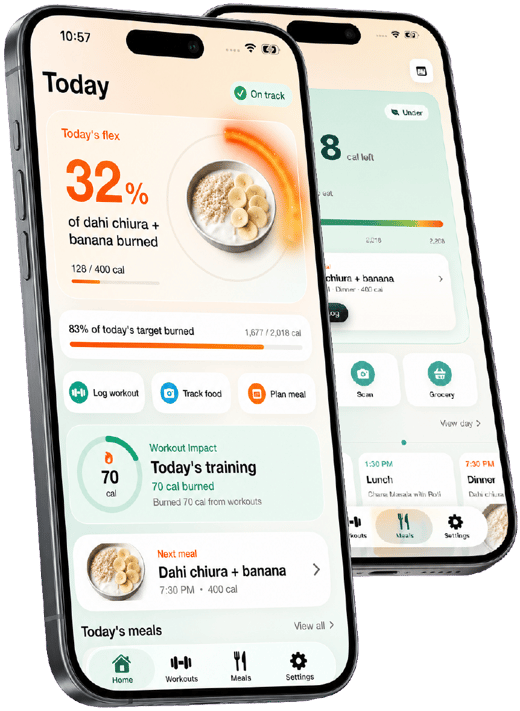
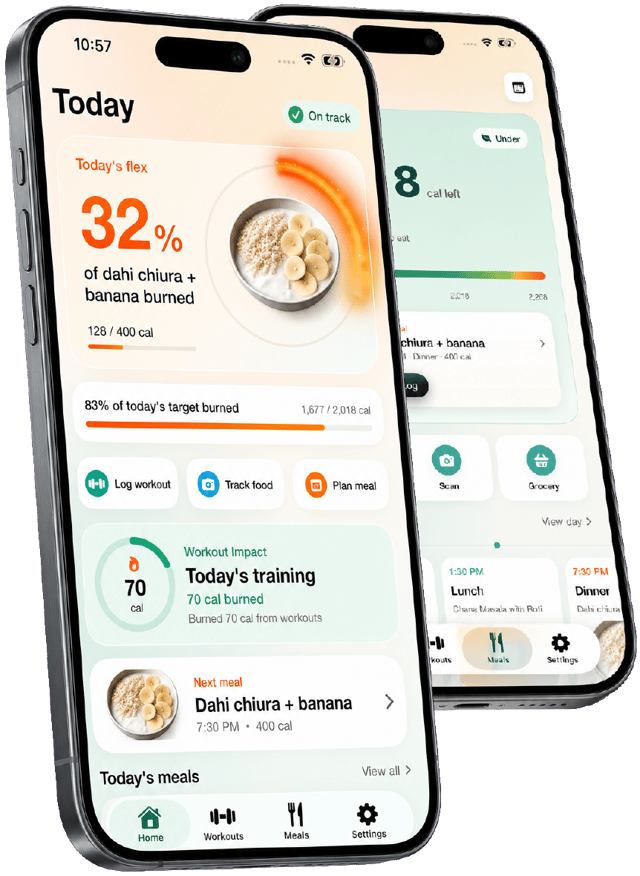
The burn bar shows how much of today's balance your training and steps have added, so an extra plate on a big training day isn't guesswork.
One account space for the whole household
Groups let a family or household share an account space, which matters at maintenance when everyone's eating the same dinner but different targets.
Practical guidance
Tips for holding maintenance without obsessing
The goal is a number you check occasionally, not a number that runs your day.
- 01 Track the weekly average, not the daily number
A single high or low day means nothing. A 7-day rolling average moving up or down over two to three weeks is the real signal.
- 02 Re-check your number every few months
Maintenance calories shift with muscle gained, weight lost or activity changes. What was accurate in January may be off by summer.
- 03 Use looser logging, not none at all
Even a rough log a few times a week catches drift early, long before it shows up as five pounds on the scale.
- 04 Let training days eat a little more
Matching intake to activity — more on hard days, less on rest days — makes the same weekly average far easier to hit.
- 05 Don't chase a perfectly flat scale
A pound or two of normal fluctuation is expected. Chasing a dead-flat number leads to overreacting to noise.

Track it with a photo, not a search bar
Start tracking free Burnplate sets your calorie and macro targets, logs meals from a photo, and shows how much of each meal your workouts and steps have burned off.
Questions
Calorie tracker for maintaining your weight: FAQ
How many calories should I eat to maintain my weight?
It depends on your body size, muscle mass and activity level, but a maintenance calorie calculator typically lands most moderately active adults somewhere between 1,800 and 2,800 calories a day. Treat the number as a starting estimate and adjust it based on two to three weeks of your own weight trend.
What is TDEE and how is it different from BMR?
BMR (basal metabolic rate) is the energy your body burns at complete rest just to function. TDEE (total daily energy expenditure) adds in your activity — walking, workouts, daily movement — and is the number that actually represents your maintenance calories.
Do I still need to track food once I'm at maintenance?
Not as precisely as during a diet, but some tracking — even a few days a week — catches slow calorie creep before it becomes noticeable weight gain. Many people log casually at maintenance and tighten up only if the trend starts drifting.
Why does my weight bounce around even at maintenance?
Sodium, carbohydrate intake, hydration and hormones can shift the scale a pound or two in either direction day to day, independent of any actual fat gained or lost. What matters is whether your weekly average stays flat over several weeks.
Can I use maintenance calories to build muscle slowly?
Yes — eating at maintenance with enough protein and consistent resistance training can produce slow muscle gain over months, especially for beginners or anyone returning to training. It's slower than a dedicated surplus but comes with less fat gain.
