Where a barbell plan adds plates, a bodyweight plan changes the lever arm: an incline push-up becomes a standard push-up becomes a decline push-up, each one harder without any equipment.
Why it's different
Why bodyweight training needs a real plan, not just random moves
Bodyweight training gets dismissed as 'not real training,' but the actual issue is usually a missing progression plan — without one, push-ups and squats plateau fast. A structured plan fixes that.
0 lb of equipment required — every move in a bodyweight plan uses just your own body as the load
12–20 reps is the typical working range once basic bodyweight moves get easy, before progressing to a harder variation
3–5×/week sessions are realistic since bodyweight training is usually lower-fatigue per session than heavy external loading
A pistol squat or single-leg glute bridge loads one side with close to full bodyweight — often more resistance than a beginner would even use with a barbell, with none of the technical risk.
A 3-second lowering phase or a 2-second pause at the bottom of a squat or push-up meaningfully increases the difficulty of a move you've already 'mastered' at normal speed.
Bodyweight movement patterns let a true beginner build coordination and control before adding significant external load, which lowers injury risk in the first few months of training.
What it looks like
A sample beginner bodyweight week
Full-body sessions built entirely from floor space, structured to build strength before adding any equipment at all.
Example week
4 Days/week25–30 min Session lengthTrue beginner LevelNone Equipment
Monday Full body A Bodyweight squat 3×15 · Incline push-up 3×10 · Glute bridge 3×15 · Plank 3×20 sec
Tuesday Cardio + core Jumping jacks 3×30 sec · Mountain climbers 3×20 · Dead bug 3×10/side
Wednesday Rest or walk 20–30 min easy walk
Thursday Full body B Reverse lunge 3×10/side · Standard push-up 3×8 · Superman 3×12 · Wall sit 3×30 sec
Friday Full body C Step-up (stairs or a sturdy chair) 3×10/side · Pike push-up 3×8 · Single-leg glute bridge 3×10/side · Side plank 3×15 sec/side
Saturday Conditioning Bodyweight circuit: squat, push-up, lunge, plank × 3 rounds, 30 sec each
Sunday Rest Full rest
How Burnplate handles it
How Burnplate builds a bodyweight plan
Burnplate's workout builder treats bodyweight as a real equipment tier, writing progressive plans that never assume you own anything at all.
A plan that assumes zero equipment
Set your equipment to bodyweight and Burnplate builds every session from floor-space moves, scaled to your level and days per week.
Session and rep logging without a weight field
Log sets and reps for bodyweight moves the same way you'd log a barbell lift, so progress from 8 to 15 push-ups is just as visible as a weight increase would be.
Calorie targets that don't assume gym access
Your daily calorie and protein targets come from your body, goal and activity level — not from an assumption that you're lifting heavy in a gym.
The burn bar for a no-equipment session
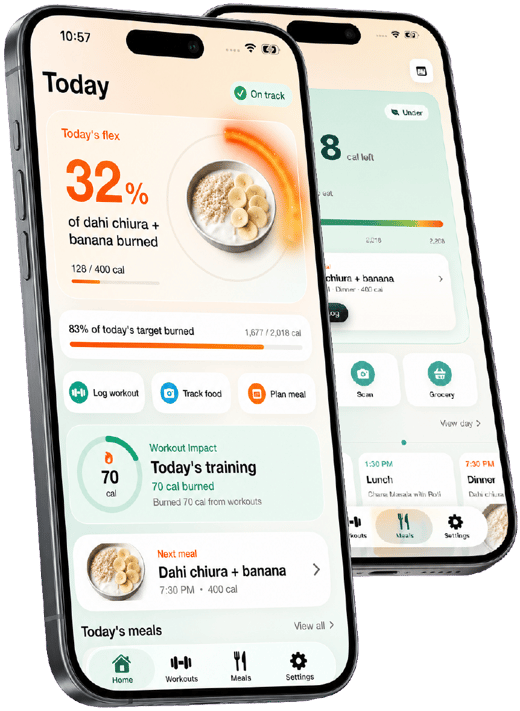
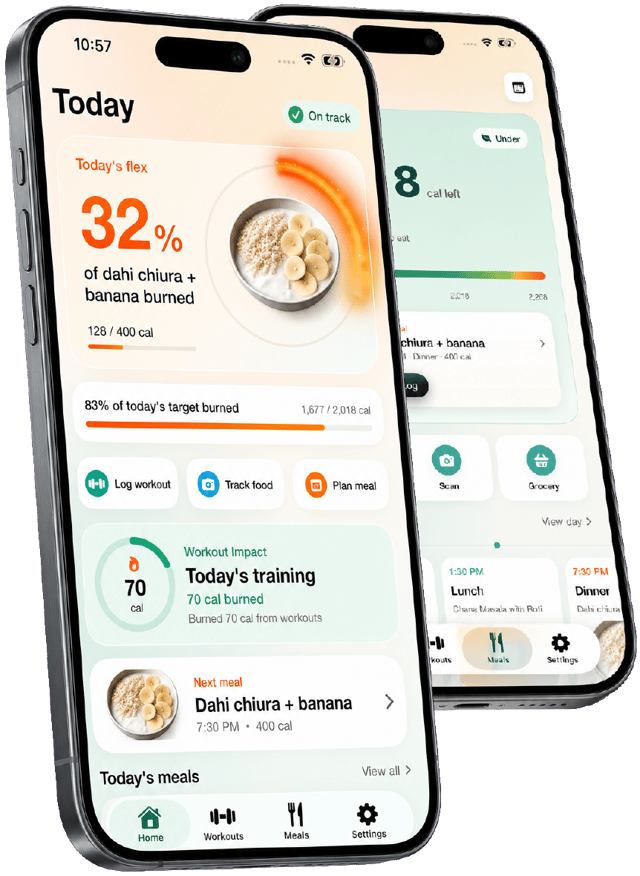
See what percentage of a meal a bodyweight circuit burned off, which is a genuinely motivating number even without a weight room in the picture.
Practical guidance
Tips for a bodyweight plan that keeps working
How to avoid the plateau that bodyweight-only training is most known for.
- 01 Master form before adding reps
A shallow squat or a push-up with sagging hips builds a bad pattern faster than it builds strength — slow down and fix the form first.
- 02 Track reps like they're plates
Writing down 3×12 push-ups this week versus 3×8 last month is exactly the progressive overload signal a weight increase would give you.
- 03 Add pauses before adding equipment
A 2-second pause at the hardest point of a rep is often enough to keep a move challenging for another few weeks.
- 04 Use stairs and furniture creatively
A sturdy chair for step-ups or a table edge for rows adds variety without buying equipment.
- 05 Don't skip pulling movements
Pushing (push-ups) is easy to overdo with no equipment; look for rows using a table or towel-assisted moves so pulling muscles aren't neglected.
- 06 Graduate to light equipment when reps get very high
Once you're comfortably doing 20+ reps of most moves, a resistance band or a light dumbbell pair extends the plan further than leverage alone can.

Build the plan around your week
Build my workout plan Tell Burnplate your days, equipment and level and it builds a progressive workout plan, logs every session, and connects what you burn to what you eat.
Questions
Workout planner for bodyweight training: FAQ
What is a good beginner bodyweight workout?
A good beginner workout bodyweight routine trains the whole body 3–4 times a week using a squat, a push-up variation, a hip hinge or bridge, and a core hold, done at 3 sets of 10–15 reps, with an easy walk or rest day between sessions.
Can you build muscle with bodyweight exercises alone?
Yes, especially for beginners — bodyweight training provides enough resistance to build real strength and some muscle, particularly when leverage changes, single-limb variations and slower tempos are used to keep increasing difficulty over time.
How do I progress a bodyweight workout routine without weights?
Move through a leverage progression (easier angle to harder angle), add reps, slow the tempo, add pauses, or switch to a single-limb version of the same move. Any one of these increases difficulty the same way adding weight would.
Is a bodyweight workout enough for weight loss?
Bodyweight training burns calories and builds strength, both of which support weight loss, but the calorie deficit itself is created mainly through nutrition. Pairing a bodyweight plan with a calorie target usually works better than either alone.
How often should I do a bodyweight workout routine?
Three to five sessions a week works well for most beginners, since bodyweight sessions tend to be lower-fatigue than heavy weighted training and recovery is usually faster between them.
Does Burnplate offer a true no-equipment workout plan?
Yes — selecting bodyweight as your equipment in Burnplate's workout builder generates a full plan using only floor-space, no-equipment exercises, scaled to your days per week and level.
