Nearly any consistent training stimulus produces strength gains in the first months, because an untrained nervous system adapts quickly. That advantage disappears fast if soreness or complexity makes you quit, so the plan has to protect consistency above all else.
Why it's different
Why a beginner needs a different plan
A program built for someone with two years of training experience will bury a beginner in volume and soreness before week two. Early progress runs on different rules.
3×/week full-body sessions is enough for a true beginner to build strength and the habit at the same time
48 hrs of rest between sessions gives untrained muscles time to recover and adapt before the next workout
8–12 reps per set is the beginner range that builds strength while you're still learning each movement
Training each muscle group three times a week, instead of once via a body-part split, gives a beginner more practice reps on the movement itself — and practice is what drives early progress, more than volume does.
Adding weight to a squat or a row you haven't grooved yet just adds weight to bad mechanics. The first few weeks are about owning the pattern with light, controlled sets before load becomes the focus.
A merely-good plan you do three times a week for three months will beat a perfect plan you quit in two weeks. The goal of week one isn't intensity — it's making it back for week two.
What it looks like
A sample first week
Three full-body sessions with a rest or easy-walk day between each one. The same four movement patterns repeat all week — you're not learning new exercises every day, you're getting better at a few.
Example week
3 Days/week40–45 min Session lengthTrue beginner LevelBodyweight + dumbbells Equipment
Monday Full body A Bodyweight squat 3x10 · Push-up (knees ok) 3x8 · Dumbbell row 3x10 · Plank 3x20s
Tuesday Rest or easy walk 20–30 min walk, stretching, or full rest
Wednesday Full body B Dumbbell Romanian deadlift 3x8 · Overhead press 3x8 · Assisted or band pulldown 3x10 · Dead bug 3x10/side
Thursday Rest or easy walk 20–30 min walk, stretching, or full rest
Friday Full body C Goblet squat 3x10 · Incline push-up 3x10 · Seated cable or band row 3x10 · Side plank 2x20s/side
Saturday Optional light cardio 20–30 min bike, walk or swim at an easy pace
Sunday Rest Full rest
How Burnplate handles it
How Burnplate builds a beginner's first plan
Burnplate turns your days, equipment and level into a plan you don't have to design yourself, then tracks whether it's working.
A plan built around your days and equipment
Tell Burnplate you're a beginner with three days a week and whatever equipment you have, and it builds a progressive full-body plan around exactly that — no generic template to adapt yourself.
Every set and rep logged in one tap
Log the weight and reps for each set as you go. Burnplate's workout history shows the trend across sessions, so you can see progress instead of guessing at it.
Calorie and macro targets that support recovery
Burnplate sets calorie and protein targets from your body and goal, so you're fueling the recovery a new training stimulus actually requires, not just tracking numbers.
See what a session actually burned
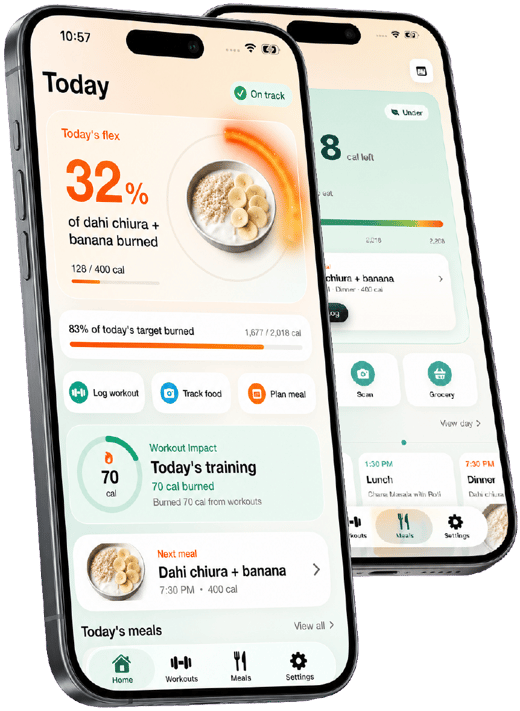
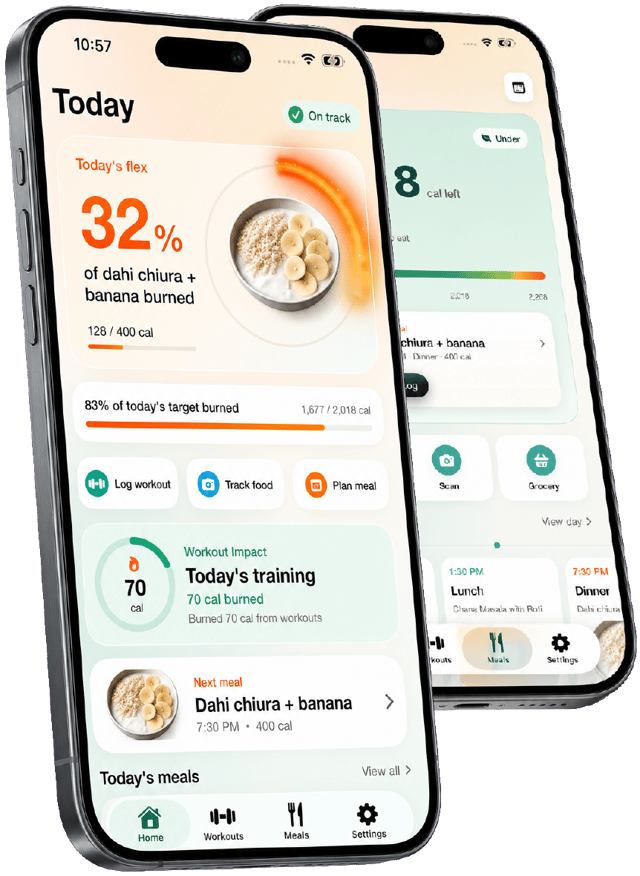
After a workout, Burnplate's burn bar shows what percentage of a logged meal your session burned off — a concrete, visible payoff for showing up.
Practical guidance
Tips for your first few months
The small habits that separate beginners who keep training from beginners who quit by week three.
- 01 Learn the four base patterns first
Squat, hinge, push and pull cover almost everything. Get comfortable with a version of each before worrying about variety.
- 02 Log the workout, not just attendance
Showing up matters, but writing down what you actually lifted is what tells you whether to add weight next time.
- 03 Put protein at every meal
Muscle you're building needs raw material to build from — aim for protein at breakfast, lunch and dinner, not just at dinner.
- 04 Walk on your off days
Easy movement on rest days speeds recovery without adding fatigue that competes with your training days.
- 05 Expect soreness to fade by week three
The worst soreness (DOMS) hits after new movements and fades quickly as your body adapts — it's not a required part of every session.
- 06 Don't chase soreness as a goal
Being unable to walk downstairs isn't proof a workout worked. Progressive, repeatable sessions beat one brutal one you can't recover from.

Build the plan around your week
Build my workout plan Tell Burnplate your days, equipment and level and it builds a progressive workout plan, logs every session, and connects what you burn to what you eat.
Questions
Workout planner for beginners: FAQ
How many days a week should a beginner work out?
Three full-body sessions a week, with a rest or easy-activity day between each, is the standard beginner routine. It's enough training stimulus to build real strength while leaving enough recovery time for someone whose body isn't yet adapted to lifting.
What is a good beginner workout routine?
A good beginner routine repeats a small set of full-body movements — a squat, a hinge, a push and a pull — three times a week, adding a little weight or a rep as each one gets easier. Complexity and variety matter far less than consistency at this stage.
Should beginners do full body or a split routine?
Full body. Training each muscle group multiple times a week gives a beginner more practice on the movement patterns themselves, which is what drives early strength gains. Split routines, which train one muscle group per day, make more sense once you're recovering well from higher weekly volume.
How long until beginners see results?
Strength gains are usually noticeable within 2–4 weeks, since a lot of early progress comes from your nervous system getting better at the movements. Visible muscle change takes longer, typically 8–12 weeks of consistent training and adequate protein.
Do beginners need a gym to start?
No. Bodyweight squats, push-ups, rows using a table or bands, and planks can build a real base of strength. A pair of adjustable dumbbells extends that further, and a gym just gives you more load options once bodyweight gets too easy.
Can Burnplate build a beginner workout plan for me?
Yes. Tell Burnplate your days per week, equipment and experience level, and it builds a progressive plan around those inputs, then logs your sets and reps so you can see whether it's working session to session.
