A large part of early strength improvement comes from your nervous system getting more efficient at recruiting muscle for a specific movement — separate from the muscle actually getting bigger. That's why strength can improve faster than visible size changes.
Why it's different
Why strength training looks different from other goals
A plan built for muscle size or fat loss uses shorter rest and more exercise variety on purpose — strength training deliberately does the opposite.
3–6 reps per set is the classic strength range — enough load per rep to train force production, not just fatigue
80–90% of your one-rep max is where most dedicated strength work in a set happens
2–5 min of rest between heavy sets lets you lift close to your best on every set instead of just the first
Lifting at 80–90% of your max, for a small number of reps, trains your body to produce high force in short bursts — which is what "being strong" at a lift actually means, distinct from muscular endurance.
Strength work depends on lifting near your best each set. Cutting rest to 60–90 seconds, common in hypertrophy or fat-loss training, leaves you too fatigued to lift heavy by set two or three.
Squat, bench press, deadlift and overhead press recruit the most muscle mass and joints at once, which is why strength programs build around a handful of these rather than a long list of isolation exercises.
What it looks like
A sample strength week
Three main lift days built around the squat, bench and deadlift, with an optional accessory day for weak points.
Example week
3–4 Days/week60–75 min Session lengthIntermediate LevelBarbell + rack Equipment
Monday Squat day Back squat 5x5 (heavy) · Leg press 3x8 · Plank 3x30s
Tuesday Rest Full rest
Wednesday Bench day Bench press 5x5 (heavy) · Overhead press 3x8 · Row 3x8
Thursday Rest or light cardio 20–30 min easy cardio or full rest
Friday Deadlift day Deadlift 5x3 (heavy) · Front squat or lunge 3x8 · Pull-up or lat pulldown 3x8
Saturday Optional accessory day Weak-point isolation work: 3x10–12 on lagging muscle groups, moderate weight
Sunday Rest Full rest
How Burnplate handles it
How Burnplate supports a strength program
Burnplate structures the lifts and tracks the numbers that actually indicate whether you're getting stronger.
A plan built around your compound lifts
Burnplate's workout builder structures a strength-focused plan around your days and equipment, centered on the major compound lifts rather than a long exercise list.
Workout history tracks your top sets
Every logged session shows your heaviest set for each lift over time, making plateaus and progress equally visible instead of relying on memory or feel.
Calorie and protein targets that support heavy training
Burnplate sets calorie and protein targets from your body and goal, so recovery from heavy sessions isn't undercut by under-fueling.
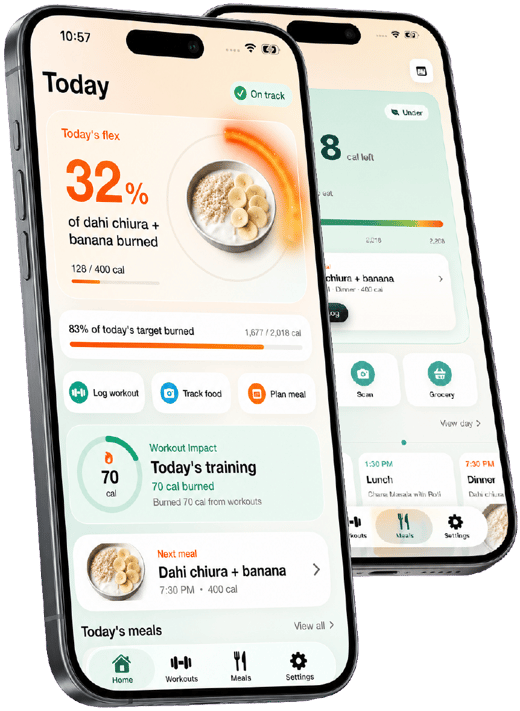
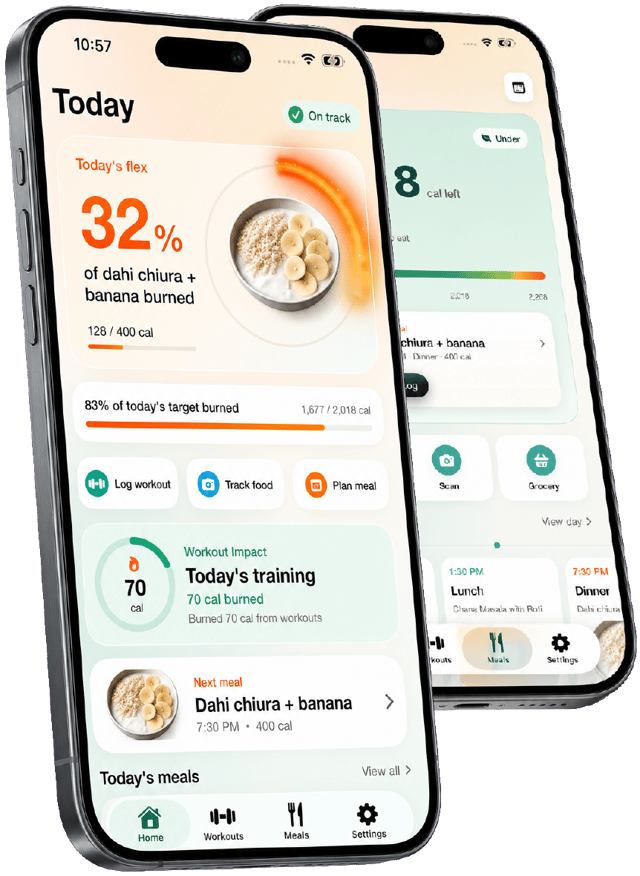
The burn bar connects training to your food
Even on a strength-focused plan, Burnplate shows what percentage of a meal a session burned off, keeping training and eating visible on the same screen.
Practical guidance
Tips for a strength-focused program
Details that matter more for strength training than for most other goals.
- 01 Master the big lifts' form first
Time spent grooving squat, bench and deadlift technique at lighter weight pays off directly once you start loading them heavily.
- 02 Rest fully between heavy sets
Two to five minutes of rest isn't laziness on a strength day — it's what lets you hit the same heavy weight on your third and fourth sets.
- 03 Track every top set
A simple log of your heaviest set per lift, per session, tells you more about progress than how a workout felt.
- 04 Eat enough to recover
Heavy strength training is demanding on the nervous system and joints — under-eating slows recovery and stalls progress faster than most other goals.
- 05 Never skip your warm-up sets
Ramping up in weight before your heaviest set primes the nervous system and reduces injury risk on maximal attempts.
- 06 Periodize heavy and light weeks
Alternating harder and easier weeks over a training block lets you push intensity without accumulating fatigue indefinitely.

Build the plan around your week
Build my workout plan Tell Burnplate your days, equipment and level and it builds a progressive workout plan, logs every session, and connects what you burn to what you eat.
Questions
Workout planner for strength: FAQ
How many days a week should I train for strength?
Three to four days a week, each built around a main compound lift, is a common and effective strength-training frequency. It allows enough recovery between heavy sessions on the same lift while still training frequently enough to build the skill.
What rep range builds strength?
Three to six reps per set at a high percentage of your one-rep max is the classic strength range, though strength also improves to some degree from moderate-rep training. Lower reps at heavier loads specifically emphasize force production over muscular endurance.
Do I need a coach to get stronger?
No, though technique coaching helps, especially on the squat, bench and deadlift where form errors compound as weight increases. Many people build meaningful strength self-coached using established programs and honest self-assessment of form.
Can beginners follow a strength program?
Yes — beginners often respond fastest to strength training because of rapid neural adaptation. Starting with lighter loads and more conservative weekly increases than an intermediate lifter, while still training the same core lifts, works well.
How long does it take to see strength gains?
Many beginners notice strength improving within 2–4 weeks, largely from the nervous system getting more efficient at the lift. More experienced lifters see slower per-week progress and typically program in multi-week or multi-month blocks.
