
A day can hit its calorie target exactly while the carbs land unevenly — a huge breakfast carb load and a tiny dinner — and still produce a rough glucose day. The calorie total alone doesn't catch that.
Why it's different
Why a diabetic calorie tracker needs to do more than count calories
Calories tell you about energy balance and weight over weeks. Blood sugar responds to carbs, meal timing and food pairing within hours — a tracker built for diabetes has to hold both pictures at once.
45–60 g carbs per meal many adults with diabetes start with — your care team sets yours
25–30 g fiber a day recommended to slow glucose absorption
5–10% body weight loss shown to meaningfully improve insulin sensitivity in type 2 diabetes
For anyone on insulin or a sulfonylurea, an accurate carb count per meal directly affects dosing decisions — a rough estimate that's fine for calorie tracking isn't precise enough for that.
Fifty grams of carbs from lentils and vegetables produces a slower, lower glucose rise than fifty grams from white bread — the fiber content of a carb total matters as much as the total itself.
For type 2 diabetes, losing even 5–10% of body weight often improves insulin sensitivity and lowers A1c — but the primary goal of daily tracking is steady glucose, with weight change as a bonus, not the driver.
What it looks like
A sample day tracking calories and carbs
Built around roughly 1,700 calories with carbs held near 45 g per meal — a common starting point for weight-stable adults with type 2 diabetes.
Example day
Daily targets
Calories ~1,700 A common starting estimate for weight-stable adults with type 2 diabetes; your target may differ
Carbs per meal 40–50 g Keeps glucose swings predictable meal to meal
Fiber 28 g Slows absorption and helps blunt the post-meal rise
Protein 100–120 g Helps with satiety and blunts the glycemic response when paired with carbs
Added sugar under 25 g Limits fast, unpredictable spikes
A logged day
7:30 AM Veggie omelet, ½ avocado, 1 slice toast42 g carbs, protein-forward start 420 kcal
10:30 AM Greek yogurt, chia, berries18 g carbs, fiber-rich 190 kcal
1:00 PM Turkey chili with beans44 g carbs from beans, high fiber 440 kcal
4:00 PM String cheese, 10 almonds4 g carbs, minimal glucose impact 170 kcal
7:00 PM Grilled chicken, roasted vegetables, ½ cup rice46 g carbs, balanced plate 480 kcal
How Burnplate handles it
How Burnplate tracks calories and carbs together
Burnplate isn't a medical device and doesn't replace your care team's targets. It turns those targets into logging that's fast enough to do at every meal.
Carbs and calories logged from one photo
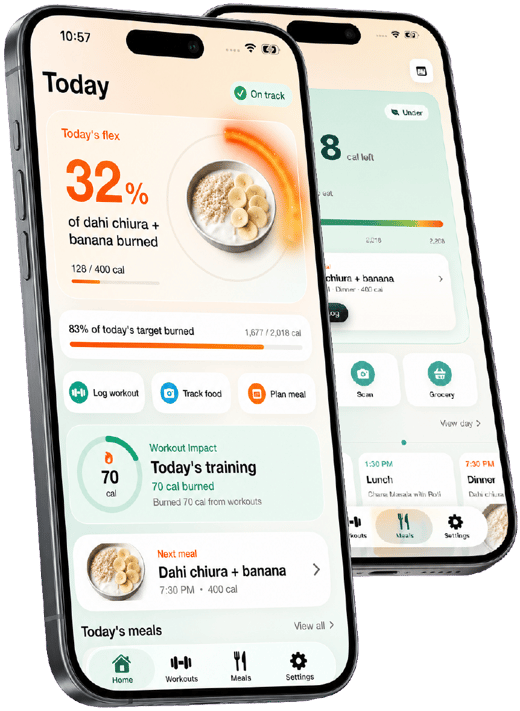
Snap a plate and Burnplate's photo calorie counter reads calories and carbs together, so a diabetic day doesn't need a second app for carb counting.
A macro target that includes carbs by design
Calorie and macro targets are set from your body, goal and activity, and carbs are shown as their own number — not buried inside the calorie total.
Swap a meal, keep the carb count in range
The AI meal plan lets you swap a meal you don't feel like eating while keeping that meal's carbs and calories in the same range, so the day still behaves.
See what a walk did to the day
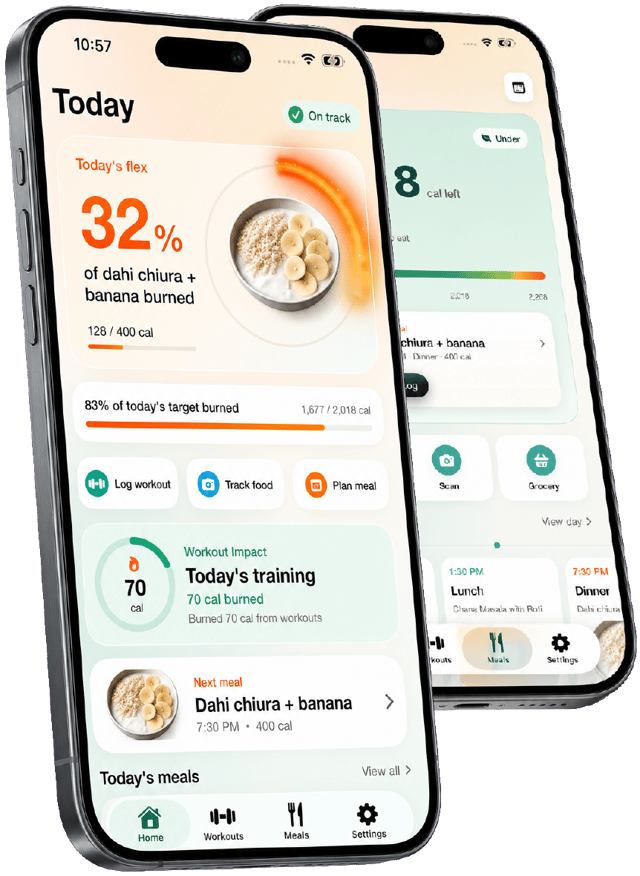
The burn bar shows how much of a meal your activity has offset — a visible reason to take the post-meal walk that helps glucose most.
Practical guidance
Practical tracking tips for diabetes
Habits that make consistent carb tracking easier to sustain, not just accurate for one day.
- 01 Anchor carbs to the same range each meal
Predictability across meals is easier for both you and your glucose to manage than an exact daily total that varies wildly meal to meal.
- 02 Pair every carb with protein or fat
Adding protein, fat or fiber to a carb slows digestion and blunts the spike — never log a carb-only meal by design.
- 03 Log carbs even on 'good' days
Consistent logging on stable days builds the pattern data that makes a rough day easier to explain later.
- 04 Walk 10-15 minutes after your meal
A short post-meal walk is one of the most reliable non-drug ways to lower the glucose peak after eating.
- 05 Track patterns, not single readings
One high reading rarely means much on its own — a repeated pattern across several days is the signal worth acting on.
- 06 Loop your care team in on changes
Carb, calorie and medication targets should shift together, not independently — your doctor or diabetes educator sets the combination.

Track it with a photo, not a search bar
Start tracking free Burnplate sets your calorie and macro targets, logs meals from a photo, and shows how much of each meal your workouts and steps have burned off.
Questions
Calorie tracker for diabetics: FAQ
How many calories should a diabetic eat in a day?
It depends on weight goal, activity level and medications, but many adults with type 2 diabetes start around 1,600–1,800 calories a day if weight loss is a goal, or a higher maintenance-level number if it isn't. Your doctor or diabetes educator can set a more specific target based on your labs and goals.
Is counting calories or carbs more important for diabetes?
Both matter for different reasons — carbs drive short-term glucose response, while calories drive longer-term weight change, which affects insulin sensitivity. Tracking only one gives an incomplete picture; a diabetic-focused calorie counter tracks both together.
Can a calorie counter for diabetics help manage blood sugar?
It can help by making carb totals per meal visible and consistent, which is one of the biggest levers for predictable glucose. It's a tracking tool, not a treatment — it doesn't replace glucose monitoring, medication or your care team's guidance.
How accurate is photo-based food logging for diabetes management?
Photo logging gives a solid estimate for typical home meals and is far faster than manual entry, but it's an estimate, not a lab-grade measurement. For insulin dosing decisions, most people cross-check the first few uses against a known carb count until they trust the accuracy.
Does losing weight help type 2 diabetes?
Often, yes — losing 5–10% of body weight commonly improves insulin sensitivity and can lower A1c meaningfully for people with type 2 diabetes. A modest calorie deficit is generally safer than an aggressive one, especially for anyone on glucose-lowering medication.
Can Burnplate replace a diabetes app?
Burnplate logs calories and carbs together and shows both against your targets, but it's a food and activity tracker, not a medical device — it doesn't monitor glucose, calculate insulin doses or replace a dedicated diabetes management app if your care team has recommended one.
