In a calorie deficit, your body will pull energy from both fat and muscle unless you give it a reason to keep the muscle. Regular resistance training is that reason — it signals the muscle is still needed.
Why it's different
Why weight-loss training isn't just cardio
Cardio-only plans lose weight, but a meaningful share of it can be muscle, not fat — which shows up as a smaller, softer version of the same body rather than a leaner one.
150–300 minutes a week of moderate cardio is the range major physical activity guidelines recommend for weight management
2–3×/week strength sessions is enough to preserve muscle while you're in a calorie deficit
8,000+ steps a day adds meaningful daily burn on top of scheduled workouts — often more than the workouts themselves
Cutting calories further gets harder to sustain and harder on hunger. Cardio sessions and daily steps add to the deficit from the output side instead, which is usually easier to stick with.
A 45-minute workout burns real calories, but the other 15+ waking hours of a day usually add up to more. Steps, fidgeting and daily activity — collectively called NEAT — often matter more to the weekly total than the gym session does.
Two people losing the same 10 pounds can end up looking very different depending on how much of that was muscle. Strength-training presence, not just the number, is what keeps the loss looking like fat loss.
What it looks like
A sample training week for weight loss
Four scheduled sessions — two strength, two cardio — plus a daily step target that does as much work as either one.
Example week
4 Days/week40–50 min Session lengthGeneral fitness LevelGym or home + cardio option Equipment
Monday Full-body strength Squat 3x10 · Bench or push-up 3x10 · Row 3x10 · Plank 3x30s
Tuesday Steady cardio 30 min brisk walk, bike or incline treadmill at a conversational pace
Wednesday Full-body strength Deadlift or hip hinge 3x8 · Overhead press 3x10 · Lat pulldown 3x10 · Dead bug 3x10/side
Thursday Rest + steps No scheduled session; hit your daily step target
Friday Full-body strength Goblet squat 3x10 · Incline press 3x10 · Cable row 3x10 · Side plank 2x30s/side
Saturday Cardio intervals 20–25 min: alternate 1 min hard / 2 min easy on a bike, run or rower
Sunday Rest + steps Full rest; keep moving toward your step target
How Burnplate handles it
How Burnplate supports a weight-loss training plan
Burnplate connects the training side and the food side on one screen, instead of treating them as two separate apps.
A plan that mixes strength and cardio around your days
Burnplate's workout builder takes your days per week and equipment and builds a plan that balances strength sessions with cardio, instead of defaulting to cardio alone.
Calorie and macro targets sized to a real deficit
Burnplate sets your calorie target and protein goal from your body, goal and activity level, so the deficit is sized to lose weight steadily without starving recovery.
Steps counted toward the day automatically
Daily steps and activity count toward your numbers alongside scheduled workouts, so the walking that quietly does a lot of the work isn't invisible.
The burn bar ties a session to a meal
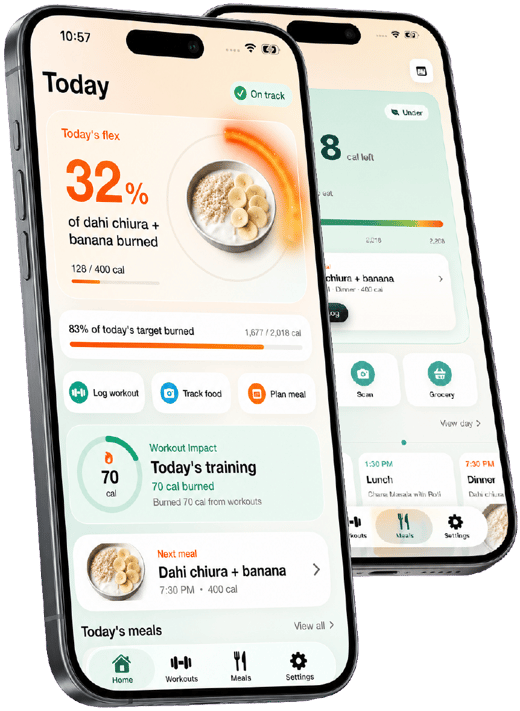
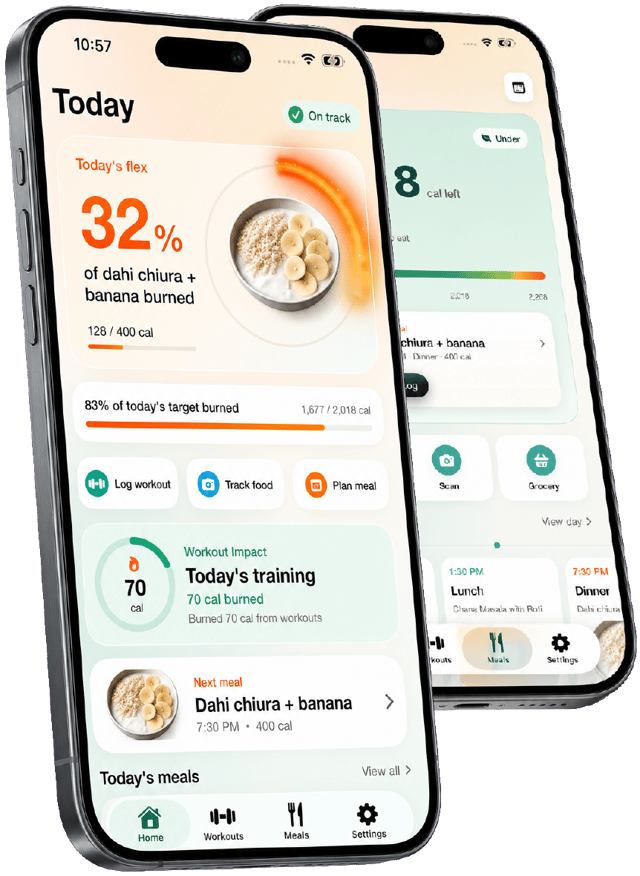
After logging a workout, Burnplate shows what percentage of a meal — or the day's target — that session burned off, making the connection between training and eating concrete instead of abstract.
Practical guidance
Training tips that actually move the scale
Habits that make the deficit sustainable and protect what you don't want to lose.
- 01 Don't cut calories and skip strength
A deficit with no resistance training is the fastest way to lose muscle along with fat — keep at least 2 strength sessions weekly even when calories are low.
- 02 Prioritize protein while cutting
Aim for roughly 1.6–2.2 g of protein per kg of body weight during a deficit — it's the single biggest lever for keeping muscle while losing weight.
- 03 Track steps like a workout
Daily steps aren't a bonus on top of training — for many people, they're the bigger contributor to the weekly deficit.
- 04 Judge progress by the trend, not the day
Weight fluctuates 1–3 lbs day to day from water and food volume alone; look at the weekly average, not single readings.
- 05 Protect your sleep
Poor sleep raises hunger hormones and makes the deficit feel harder, which is often what derails an otherwise good plan.
- 06 Walk after meals when you can
A 10–15 minute walk after eating adds easy steps and takes the edge off post-meal sluggishness.

Build the plan around your week
Build my workout plan Tell Burnplate your days, equipment and level and it builds a progressive workout plan, logs every session, and connects what you burn to what you eat.
Questions
Workout planner for weight loss: FAQ
How many times a week should you work out to lose weight?
Four sessions a week — a mix of strength and cardio — works well for most people, but weight loss itself is driven more by the calorie deficit than the exact session count. Two strength sessions a week is close to the minimum to meaningfully protect muscle.
Can you lose weight with just cardio?
Yes, cardio alone will create a deficit and cause weight loss, but without resistance training a larger share of that loss can come from muscle rather than fat. Adding even 2 strength sessions a week meaningfully changes what kind of weight comes off.
What is the best workout split for weight loss?
A split mixing 2–3 full-body strength sessions with 2–3 cardio sessions a week, plus a daily step target, covers both sides of the equation — the deficit source (cardio and steps) and the muscle protection (strength). There's no single required split; consistency across both matters more than the exact structure.
How long does it take to see results from a weight-loss workout plan?
Scale changes can show up within the first 1–2 weeks, partly from water weight. Visible body composition change typically takes 6–8 weeks of consistent training and a real calorie deficit, tracked by the weekly trend rather than single readings.
Do I need to do both cardio and weights to lose weight?
You don't strictly need both to lose weight — a deficit alone will do that. But combining them is what determines whether the loss is mostly fat or a mix of fat and muscle, which is why most weight-loss programs include both.
