Women have roughly a tenth of the testosterone men do, so significant muscle bulk takes years of deliberate, high-volume training to build — not a few months of squats. What you get instead is more strength, a firmer shape and a faster metabolism.
Why it's different
Why women's training plans should look different
The default advice women get is cardio for weight loss and light dumbbells for toning. Neither matches what actually changes strength, shape or long-term health.
3×/week resistance sessions weekly is what most exercise guidelines recommend for women
1–2%/yr bone density gain per year from resistance training, versus the decline after 30
8–12 reps the rep range that reliably builds strength and lean muscle without maximal loads
Bone density starts declining by about 1% a year after your early 30s. Resistance training and impact exercise are two of the few interventions shown to slow or partially reverse that, and the earlier the habit starts, the more it banks.
Many women feel stronger in the days after their period and more fatigued in the late luteal phase. A plan flexible enough to trade a heavy day for a lighter one that week beats a rigid schedule that ignores it.
Cardio burns calories during the session; resistance training builds muscle that keeps burning after it. Combining both changes body composition faster than either alone, which is why the plan below leans on lifting first.
What it looks like
A sample week on a workout plan for women
Four sessions a week, built around compound lifts, with room for cardio and recovery. This is the shape a Burnplate-built workout program for women typically takes for a beginner to intermediate lifter.
Example week
4 Days/week40–50 min Session lengthBeginner–intermediate LevelDumbbells + bodyweight Equipment
Monday Upper body strength Push-up 3×10 · Dumbbell row 3×10 · Shoulder press 3×10 · Plank 3×30s
Tuesday Lower body strength Squat 4×10 · Romanian deadlift 3×10 · Glute bridge 3×15 · Calf raise 3×15
Wednesday Active recovery 30 min walk · light mobility work
Thursday Full body + core Deadlift 3×8 · Reverse lunge 3×10 · Row 3×10 · Dead bug 3×12
Friday Cardio intervals 20–25 min: 1 min hard · 2 min easy, repeated
Saturday Optional mobility Yoga or stretching, 20–30 min
Sunday Rest Full rest
How Burnplate handles it
How Burnplate builds a workout plan for women
Burnplate is a workout planner for women that adapts to your schedule and level rather than handing you a generic template.
A plan built around your schedule
Set your days per week, equipment and level and Burnplate's workout planner builds a progressive strength plan for you, then adjusts it as you get stronger.
Every session logged, and remembered
Log sets, reps and weight in seconds. Burnplate keeps your workout history so you always know what you lifted last time and what to aim for next.
Protein and calorie targets for your goal
Burnplate sets calorie and protein targets from your body, goal and activity level, so the muscle you're building has what it needs to recover.
Training and food on one screen
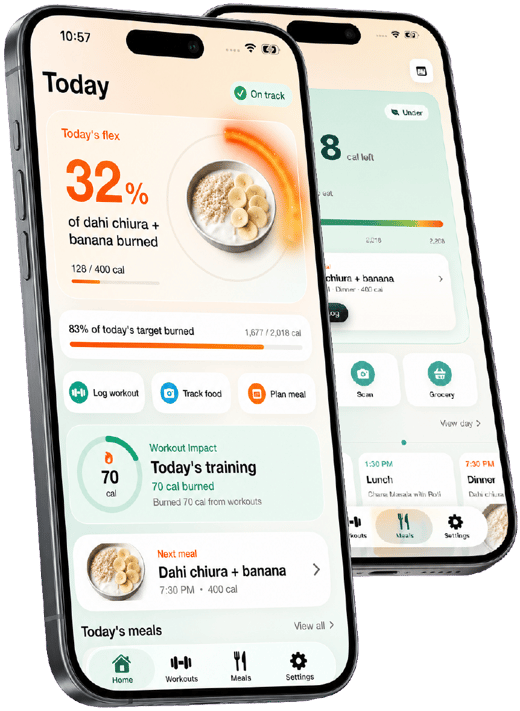
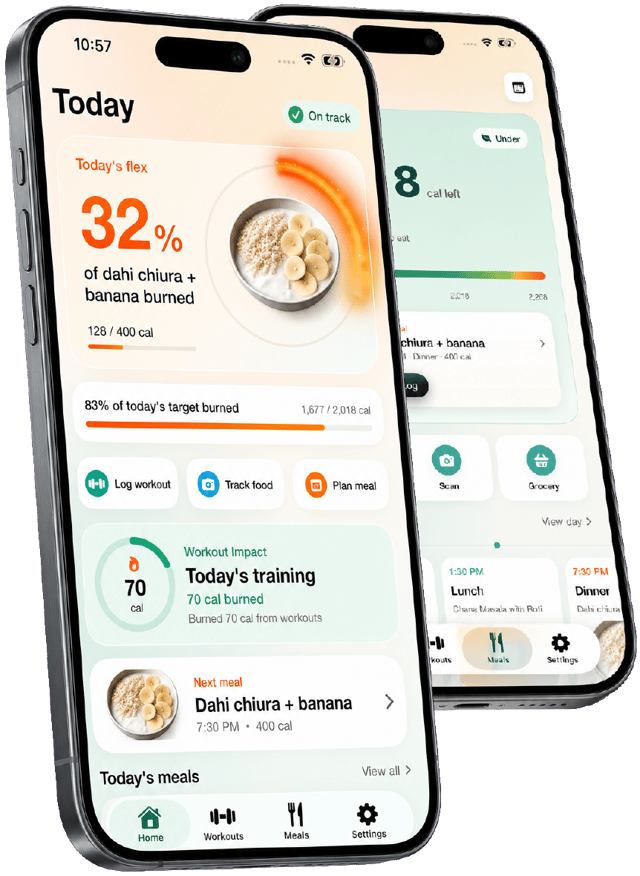
The burn bar shows how much of a meal or your day's target your training and steps have covered, connecting the workout to what you ate.
Practical guidance
Tips for getting more from a women's workout plan
The habits that separate a workout plan for women that sticks from one that fizzles out by week three.
- 01 Lift heavy enough to feel challenged
Light weights for endless reps under-stimulate muscle. The last two reps of a working set should feel genuinely hard.
- 02 Don't fear a slower scale
Adding muscle while losing fat can mean the scale barely moves even as your shape changes — track photos or measurements too.
- 03 Prioritize protein at every meal
Aim for a protein source at each meal, not just after a workout, to support the muscle repair training triggers.
- 04 Put strength before cardio, not after
If a session gets cut short, keep the lifting and trim the cardio — strength training has the bigger long-term payoff.
- 05 Warm up hips and shoulders specifically
These joints handle the most load across squats, presses and rows; five minutes of mobility work lowers injury risk.
- 06 Treat rest days as part of the plan
Muscle adapts during recovery, not during the workout. Skipping every rest day slows progress and raises injury risk.

Build the plan around your week
Build my workout plan Tell Burnplate your days, equipment and level and it builds a progressive workout plan, logs every session, and connects what you burn to what you eat.
Questions
Workout planner for women: FAQ
How many days a week should women strength train?
Three to four sessions a week is enough to build meaningful strength and support bone density, according to most exercise guidelines. Two full-body sessions work if that's all your schedule allows; four sessions split by body region lets you push each muscle group harder.
Will lifting weights make women bulky?
No. Women have roughly a tenth of the testosterone men have, so significant muscle bulk requires years of deliberate high-volume training and often a calorie surplus — it doesn't happen by accident. Most women who lift end up leaner and more defined, not bulkier.
What's the best workout program for women just starting out?
A full-body strength program two to three times a week, focused on squats, hinges, pushes and pulls, beats an isolated split for beginners. It builds strength everywhere at once and is easier to recover from while you're learning the movements.
How does a workout planner for women adjust to my schedule?
Burnplate builds your plan from the days per week, equipment and level you enter, then adapts as your logged sessions show you're getting stronger. If your schedule changes, you can rebuild the plan around your new availability at any time.
How much cardio do women need alongside strength training?
Most guidelines suggest 150 minutes of moderate cardio a week for general health, which can be as simple as walking. For body composition goals specifically, prioritizing strength training and layering in one or two cardio sessions tends to work better than cardio-first plans.
Do workout plans for women need to change around the menstrual cycle?
Not dramatically, but flexibility helps. Many women have more capacity in the days after their period and less in the late luteal phase — trading a heavy day for a lighter one that week keeps the plan sustainable without losing progress.
