Sarcopenia, the age-related loss of muscle mass, speeds up through your 50s and 60s. Resistance training is the most effective countermeasure at any age, and starting or continuing it now has an outsized effect on strength for the next decade.
Why it's different
Why training after 50 needs a different approach
The lifts don't have to change much after 50 — the structure around them does, to account for slower recovery and joints with more mileage.
~1–2%/yr typical testosterone decline after 30, a factor in slower recovery and muscle loss
3×/week strength sessions weekly that balance progress with the recovery your 50s now need
48–72 hrs the recovery window most men need between hard sessions on the same muscle after 50
Lower testosterone and reduced recovery capacity mean the same workout that took 48 hours to bounce back from at 30 might take 72 at 55. Spacing hard sessions further apart, not training less, is usually the fix.
Decades of movement, old injuries and normal wear mean some exercises need substitution — a trap-bar deadlift instead of a straight bar, a leg press alongside squats. The goal or the muscle worked doesn't change, just the tool.
Heart disease risk rises with age, and cardio training alongside strength work is one of the most effective ways to manage it. A plan that only lifts and skips cardio misses half of what matters most now.
What it looks like
A sample week on a workout plan for men over 50
Three strength sessions spaced with recovery in mind, plus dedicated mobility and cardio. Loads stay meaningful — the spacing and exercise selection are what change.
Example week
4 Days/week45–55 min Session lengthIntermediate, joint-conscious LevelFull gym Equipment
Monday Full body strength Trap-bar deadlift 3×6 · Leg press 3×10 · Row 3×8 · Overhead press 3×8
Tuesday Mobility + cardio 20 min hip and shoulder mobility · 20 min moderate cardio
Wednesday Rest Full rest or an easy walk
Thursday Full body strength Goblet squat 3×10 · Chest press 3×8 · Lat pulldown 3×10 · Farmer carry 3×30m
Friday Cardio + core 25–30 min moderate cardio · Plank 3×40s · Dead bug 3×12
Saturday Full body strength Split squat 3×10 · Incline press 3×10 · Cable row 3×10 · Calf raise 3×15
Sunday Rest Full rest
How Burnplate handles it
How Burnplate builds a plan for men over 50
Burnplate's workout planner adjusts for level and equipment, and keeps the tracking simple enough to actually stick with.
A plan built around your level and recovery
Set your level and days per week and Burnplate's workout planner builds a progressive strength plan with appropriate spacing between hard sessions.
Every session logged and easy to review
Log sets, reps and weight, and Burnplate keeps a full workout history — useful for spotting whether a joint is reacting to a specific exercise.
Protein targets that support recovery
Burnplate sets a protein target from your body and goal, supporting the higher protein needs that help offset slower recovery after 50.
See training and food connected
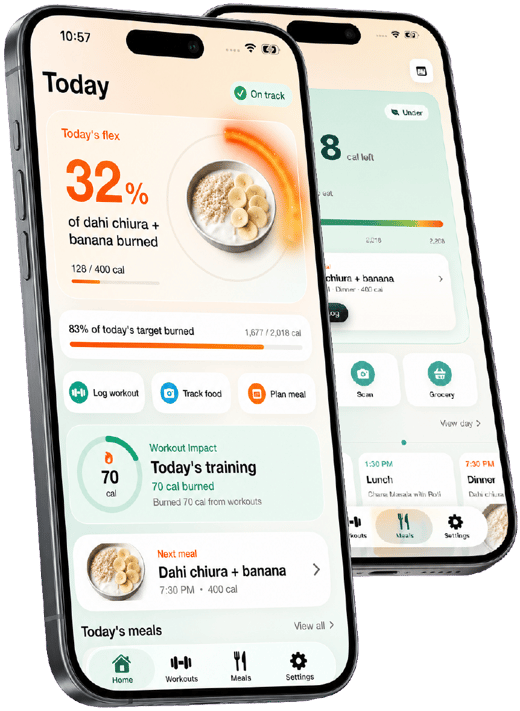
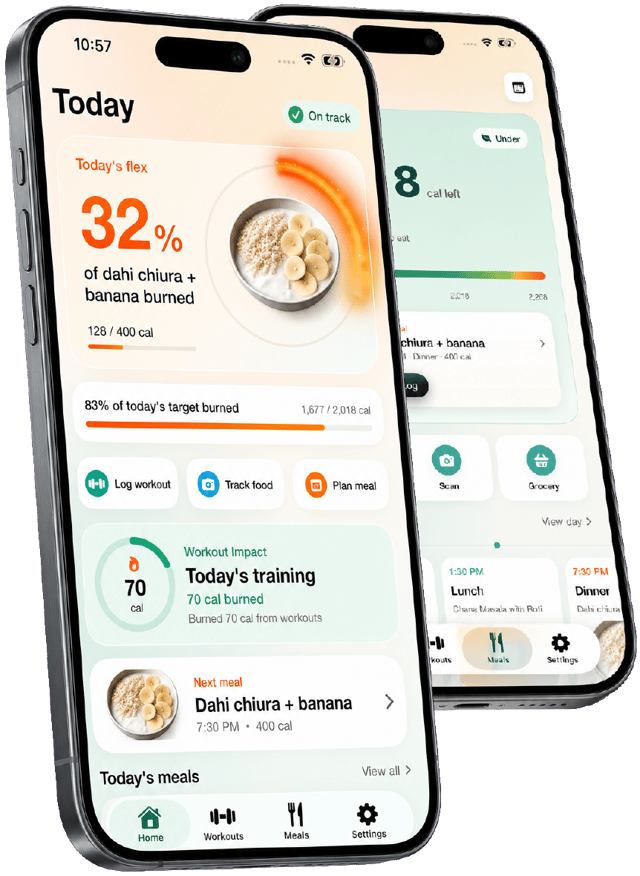
The burn bar shows how much of your day's calories a session and daily steps have covered, keeping training and eating on one screen.
Practical guidance
Tips for training smarter after 50
Adjustments that keep the training productive instead of just harder to recover from.
- 01 Warm up longer than you used to
Ten minutes of dedicated mobility and a couple of light warm-up sets protect joints far more than skipping straight to working weight.
- 02 Prioritize compound lifts, adapted
Squats, presses, rows and deadlifts still build the most strength — swap the variation before you drop the movement pattern.
- 03 Space hard sessions further apart
Two full days between sessions hitting the same muscle group is a reasonable default once recovery slows.
- 04 Don't skip cardio for lifting
Heart health risk rises with age — keep at least two cardio sessions a week alongside strength training, not instead of it.
- 05 Increase protein intake
Higher protein intake helps offset age-related muscle loss and supports recovery between sessions.
- 06 Track joint response, not just the lift
If a lift leaves a joint sore for days rather than the muscle, that's the signal to modify the exercise, not push through it.

Build the plan around your week
Build my workout plan Tell Burnplate your days, equipment and level and it builds a progressive workout plan, logs every session, and connects what you burn to what you eat.
Questions
Workout planner for men over 50: FAQ
What is the best workout routine for men over 50?
A full-body or upper/lower strength split three to four times a week, combined with mobility work and cardio, covers the main risks of this decade: muscle loss, joint stiffness and cardiovascular health. Compound lifts, adapted where joints need it, remain the foundation.
Can men over 50 still build muscle?
Yes. Muscle-building slows compared to your 20s and 30s due to lower testosterone and slower recovery, but resistance training still reliably builds and preserves muscle at 50 and well beyond. Consistency and adequate protein matter more than intensity alone.
How much recovery do men over 50 need between workouts?
Most men need 48 to 72 hours between hard sessions hitting the same muscle group after 50, compared to roughly 48 hours in their 30s. Spacing sessions further apart, rather than training less overall, is usually the better adjustment.
Should men over 50 lift heavy or focus on light weights?
Meaningful load still matters for building and preserving muscle and bone density — the difference at 50-plus is more warm-up, careful exercise selection around problem joints, and more recovery time, not automatically lighter weights.
Is cardio or strength training more important after 50?
Both matter for different reasons: strength training preserves muscle and bone, while cardio supports heart health, which becomes a bigger risk factor with age. A workout plan for men over 50 should include both rather than choosing one.
What should a workout routine for men over 50 avoid?
Avoid jumping straight into heavy loads without a proper warm-up, ignoring joint pain that lingers past a session, and skipping cardio entirely in favor of only lifting. Adapting exercises around old injuries beats pushing through them.
