A band is easiest at the start of a rep and hardest at the end, the opposite of many dumbbell exercises — that shifts tension onto the lockout portion of presses and the top of rows in a way free weights don't.
Why it's different
Why resistance bands train differently than weights
A dumbbell's resistance is constant through the whole rep. A band's resistance grows as it stretches — that single difference changes which part of a movement gets the hardest work, and who bands are especially good for.
3–5 bands of increasing resistance (light to heavy) covers a full progression without any other equipment
15–25 reps is the typical working range for band exercises, since the resistance curve behaves differently than a fixed weight
3–4×/week sessions work well since bands are gentle enough on joints to allow more frequent training for many people
Unlike a dumbbell, which can rest on momentum briefly at certain joint angles, a band keeps tension on the muscle through the entire range, which many people feel as a deeper, more consistent burn.
Bands let you train a full range of motion with lower peak joint stress than a comparable free weight, which is part of why physical therapists use them so often during recovery.
A set of 3–5 loop bands and a door anchor covers presses, rows, squats, deadlifts and isolation work — a legitimate full-body system that costs less than one gym month and fits in carry-on luggage.
What it looks like
A sample beginner resistance band week
Built around a set of loop bands and one long tube band with a door anchor, covering the whole body without a single piece of iron.
Example week
4 Days/week25–30 min Session lengthTrue beginner LevelBands + door anchor Equipment
Monday Full body A Band squat 3×15 · Band chest press 3×15 · Band row 3×15 · Glute bridge with band 3×15
Tuesday Cardio + core 20 min brisk walk · Band pallof press 3×10/side · Dead bug 3×10/side
Wednesday Rest or mobility Band-assisted stretching for hips and shoulders
Thursday Full body B Band deadlift 3×15 · Band overhead press 3×12 · Band pull-apart 3×15 · Lateral band walk 3×10 steps/side
Friday Full body C Band lunge 3×10/side · Band lat pulldown 3×12 · Band bicep curl 3×15 · Band plank row 3×10/side
Saturday Conditioning Band circuit (5 moves × 30 sec) × 3 rounds
Sunday Rest Full rest
How Burnplate handles it
How Burnplate builds a resistance band plan
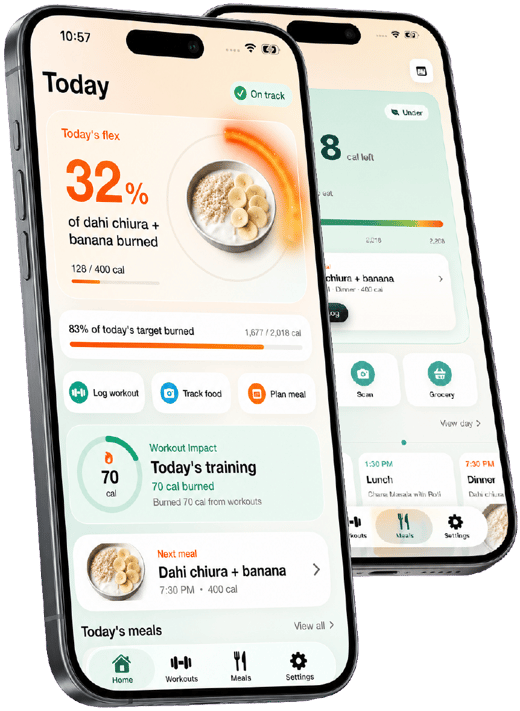
Burnplate's workout builder supports resistance bands as a standalone equipment type, useful for travel, small spaces or joint-friendly training.
A plan that only uses band exercises
Set resistance bands as your equipment and Burnplate writes every session from band-compatible movements, scaled to your level and days per week.
Log sets and reps by band color or resistance level
Track your working resistance and reps per session so moving up a band level is based on a visible trend.
Nutrition tracking that travels too
Photo or search-log meals on the road, so a band-based travel plan doesn't mean nutrition logging falls apart at the same time.
The burn bar wherever you train
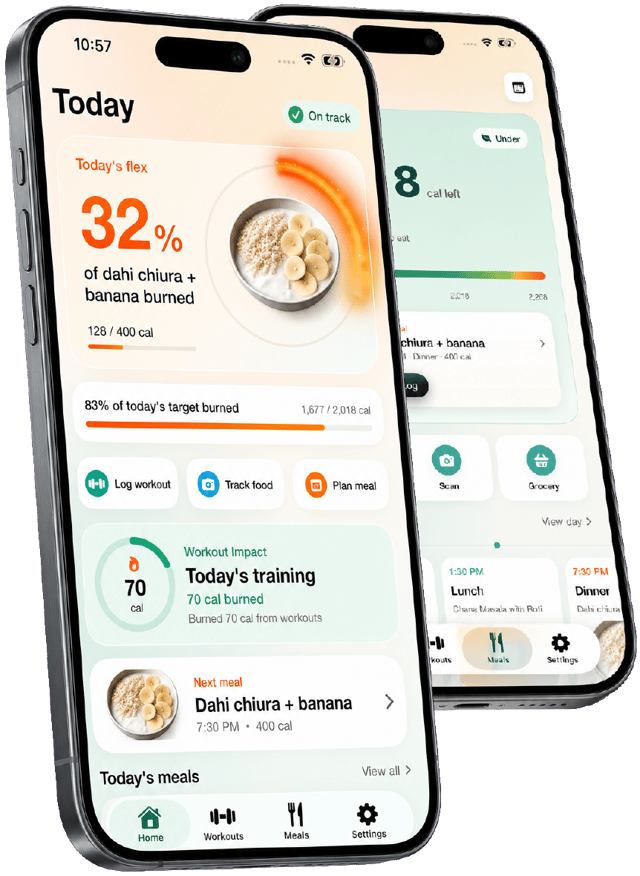
See how much of a meal a band session burned off, whether you trained in a hotel room or your living room.
Practical guidance
Tips for a resistance band plan that delivers
How to get real strength gains out of bands, not just a light sweat.
- 01 Buy a real set, not one loop
A graduated set of 3–5 bands plus a door anchor covers a genuine full-body plan; one single band limits you fast.
- 02 Anchor points matter
A sturdy door anchor or a solid pole gives you rows, presses and pulldowns; without one, you're limited to squats, lunges and glute work.
- 03 Control the return, not just the pull
Letting a band snap back defeats half its benefit — control the release just as deliberately as the working phase.
- 04 Check bands for wear regularly
Small nicks or thinning spots in a band are a snapping risk — inspect before heavy sessions and replace bands that show damage.
- 05 Combine bands with bodyweight moves
Banded glute bridges, banded push-ups and banded squats layer resistance onto bodyweight basics for more stimulus without new equipment.
- 06 Don't neglect the anti-rotation core work
Pallof presses and band-resisted rotations train core stability in a way few other portable tools do as well.

Build the plan around your week
Build my workout plan Tell Burnplate your days, equipment and level and it builds a progressive workout plan, logs every session, and connects what you burn to what you eat.
Questions
Workout planner for resistance bands: FAQ
Can resistance bands build real muscle?
Yes — research on variable resistance training shows bands can produce meaningful strength and muscle gains, particularly for beginners and intermediates, since the key driver is progressive overload, which bands provide through resistance level, length and reps.
What is a good beginner workout with resistance bands?
A good beginner resistance band workout plan trains the whole body 3–4 times a week with a band squat, chest press, row and glute bridge, at 3 sets of 15 reps, progressing to a heavier band once the current one feels easy.
How many resistance bands do I need to start?
A set of 3–5 loop bands in increasing resistance, plus a door anchor for a long tube band, covers a full beginner-to-intermediate program. Start with light and medium; add heavier bands as you progress.
Are resistance bands as effective as weights?
For most fitness and strength goals, yes, especially for beginners — bands provide progressive, variable resistance that drives similar adaptations to free weights. Very advanced lifters chasing maximal strength eventually outgrow what bands alone can offer.
Are resistance bands good for beginners or older adults?
Yes — bands are lower-impact and easier to control through a full range of motion than free weights, which makes them a common choice for beginners, older adults and anyone easing back into training after time off.
Does Burnplate build workout plans using only resistance bands?
Yes — selecting resistance bands as your equipment in Burnplate's workout builder generates a plan using only band-based exercises, scaled to your days per week and experience level.
