
A butter chicken or dal makhani carries a meaningful amount of its calories from ghee, cream or oil folded into the sauce — none of which is visible the way a pat of butter on toast would be, making it easy to undercount by a lot.
Why it's different
Why Indian food tracking needs a different approach
Indian cooking is built on layering fat and spice into a dish rather than serving it on the side, which makes calorie estimation genuinely harder than a plate with clearly separated components.
150–250 extra calories a typical curry gains from tadka (oil-tempered spices) and cream or ghee finishing
1 roti ≈ 70–100 kcal depending on size and how much ghee is brushed on — easy to undercount across a meal
3–4 components in a typical Indian plate (dal, sabzi, roti/rice, curry) that each need separate portion tracking
Curry, dal and rice are often served from a shared pot rather than a pre-measured portion, which makes 'how much did I actually eat' harder to answer than with individually plated Western meals.
A 'paneer curry' can range from a light tomato-based version to a heavy cashew-and-cream one — a generic database entry for 'paneer curry' can be off by hundreds of calories depending on which version was actually cooked.
A meal with both roti and rice, or multiple rotis, adds up carbs faster than tracking either alone would suggest — each one needs to be counted, not just the main curry.
What it looks like
A sample day eating home-style Indian meals
Around 1,900 calories across typical home-cooked Indian meals — dal, sabzi, roti and a curry — with ghee and oil accounted for rather than assumed to be minimal.
Example day
Daily targets
calories ~1,900 adjust to your own goal — curries and ghee-finished dishes run calorie-dense
protein 90 g+ from dal, paneer, yogurt or meat curries depending on preference
carbs moderate roti and rice portions tracked together, not counted separately by habit
fiber 25 g+ dal, vegetables and whole-wheat roti contribute well here by default
A logged day
8:00 AM Masala chai + 2 vegetable parathasghee brushed on each paratha counted, not skipped 410 kcal
1:00 PM Dal, jeera rice, 1 roti, cucumber raitadal tempered with ghee is denser than it looks 620 kcal
4:30 PM Chai + 2 marie biscuitsa small, realistic mid-afternoon entry, not skipped 140 kcal
8:00 PM Paneer butter masala (moderate cream), 2 rotithe cream-and-ghee curry logged as its real calorie density 580 kcal
9:00 PM Small bowl of kheera modest dessert portion, logged rather than left out 150 kcal
How Burnplate handles it
How Burnplate handles Indian meals
Burnplate's photo logging is built to recognize mixed, sauce-based dishes rather than only clean, separated Western plates — a real advantage for Indian home cooking and restaurant meals alike.
Photo logging for curries and mixed dishes
Snap a photo of a dal, sabzi or curry, confirm what it found, and adjust for how much oil or cream the specific version used — a heavier butter chicken and a lighter tomato-based curry get tracked differently, not lumped together.
Component-by-component portioning
Log roti, rice, dal and curry as separate portions on the same plate, so a meal with 2 rotis and a side of rice gets counted accurately instead of averaged into one guess.
Search logging that recognizes Indian dish names
Search and log dishes by their actual names — dal makhani, chole, aloo gobi — rather than approximating with the closest Western dish in a generic database.
AI meal plan that can include Indian-style meals
Generate a 7-day plan that fits your calorie and protein targets around meals you'll actually cook and eat, including Indian home-style dishes if that's your preference, with a matching grocery list.
Practical guidance
Tracking tips for Indian meals
Practical habits for logging Indian food accurately without under- or overestimating.
- 01 Count the ghee and oil, not just the dish
A curry finished with a generous ghee tadka can add 100–150 calories beyond the base recipe — log it as cooked, not as a lean version.
- 02 Count every roti and rice serving separately
If you eat 2 rotis and a side of rice, log both — it's common to only track one and undercount the meal's real carb and calorie total.
- 03 Note cream- or cashew-based curries specifically
Butter chicken, korma and makhani-style curries run meaningfully higher in calories than tomato- or onion-based ones — treat them as their own category, not interchangeable.
- 04 Portion dal and sabzi by the ladle, roughly
A standard serving spoon of dal or a vegetable sabzi is a reasonable estimate when you can't measure — better than skipping the entry entirely.
- 05 Watch snacks and chai
Samosas, pakoras and sweetened chai between meals add up fast and are easy to forget when only the main meals get logged.
- 06 Log festival and restaurant meals as-is
A restaurant curry is usually richer than a home-cooked version — log it as its own entry rather than assuming it matches your usual home portion.

Track it with a photo, not a search bar
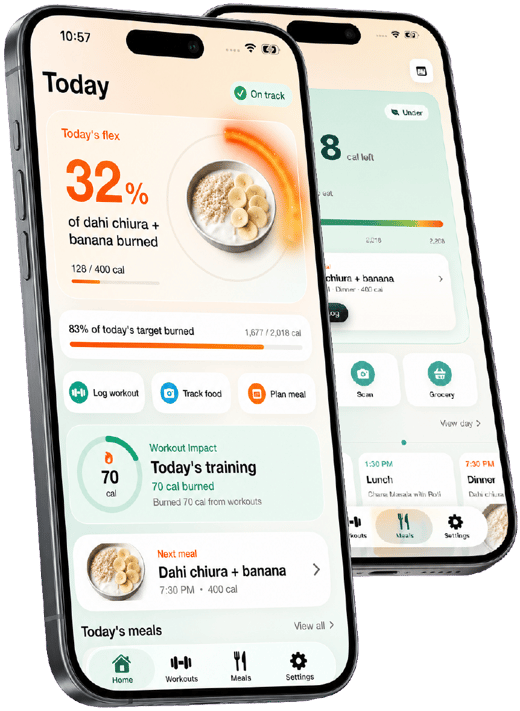
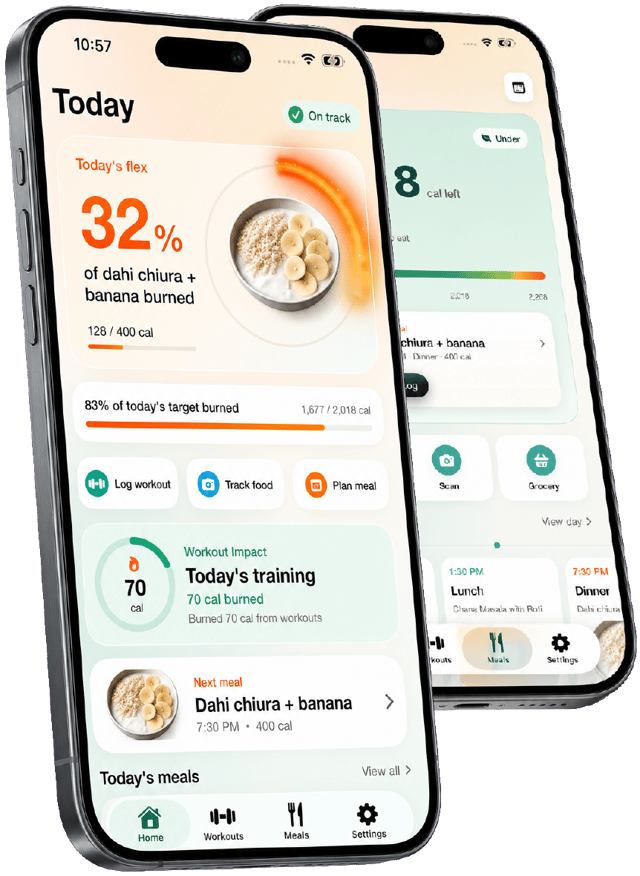
Start tracking free Burnplate sets your calorie and macro targets, logs meals from a photo, and shows how much of each meal your workouts and steps have burned off.
Questions
Calorie tracker for Indian food: FAQ
How many calories are in a typical Indian curry?
It varies enormously — a tomato-based sabzi might run 150–250 calories a serving, while a cream- or cashew-based curry like butter chicken or korma can run 350–500+ calories for the same portion size, mostly from added fat. The cooking style matters more than the dish name alone.
How many calories are in roti and rice?
A plain whole-wheat roti is roughly 70–100 calories depending on size and how much ghee is brushed on; a cup of cooked rice is roughly 200 calories. Eating both together, which is common, means counting each rather than picking one to represent the meal.
Is Indian food hard to track for weight loss?
It's harder than tracking a plate with separated components, mainly because oil and ghee are cooked into dishes rather than added visibly. It's very trackable with attention to how a dish was actually prepared — home-style with less oil, or restaurant-style with more.
Can I lose weight eating dal, roti and curry regularly?
Yes — these are real foods that fit a calorie target the same as any other cuisine. The key is portioning rice and roti deliberately, choosing lighter curry preparations more often than cream-heavy ones, and tracking ghee and oil rather than assuming a dish is lean because it's home-cooked.
Does Burnplate recognize Indian dishes by photo?
Yes. Snap a photo of a curry, dal or thali-style plate, confirm what it found, and adjust the portion and richness to match what was actually cooked — useful for mixed, sauce-based Indian dishes that don't separate cleanly into single ingredients.
What's a realistic calorie count for a home-cooked Indian meal?
A typical home-style plate with dal, a vegetable sabzi, 1–2 rotis and rice lands somewhere around 500–700 calories, depending on portion size and how much ghee or oil was used in preparation. A richer curry-based dinner can run higher.
