The triceps make up roughly two-thirds of upper-arm size, yet most people default to curls out of habit. A plan built around pressdowns, extensions and close-grip pressing grows arms faster than biceps work alone.
Why it's different
Why most arm training stalls
Arms are the most over-trained and under-programmed muscle group at once — plenty of curls, not enough structure. A few physiology basics change that.
10–20 sets weekly hard sets per arm is the volume range most hypertrophy research supports
2×/week training each arm twice weekly beats one heavy session, since small muscles recover fast
8–15 reps the rep range that most reliably builds visible size in biceps and triceps
Ten to twenty hard sets per arm per week, spread across two sessions, drives more growth than one long arm day. Splitting the work also means less soreness getting in the way of the rest of your training.
Biceps and triceps are small enough to bounce back in about 48 hours, which is why twice-weekly frequency beats training them once and maxing out. A push/pull or full-body split makes that frequency easy to fit in.
Heavy curls and skull crushers done with momentum put a lot of strain on the elbow tendons. Controlled tempo and a full range of motion build more muscle with less joint wear than swinging the weight.
What it looks like
A sample week for building arms
Arms grow fastest inside a plan that still trains the whole body, not four days of curls. Two of the sessions below add focused arm supersets on top of a push day and a pull day.
Example week
4 Days/week45–55 min Session lengthBeginner–intermediate LevelDumbbells, bar, cables Equipment
Monday Push + triceps Bench press 4×8 · Overhead press 3×10 · Triceps pressdown 3×12 · Overhead extension 3×12
Tuesday Legs Squat 4×8 · Romanian deadlift 3×10 · Walking lunge 3×12 · Calf raise 3×15
Wednesday Recovery 20–30 min walk · light stretching
Thursday Pull + biceps Row 4×8 · Lat pulldown 3×10 · Barbell curl 3×12 · Hammer curl 3×12
Friday Full body Deadlift 3×6 · Push-up 3×12 · Face pull 3×15
Saturday Arm finisher Close-grip bench 3×10 · Incline curl 3×12 · Rope pressdown 3×15 · Cable curl 3×15
Sunday Rest Full rest or light activity
How Burnplate handles it
How Burnplate builds an arm-focused plan
Burnplate turns the structure above into a plan you don't have to design yourself, then tracks whether it's working.
A plan built around your split
Tell Burnplate you want to prioritize arms and it builds a progressive plan around your days per week, equipment and level, with the extra volume placed where it counts.
Every set, rep and weight logged
Log each session and Burnplate keeps your workout history, so you can see exactly when it's time to add weight and when a lift has stalled.
Protein targets that support growth
Burnplate sets a protein target from your body and goal and shows your daily balance, so the muscle you're training has what it needs to recover.
The burn bar connects the session to food
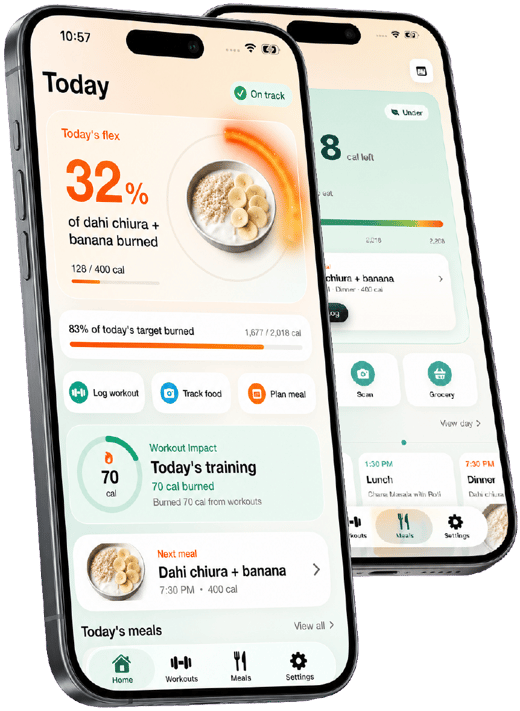
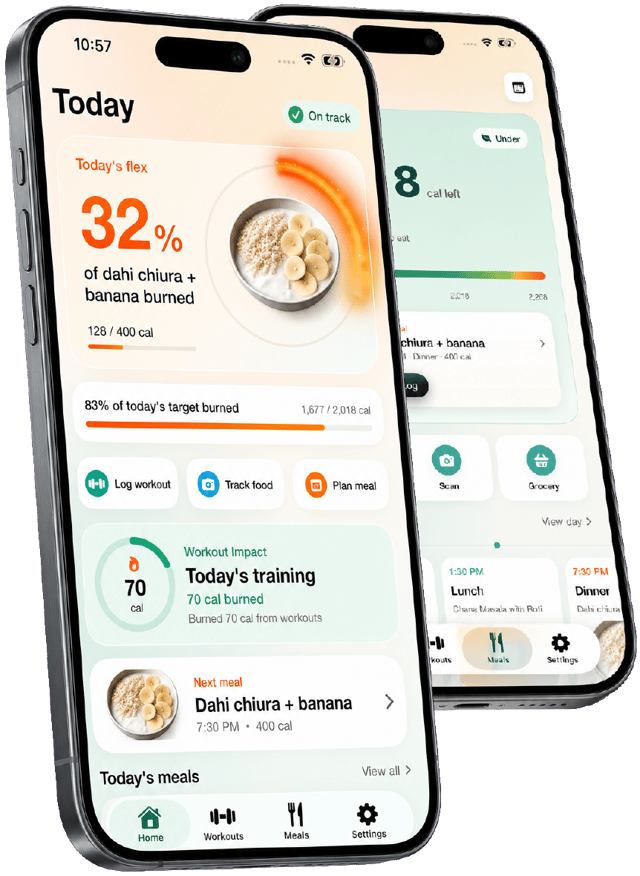
Log the workout and Burnplate's burn bar shows how much of your day's calories that session accounted for, tying the training to what you ate.
Practical guidance
Tips for a faster-growing arm workout
Small programming choices that separate arms that grow from arms that just get sore.
- 01 Train triceps as hard as biceps
Most people default to curls. Match your triceps volume set for set and the whole arm grows faster.
- 02 Use a full range of motion
Half reps with heavier weight build less muscle than full-range reps with a weight you actually control.
- 03 Slow the lowering phase down
A 2–3 second eccentric on curls and extensions adds tension time without adding weight.
- 04 Don't skip forearms
Wrist curls and farmer carries round out the lower arm and improve your grip on every other lift.
- 05 Give each arm 48 hours to recover
Soreness is a signal, not a badge — hit each arm twice a week, not every single day.
- 06 Track the number, not the pump
A pump fades within the hour; logged sets and added weight are what tell you the plan is working.

Build the plan around your week
Build my workout plan Tell Burnplate your days, equipment and level and it builds a progressive workout plan, logs every session, and connects what you burn to what you eat.
Questions
Workout planner for arms: FAQ
What is the best workout for arms?
The best arm workout balances biceps and triceps rather than favoring curls, since the triceps make up most of upper-arm size. Ten to twenty hard sets per arm per week, split across two sessions and mixing pressing with curling movements, is the range most hypertrophy research supports.
How often should I train arms for growth?
Twice a week beats once. Biceps and triceps are small muscles that recover within about 48 hours, so hitting them again before that window closes leaves growth on the table. A push/pull or full-body split makes twice-weekly arm work easy to schedule.
Can I build arms without weights?
Yes, to a point. Push-ups, dips, chin-ups and resistance bands build real arm size, especially early on, but progress slows once bodyweight strength outpaces the challenge. Dumbbells or bands with adjustable resistance let you keep adding load as you get stronger.
Why aren't my arms growing even though I train them?
The two most common reasons are too little weekly volume and training biceps far harder than triceps. If you're doing one arm day with a handful of curls, doubling your frequency and adding triceps-focused work usually restarts progress within a few weeks.
How long does an arm workout plan take to show results?
Visible size usually takes 8–12 weeks of consistent training with progressive overload, though strength improves sooner. Nutrition matters as much as the workout — a calorie intake that supports muscle repair, not a deficit that fights it, speeds the process.
Do I need a separate plan just for arms?
Not really — arms grow fastest as part of a plan that also trains your back, chest and legs, since compound lifts contribute real arm work too. Burnplate builds that full plan and layers extra arm volume on top of it.
