
Resting metabolic rate declines gradually with age, mostly because of lost muscle mass rather than age itself. Total calorie needs drop, but the need for nutrient-dense food doesn't shrink at the same rate.
Why it's different
Why senior calorie needs are their own category
A calculator built for a 35-year-old assumes stable muscle mass and predictable appetite. Neither holds reliably after 65 — which changes both how many calories are needed and where they should come from.
~1,800 kcal/day estimate for a moderately active 70-year-old woman
1–1.2 g/kg protein target for seniors — well above the standard 0.8 g/kg RDA
25–30 g fiber a day most guidelines recommend for gut and heart health
Sarcopenia — age-related muscle loss — accelerates after 60 and directly increases protein needs even as total calories fall. That's the opposite of what most people assume about eating less as they age.
Reduced taste and smell sensitivity, medication side effects and slower digestion commonly reduce appetite before calorie needs actually drop, risking under-eating well before it's obvious.
With a smaller calorie budget, every meal has to work harder — protein, fiber, calcium and B vitamins need to show up in less food than they did at 40.
What it looks like
A sample day for a moderately active senior
Built around roughly 1,800 calories for a moderately active 70-year-old. Men and more active seniors typically run higher.
Example day
Daily targets
Calories ~1,800 Estimate for a moderately active 70-year-old woman; men and more active seniors run higher
Protein 1.0–1.2 g/kg Above the standard 0.8 g/kg RDA — helps offset age-related muscle loss
Fiber 25–30 g Supports digestion and heart health; many older adults fall short
Vitamin B12 & D priority nutrients Absorption declines with age — fortified foods or a supplement often needed
Fluids ~64 oz Thirst cues weaken with age, so steady sipping matters more than feeling thirsty
A logged day
7:30 AM Greek yogurt, berries, walnutsProtein-forward start 340 kcal
10:30 AM Hard-boiled egg and an orangeSmall, easy-to-digest snack 160 kcal
12:30 PM Salmon, quinoa, steamed greensProtein plus omega-3s at lunch 480 kcal
3:30 PM Cottage cheese and a peachAnother protein touchpoint 180 kcal
6:30 PM Chicken thigh, sweet potato, saladBalanced, easy-to-chew dinner 460 kcal
Evening Milk or a fortified alternativeCalcium and vitamin D before bed 170 kcal
How Burnplate handles it
How Burnplate fits a senior's routine
Burnplate isn't a medical device and doesn't set clinical targets. What it does is turn a body-based calorie and protein target into simple daily logging.
Targets built from your body
Calorie and protein targets are set from your own body, goal and activity level, rather than a flat age-based estimate.
Photo logging beats a food list
Snap a photo of a plate instead of typing a search — faster and easier than a manual food diary.
Protein tracked front and center
Macro targets show protein alongside calories, so it's easy to see when a day is falling short without doing the math yourself.
See what a walk added to the day
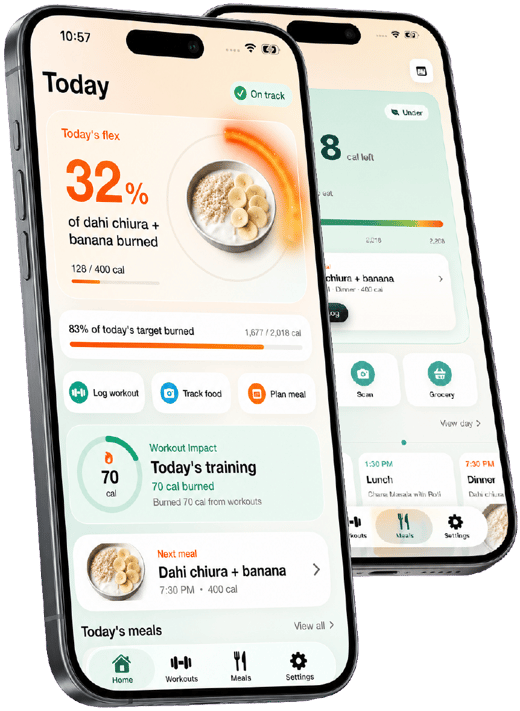
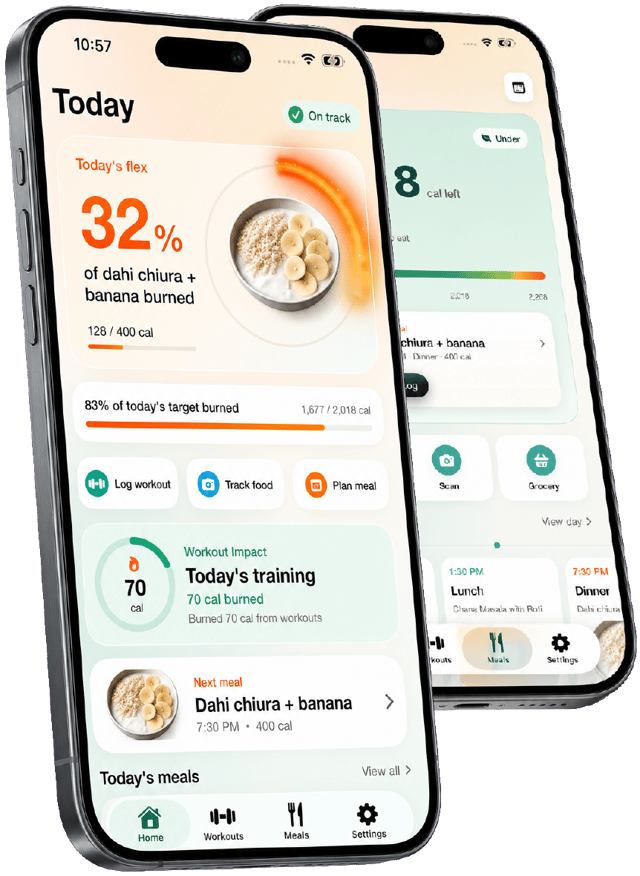
The burn bar shows how much of a meal a walk or light activity has offset — a small, visible reason to take the stroll.
Practical guidance
Practical tips for eating well as a senior
Small habits that protect both calorie intake and muscle mass without requiring a diet mentality.
- 01 Put protein on every plate
Spreading protein across three or more meals uses it more efficiently than loading it into one big dinner.
- 02 Don't skip meals to 'save' calories
Under-eating is a bigger risk than over-eating for most seniors — skipped meals rarely get made up later in the day.
- 03 Strength training protects the muscle
Even light resistance work two or three times a week helps the body use extra protein to maintain muscle, not just replace it.
- 04 Watch for quiet weight loss
Unintentional weight loss in older adults is a signal worth flagging to a doctor, not something to assume is healthy.
- 05 Make low-energy days easy
Keep a few no-prep, high-protein options on hand — yogurt, canned fish, eggs — for days when cooking feels like too much.
- 06 Check labels for sodium too
Sodium affects blood pressure more directly than calories do for many older adults, and it's easy to miss in packaged food.

Track it with a photo, not a search bar
Start tracking free Burnplate sets your calorie and macro targets, logs meals from a photo, and shows how much of each meal your workouts and steps have burned off.
Questions
Calorie tracker for seniors: FAQ
How many calories should a 70-year-old eat?
A moderately active 70-year-old woman typically needs around 1,800 calories a day, and a moderately active man closer to 2,200, though activity level and muscle mass shift this significantly in either direction. These are starting estimates — tracking a few weeks of actual intake against weight trend refines the real number.
Do calorie needs really drop with age?
Yes, mainly because resting metabolic rate declines as muscle mass is lost and activity often decreases. The drop is gradual rather than sudden, which is why calorie needs at 70 are noticeably lower than at 40 even with a similar lifestyle.
How much protein do seniors need?
Most guidance for older adults suggests 1.0–1.2 g of protein per kg of body weight, well above the general adult RDA of 0.8 g/kg. The higher target helps counter age-related muscle loss, and needs can run even higher for seniors doing regular resistance training.
Is losing weight healthy for older adults?
It depends on starting weight and health status — intentional weight loss can help some seniors, but unintentional loss is often a warning sign of an underlying issue, appetite loss or inadequate protein. Any weight-loss goal for an older adult should be discussed with a doctor rather than pursued on assumption.
Can a calorie calculator account for medications?
Not directly — medications can affect appetite, taste, digestion and metabolism in ways a standard calculator doesn't model. Those effects are worth discussing with a doctor or pharmacist, and adjusting intake based on actual weight trend rather than the calculator number alone.
Does Burnplate work for tracking meals as a senior?
Yes — it sets calorie and protein targets from your body and activity, lets you log by photo or search, and shows protein alongside calories so it's easy to see when a day is falling short on the nutrient that matters most at this age.
