Five days lets you train each major muscle group twice a week instead of once, which research consistently links to better strength and size gains than a single weekly hit — as long as total volume stays reasonable.
Why it's different
Why a 5 day split needs more planning than a 3 day one
Adding training days doesn't just mean more work — it means the same weekly volume has to be divided more carefully, or you end up training tired muscles instead of fresh ones.
10–20 sets weekly working sets per major muscle group is the range most hypertrophy research supports
48–72 hrs recovery a trained muscle group typically needs before the next hard session
45–60 min a realistic session length that keeps 5 days a week sustainable for months, not weeks
A common mistake is stacking push-heavy days back to back, or hitting shoulders on both a 'push' day and a 'shoulders' day two days later. The muscle never gets the 48–72 hours it needs, and strength stalls instead of improving.
Most 3 and 4 day plans have no room for extra work on lagging areas. The fifth day is where you can add calves, core, arms or mobility work without cutting into your main lifts.
A well-designed 5 day plan is worthless if you can only manage it for two weeks. Session length and exercise selection matter less than whether the plan fits your actual week.
What it looks like
A sample 5 day workout plan
A push/pull/legs base with two focused days added on top — enough frequency for real progress without repeating a muscle group too soon.
Example week
5 Days/week45–60 min Session lengthBeginner–intermediate LevelFull gym Equipment
Monday Push Bench press 4×8 · Overhead press 3×10 · Incline dumbbell press 3×10 · Triceps pushdown 3×12
Tuesday Pull Deadlift 3×6 · Lat pulldown 4×10 · Seated cable row 3×10 · Barbell curl 3×12
Wednesday Legs Back squat 4×8 · Romanian deadlift 3×10 · Leg press 3×12 · Standing calf raise 3×15
Thursday Upper accessory Incline machine press 3×10 · Cable fly 3×12 · Face pull 3×15 · Curl + pushdown superset 3×12
Friday Lower + core Front squat 3×8 · Walking lunge 3×12/leg · Hip thrust 3×10 · Plank 3×45s
How Burnplate handles it
How Burnplate handles a 5 day training week
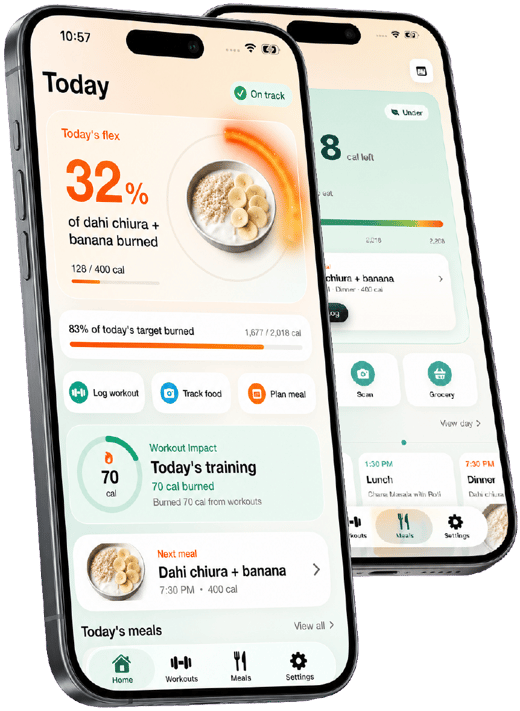
Burnplate builds the split around your actual schedule and keeps your food matched to a week with more training days than most plans assume.
A plan built around 5 days, not 3
Tell Burnplate you're training 5 days a week and it builds a progressive plan that spaces muscle groups correctly instead of guessing at a generic template.
Session logging that takes seconds
Log sets and reps as you go, and Burnplate keeps your workout history so you can see whether your top sets are actually trending up week to week.
Calories that scale with 5 sessions
Training five days a week burns meaningfully more than three. Burnplate adjusts your daily calorie and protein targets so you're not under-fueling a heavier week.
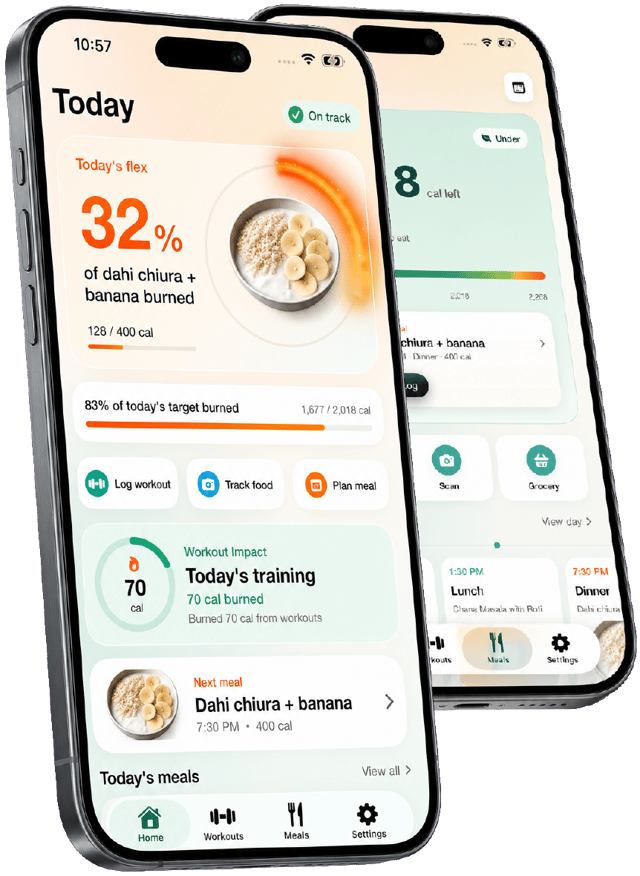
The burn bar shows the week adding up
Each session's burn shows against your day's food, so by Friday you can see how five days of training actually offset what you've eaten — not just guess at it.
Practical guidance
Tips for making a 5 day split work long-term
The details that decide whether a 5 day workout plan lasts a year or gets abandoned in a month.
- 01 Protect one full rest day
Even on a 5 day split, two consecutive rest days beats scattering single days off — your nervous system needs at least one longer break.
- 02 Put your hardest day where energy is highest
Most people recover best from the weekend, so put squats or deadlifts on the first training day, not the last.
- 03 Keep accessory work in reserve
On a 5 day split, accessory exercises don't need to be pushed to failure every session — save the hardest effort for your main lifts.
- 04 Sleep is non-negotiable at this frequency
Five sessions a week without 7+ hours of sleep is the fastest way to stall progress and start missing days.
- 05 Fuel the day before a heavy lift
Carbs the evening before a squat or deadlift day noticeably improve how the session feels — don't train your hardest day underfed.
- 06 Swap, don't skip, when life gets busy
If a day gets cut short, do a shorter version of that day's main lift rather than skipping it entirely — consistency in the split matters more than any single session's length.

Build the plan around your week
Build my workout plan Tell Burnplate your days, equipment and level and it builds a progressive workout plan, logs every session, and connects what you burn to what you eat.
Questions
Workout planner for 5 days a week: FAQ
Is a 5 day workout split good for building muscle?
Yes, for most people it's one of the more effective structures, because it allows each muscle group to be trained twice a week with adequate recovery between sessions. The key is dividing volume so you're not hitting the same muscles on back-to-back days.
What's the best 5 day workout plan for beginners?
Beginners generally do better starting with 3–4 days and progressing to 5 once basic movement patterns feel comfortable. If you do start at 5 days, keep sessions to 45 minutes and prioritize compound lifts over isolation work.
How do I structure a 5 day split by muscle group?
A push/pull/legs base covering three days, followed by an upper-body accessory day and a lower-body plus core day, spreads volume evenly and keeps at least 48 hours between sessions that stress the same muscles.
Is training 5 days a week too much?
Not for most healthy adults, as long as session length and intensity are managed and at least one full rest day is included. A well-built workout plan for 5 days a week trains each muscle group twice, not five times, so total stress per muscle stays reasonable.
What if I miss a day on a 5 day split?
Shift the remaining days back rather than skipping the missed workout entirely, or simply drop that day's session and pick up the split where you left off the following week. Missing one day occasionally won't undo progress.
Do I need a full gym for a 5 day workout plan?
It helps for progressive overload on big lifts, but a 5 day split can also be built with dumbbells, bands or bodyweight movements — the structure of spacing muscle groups matters more than the specific equipment.
