
Falling estrogen shifts fat storage from hips and thighs toward the abdomen — visceral fat can increase even when body weight barely changes, which is part of why the mirror and the scale disagree so often at this stage.
Why it's different
Why the numbers change after 50
The same eating pattern that maintained weight at 40 often doesn't at 55 — not because willpower changed, but because the hormonal environment did. Fat storage, muscle retention and bone density all shift together.
~1,600 kcal/day estimate for a moderately active woman over 50
1.2–1.6 g protein per kg body weight — above typical adult guidance as estrogen drops
1,000 mg daily calcium target after 50, alongside vitamin D, for bone density
Age-related muscle loss speeds up through the menopause transition, and less muscle means a lower resting metabolic rate — one of the main reasons maintenance calories drop even without eating more.
Estrogen protects bone density, so its decline raises the stakes on calcium and vitamin D intake in a way that wasn't as urgent a decade earlier.
Hot flashes and disrupted sleep common in this transition affect appetite-regulating hormones, which can shift hunger and cravings independent of anything on a food log.
What it looks like
A sample day for a woman over 50
Built around roughly 1,600 calories for a moderately active woman navigating the menopause transition. Adjust for your own activity level.
Example day
Daily targets
Calories ~1,600 Maintenance estimate for a moderately active woman over 50; adjust to your activity
Protein 1.2–1.6 g/kg Above general adult guidance — the biggest lever against age-related muscle loss
Calcium 1,000 mg Rises to 1,200 mg after 51 per most guidelines
Vitamin D 600–800 IU Supports the calcium your bones need to actually use
Fiber 25 g Supports metabolic and heart health through the transition
A logged day
7:00 AM Eggs, avocado, whole-grain toastProtein-forward, keeps mid-morning hunger away 400 kcal
10:30 AM Cottage cheese and a pearSmall protein touchpoint 170 kcal
12:30 PM Grilled chicken salad, olive oil dressingProtein and healthy fat at lunch 420 kcal
3:30 PM Greek yogurt and almondsCalcium and protein together 190 kcal
6:30 PM Salmon, farro, roasted vegetablesOmega-3s and fiber at dinner 440 kcal
How Burnplate handles it
How Burnplate fits this stage
Burnplate doesn't treat 55 like 30. Targets and tracking are built to reflect what's actually changing, not a formula that ignores it.
Targets that account for the shift
Calorie and macro targets are calculated from your body, goal and activity — with protein weighted to help counter age-related muscle loss.
Photo logging that keeps up with a busy day
Log a meal from a photo in seconds instead of searching a food database — built to actually stick past the first week.
Strength training synced to the tracker
Burnplate's workout planner builds a progressive strength plan around your days and equipment, logged right alongside your food.
One space to see food and training together
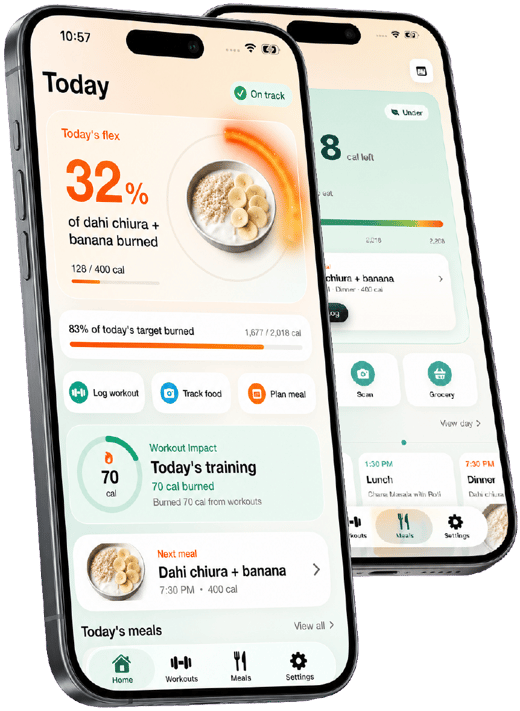
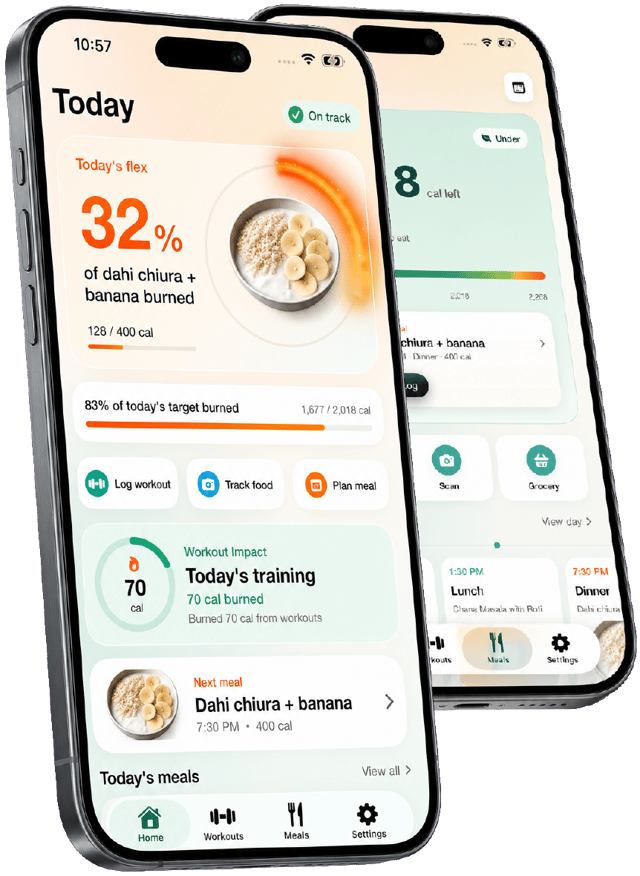
The burn bar shows how much of a meal your training and steps have offset, connecting the two habits that matter most now.
Practical guidance
Practical tips for this transition
Habits with the most research behind them for managing weight and body composition after 50.
- 01 Prioritize protein at breakfast
A protein-forward first meal reduces mid-morning hunger and makes it easier to hit the day's total without much effort.
- 02 Add resistance training, not just cardio
Strength work is the most direct counter to the muscle loss driving the metabolic slowdown — cardio alone doesn't address it.
- 03 Don't chase your 30s calorie targets
Eating like you did at 30 while your maintenance calories have genuinely dropped is the most common driver of slow weight gain at this stage.
- 04 Watch calcium and vitamin D too
Bone density work happens quietly — it's easy to hit a calorie target while missing these two entirely.
- 05 Expect the scale to lag the mirror
Body composition can shift — less muscle, more visceral fat — before the number on the scale moves at all.
- 06 Sleep is part of the equation
Poor sleep from hot flashes affects hunger hormones the next day; treating sleep as a variable, not background noise, helps the rest of the plan work.

Track it with a photo, not a search bar
Start tracking free Burnplate sets your calorie and macro targets, logs meals from a photo, and shows how much of each meal your workouts and steps have burned off.
Questions
Calorie tracker for women over 50: FAQ
How many calories should a woman over 50 eat?
A moderately active woman over 50 typically needs around 1,600–1,800 calories a day to maintain weight, though this varies with muscle mass, height and activity level. It's usually lower than a woman's maintenance calories in her 30s or 40s, even with the same habits, because of the metabolic shift through menopause.
Why is it harder to lose weight after 50?
Declining estrogen speeds up muscle loss, which lowers resting metabolic rate, while fat storage shifts toward the abdomen regardless of total weight. The same calorie deficit that worked at 35 often needs to be paired with strength training and higher protein to produce results after 50.
How much protein should a woman over 50 eat?
Most guidance suggests 1.2–1.6 g of protein per kg of body weight, meaningfully above the standard adult RDA of 0.8 g/kg. The higher target helps counter the muscle loss that accelerates through the menopause transition, especially when paired with resistance training.
Does menopause really slow metabolism?
Indirectly, yes — falling estrogen accelerates muscle loss, and less muscle mass means a lower resting metabolic rate. It's not that menopause itself burns fewer calories directly, but the downstream effect on body composition genuinely lowers maintenance calories over time.
Should I eat fewer calories than I did at 30?
Likely yes, to maintain the same weight, simply because maintenance calories tend to decline with age-related muscle loss. The better fix is usually adding strength training to preserve muscle rather than cutting calories further and further.
Can Burnplate help with weight loss after 50?
Yes — it sets calorie and protein targets from your body and activity, builds a strength-training plan through the workout planner, and shows how training affects your day through the burn bar, so food and exercise aren't tracked separately.
