Without a full dumbbell rack, adding weight every week isn't always an option. Home plans progress through tempo, range of motion, pause reps, single-limb variations and added reps instead.
Why it's different
Why a home workout plan needs its own design
A gym plan assumes a squat rack, a cable stack and a wall of dumbbells. A home plan has to build real strength and conditioning from a much smaller equipment pool — which changes the exercise selection, not just the setting.
6×6 ft of clear floor space is enough for the large majority of home strength and cardio moves
3–4×/week full-body sessions is the most efficient split when you're not swapping equipment between areas
20–40 min is a realistic session length that a home routine can sustain long-term without excuses creeping in
With limited equipment and no separate stations, hitting every major muscle group 2–3 times a week in full-body sessions is more efficient than a 5-day split built for a gym's layout.
Big barbell lifts need a rack and plates; most of their benefit is replicable at home with goblet squats, single-arm presses and rows, floor presses and hip hinges that need a fraction of the footprint.
The upside of training at home is zero commute and zero waiting for equipment — which means more consistent frequency, and frequency beats almost any other single variable for long-term progress.
What it looks like
A sample home week
Built around one pair of adjustable dumbbells, a mat and a resistance band — the equipment most home setups already have or can add cheaply.
Example week
4 Days/week35 min Session lengthBeginner–intermediate LevelDumbbells + band Equipment
Monday Full body A Goblet squat 4×10 · Single-arm row 3×10/side · Floor press 3×10 · Glute bridge 3×15
Tuesday Conditioning 20 min brisk walk or bodyweight circuit: burpees, mountain climbers, jumping jacks × 4 rounds
Wednesday Full body B Bulgarian split squat 3×8/side · Band pull-apart 3×15 · Overhead press 3×10 · Dead bug 3×10/side
Thursday Rest or mobility Hip flexor stretch, thoracic rotations, 10 min easy walk
Friday Full body C Romanian deadlift 3×10 · Push-up 3×AMRAP · Reverse lunge 3×10/side · Plank 3×30 sec
Saturday Conditioning 25 min interval walk/jog or bodyweight EMOM
Sunday Rest Full rest
How Burnplate handles it
How Burnplate builds a home plan
Burnplate's workout builder asks what you actually have before it writes a single exercise — so the plan it hands you is one you can do today, not one that assumes a gym membership.
A plan built around your real equipment
Tell Burnplate what you own — bodyweight only, a couple of dumbbells, a bench — and your days per week and level, and it builds sessions that only use what you have.
Session and set logging in seconds
Log sets, reps and weight as you go so you can see the same lifts getting easier or heavier over weeks, even without gym equipment to compare against.
Calories and macros without a food scale
Snap a photo of your meal or search and log it; Burnplate estimates calories and macros so nutrition keeps pace with a home training habit.
See the workout's payoff on your plate
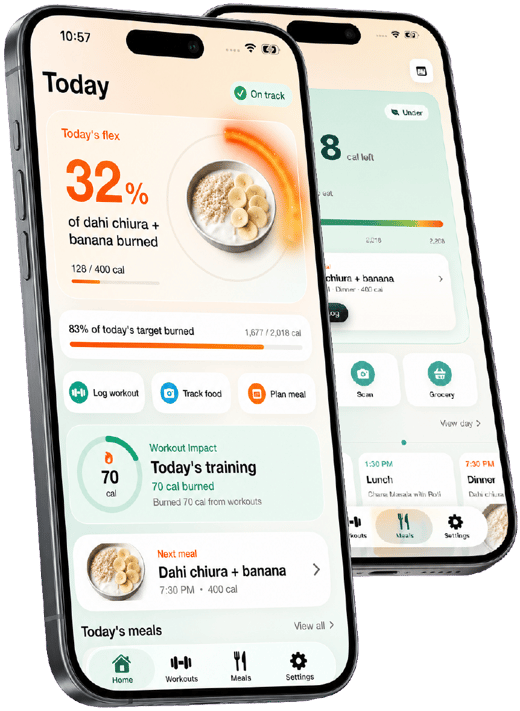
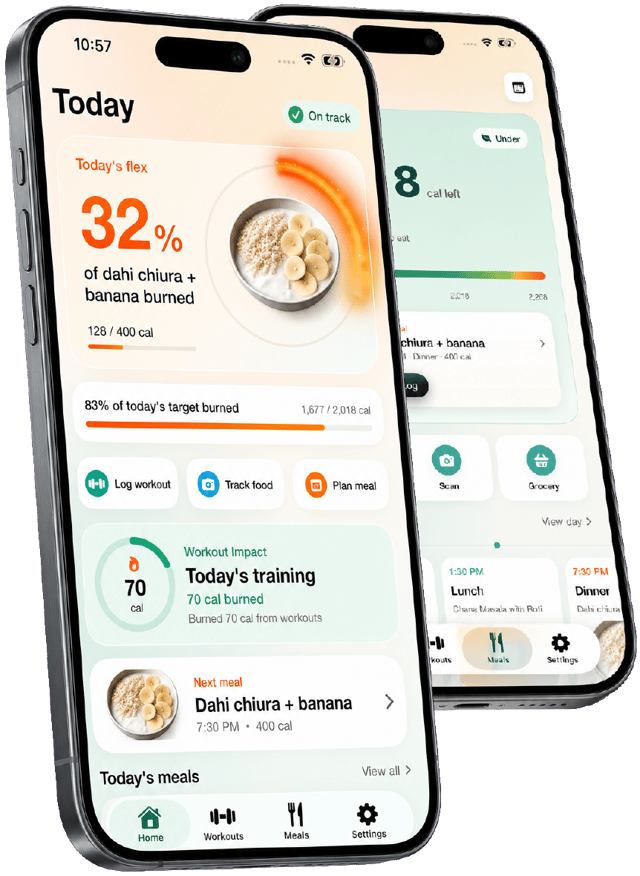
The burn bar shows how much of a meal your session covered — a visible link between the living-room workout and the food, without needing a gym check-in to feel the connection.
Practical guidance
Tips for a home workout plan that actually sticks
The small setup and habit choices that make training at home sustainable past week two.
- 01 Claim a fixed spot
Even a 6×6 ft corner that's always ready removes the setup friction that kills most home routines within a month.
- 02 Buy adjustable over fixed
One pair of adjustable dumbbells covers a far wider range than several fixed pairs and takes up a fraction of the space.
- 03 Schedule it like an appointment
Without a gym trip as a cue, home sessions need their own slot on the calendar or they quietly slide.
- 04 Use a doorway anchor for bands
A $15 door anchor turns a resistance band into rows, presses and pull-aparts — cheap coverage for pulling patterns dumbbells don't do well.
- 05 Film your form occasionally
Without a mirror wall, a quick phone video once in a while catches form drift before it becomes a habit.
- 06 Layer in conditioning on off days
Bodyweight circuits or a brisk walk on non-lifting days keep the week active without needing any extra gear.

Build the plan around your week
Build my workout plan Tell Burnplate your days, equipment and level and it builds a progressive workout plan, logs every session, and connects what you burn to what you eat.
Questions
Workout planner for working out at home: FAQ
What is a good workout routine for beginners at home?
A good beginner home routine trains the whole body 3 times a week with basic patterns — a squat, a push, a pull and a hinge — using bodyweight or one set of dumbbells, with a rest or light walking day between sessions. Add reps before adding difficulty in the first month.
Can I build muscle with a home workout plan?
Yes. Muscle growth responds to progressive overload — more reps, more resistance, better technique or slower tempo over time — none of which require a gym. Bodyweight and dumbbell training can build meaningful muscle, especially for beginners and intermediates.
How much equipment do I actually need for a home workout plan?
One pair of adjustable dumbbells and a resistance band cover most of a well-rounded plan. Bodyweight alone works too, especially early on; a pull-up bar and a few dumbbells are the next upgrades worth making.
How many days a week should a home workout routine be?
Three to four full-body sessions a week is the most efficient home split, since it hits every muscle group repeatedly without needing separate equipment stations. Add light cardio or a walk on the days between.
Does Burnplate work without a gym membership?
Yes. Burnplate's workout builder asks about your equipment and space before writing your plan, so a bodyweight-only or dumbbells-only setup gets a plan designed for it, not a gym routine with items crossed out.
How do I know a home workout plan is working without gym machines to compare?
Track the same numbers a gym plan would: reps at a given weight, how many rounds you complete, or how a set feels. Burnplate logs sets, reps and weight over time so progress is visible even without machine stacks to reference.
