Training frequency research consistently favors hitting a muscle group twice weekly over once — an upper/lower split achieves that with just 4 days, without the complexity of push/pull/legs.
Why it's different
Why an upper/lower split is such a durable structure
It sits in a practical middle ground — more frequency than a full-body-only plan, less daily commitment than a 5 or 6 day body-part split.
10–20 sets weekly sets per muscle group most hypertrophy research supports — upper/lower spreads this across 2 sessions
48–72 hrs typical spacing between the two upper (or two lower) days in a standard 4-day week
50–60 min a realistic session length covering 5–6 exercises per day at working intensity
Four days fits comfortably into most weeks with a rest day between sessions when needed, and it's easy to compress to 3 days (upper, lower, full body) if a week gets busy.
Splitting the whole body into two halves means each session covers fewer muscle groups than a full-body day, which keeps individual workouts from running too long.
Beginners can run it with lighter loads and simpler exercises; advanced lifters can add sets, exercises or a 5th day without changing the underlying structure.
What it looks like
A sample upper/lower workout plan
Four sessions a week — two upper, two lower — spaced so each half of the body gets roughly equal recovery time before its next session.
Example week
4 Days/week50–60 min Session lengthBeginner–intermediate LevelFull gym Equipment
Monday Upper A Bench press 4×8 · Barbell row 4×8 · Overhead press 3×10 · Lat pulldown 3×10 · Triceps pushdown 3×12
Tuesday Lower A Back squat 4×8 · Romanian deadlift 3×10 · Leg press 3×12 · Calf raise 3×15
Wednesday Rest Full rest or light walking
Thursday Upper B Incline dumbbell press 4×10 · Seated cable row 4×10 · Lateral raise 3×15 · Face pull 3×15 · Barbell curl 3×12
Friday Lower B Deadlift 3×6 · Front squat 3×8 · Walking lunge 3×12/leg · Leg curl 3×12
How Burnplate handles it
How Burnplate handles an upper/lower plan
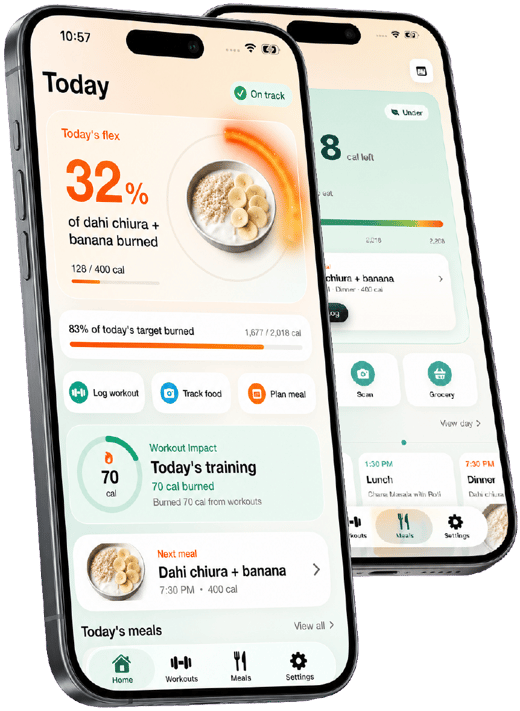
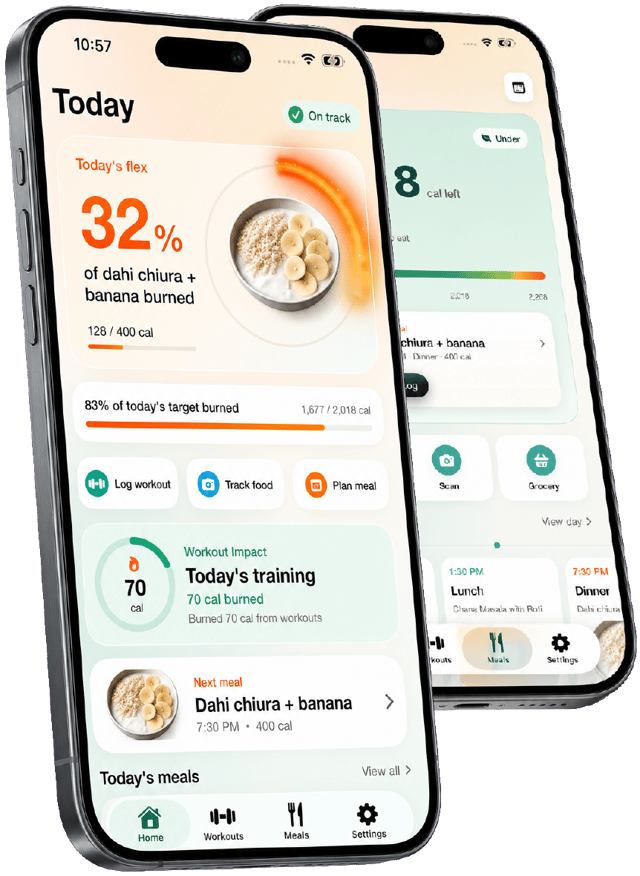
Burnplate builds the 4-day structure around your schedule and keeps the plan progressing without manual spreadsheet tracking.
A plan built around 4 days, scalable to 3 or 5
Tell Burnplate how many days you have and it builds an upper/lower plan sized to fit, with a clear path to add or drop a day later.
Session logging that separates upper and lower history
Log each session and see your upper and lower body progress tracked separately, making it easy to spot if one half is lagging.
Calorie and protein targets matched to training days
Burnplate sets your daily targets from your body, goal and how often you're training, so a 4-day plan is fueled appropriately.
The burn bar shows each session's contribution
Whether it's an upper or lower day, the burn bar reflects how much of your day's food that session offset.
Practical guidance
Tips for getting the most from an upper/lower split
Practical guidance for running a 4-day upper/lower workout plan well.
- 01 Keep at least one rest day between lower sessions
Squats and deadlifts create more systemic fatigue than most upper-body work — don't schedule both lower days back to back if avoidable.
- 02 Prioritize compound lifts early in each session
Bench, squat, row and deadlift variations should come first while you're freshest; accessory work can flex later in the session.
- 03 Don't duplicate exercises across A and B days
Using different variations (incline vs. flat press, front vs. back squat) on the two passes covers more of each muscle and reduces staleness.
- 04 Match rep ranges to your main goal
Lean toward 5–8 reps on main lifts for strength focus, or 8–12 for more muscle-building emphasis — an upper/lower split accommodates either.
- 05 Use the rest day for mobility, not another workout
The single rest day in a 4-day week matters for recovery — light stretching or walking is fine, but avoid another hard session.
- 06 Reassess every 6–8 weeks
If a lift stalls for 3+ weeks in a row, that's the signal to adjust volume, add a deload week, or swap the exercise.

Build the plan around your week
Build my workout plan Tell Burnplate your days, equipment and level and it builds a progressive workout plan, logs every session, and connects what you burn to what you eat.
Questions
Workout planner for an upper/lower split: FAQ
What is an upper lower split?
It's a training structure that divides the body into two halves — upper body and lower body — trained on separate days. A standard 4-day version trains each half twice a week for solid recovery and frequency.
Is an upper lower workout plan good for beginners?
Yes. It's simple to understand, covers all major muscle groups with clean recovery spacing, and scales easily as strength and experience grow — a common recommendation for people past their first few months of training.
How many days a week is an upper/lower split?
Most commonly 4 days — two upper, two lower — though it can be compressed to 3 days by combining one pair into a full-body session, or expanded to 5–6 for more advanced lifters.
Is upper/lower better than push/pull/legs?
Neither is objectively better — upper/lower needs fewer weekly days for the same twice-a-week frequency per muscle group, while push/pull/legs allows more specialization within a session. The right choice depends on how many days fit your schedule.
How long should upper/lower workouts be?
Most sessions run 50–60 minutes covering 5–6 exercises with warm-up. Sessions can run shorter with fewer exercises if time is limited, without losing the split's core benefit of twice-weekly frequency.
Can I do cardio on upper/lower rest days?
Yes — light to moderate cardio on rest days is generally fine and doesn't interfere meaningfully with strength recovery, as long as it isn't so intense it adds significant fatigue before the next lifting session.
