Training one side at a time exposes and corrects the left/right imbalances a barbell can mask, since a stronger side often compensates on a bar without you noticing.
Why it's different
Why a dumbbells-only plan needs its own structure
A dumbbell plan built like a barbell program with the bar swapped out underperforms. Dumbbells have real strengths — and real limits — that change how the week should be built.
1 pair of adjustable dumbbells (roughly 5–50 lb) is enough equipment for a complete strength program
8–15 reps is the sweet spot range for most dumbbell accessory and unilateral work
3–4×/week full-body sessions make the most of a single dumbbell pair without needing to swap loads mid-session
Without a bench, a floor press still loads the chest, shoulders and triceps heavily — the reduced range of motion is a minor tradeoff for the big pressing pattern it preserves.
Single-arm rows and presses demand core and shoulder stability that a machine or barbell version doesn't ask for — that's a feature for real-world strength, not a downside.
A single dumbbell pair tops out eventually. Once you're near your dumbbells' max, tempo changes, paused reps and single-limb variations keep the stimulus growing without buying more weight.
What it looks like
A sample dumbbells-only week
Full-body, four sessions, using one adjustable pair (or a couple of fixed pairs spanning light to moderately heavy).
Example week
4 Days/week35–40 min Session lengthBeginner–intermediate LevelDumbbells only Equipment
Monday Push + legs Floor press 4×10 · Goblet squat 4×10 · Shoulder press 3×10 · Reverse lunge 3×8/side
Tuesday Pull + core Single-arm row 4×10/side · Romanian deadlift 3×10 · Renegade row 3×8/side · Plank 3×30 sec
Wednesday Rest or walk 20–30 min easy walk
Thursday Push + legs Incline floor press 3×10 · Bulgarian split squat 3×8/side · Lateral raise 3×15 · Calf raise 3×15
Friday Pull + core Bent-over row 4×10 · Sumo deadlift 3×10 · Bicep curl to press 3×10 · Side plank 3×20 sec/side
Saturday Conditioning Dumbbell complex (5 moves × 30 sec) × 4 rounds
Sunday Rest Full rest
How Burnplate handles it
How Burnplate builds a dumbbells-only plan
Burnplate's workout builder treats dumbbells-only as a first-class equipment option, not a fallback — the plan it writes assumes exactly the equipment you tell it you have.
A plan that never assumes a rack or bench
Set your equipment to dumbbells only and every exercise Burnplate selects is one you can actually do with what's on your floor.
Weight and rep logging built for dumbbells
Log the exact dumbbell weight and reps per side, so single-arm and single-leg progress is tracked as precisely as any barbell lift.
Meal logging that matches a busy schedule
Snap a photo or search-log a meal in seconds — useful when a dumbbell session at home replaces a longer gym trip and you want nutrition logging just as fast.
See training and food connected
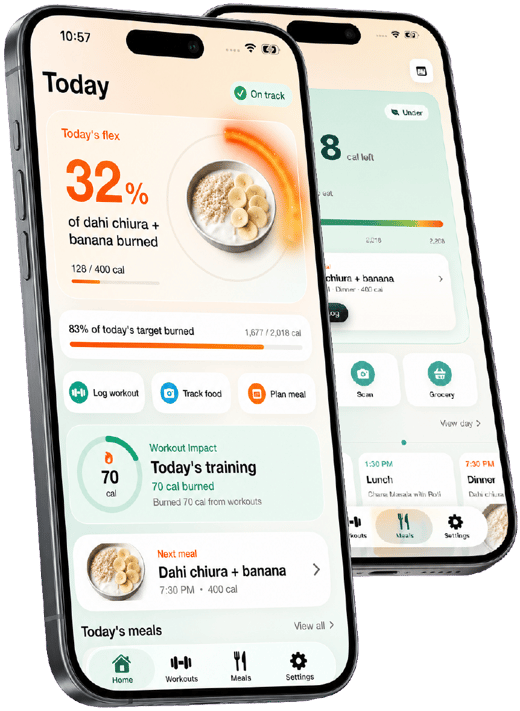
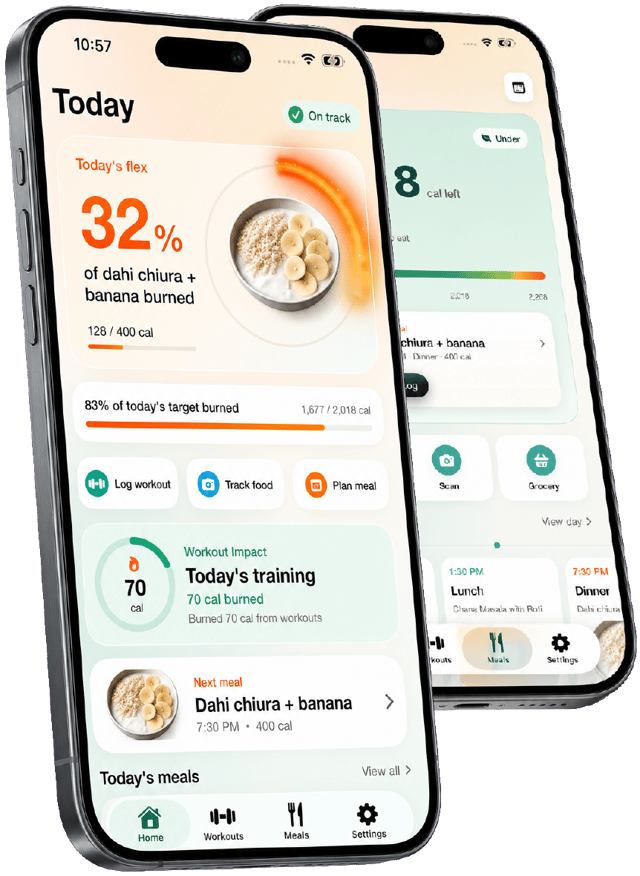
The burn bar shows how much of your last meal a dumbbell session covered, keeping the two halves of the plan — training and food — visible on one screen.
Practical guidance
Tips for getting more from a dumbbells-only plan
How to make one pair of dumbbells go further, technically and practically.
- 01 Buy adjustable if you're starting from scratch
One adjustable pair (5–50 lb or similar) replaces a rack of fixed dumbbells and takes a fraction of the space and cost.
- 02 Master the goblet squat first
It's the single move that teaches squat depth and bracing best with just one dumbbell, and it transfers directly to every other squat variation later.
- 03 Don't skip single-arm rows
They're the closest dumbbell equivalent to a barbell row's back-building effect, and they fix side imbalances a barbell row can't.
- 04 Use the floor, not just a bench
A bench helps but isn't required — floor presses and floor-supported rows cover most of what a bench adds for a dumbbells-only plan.
- 05 Increase reps before you plateau on weight
If your dumbbells top out before your strength does, climbing from 10 to 15+ reps keeps building strength and muscle for a good while longer.
- 06 Rotate grip and angle
Neutral-grip presses, incline angles on the floor (propped on a pillow) and different row angles all change the stimulus without new equipment.

Build the plan around your week
Build my workout plan Tell Burnplate your days, equipment and level and it builds a progressive workout plan, logs every session, and connects what you burn to what you eat.
Questions
Workout planner for dumbbells only: FAQ
Can you get a full workout with just dumbbells?
Yes. A dumbbell only workout plan can train every major muscle group — legs, back, chest, shoulders, arms and core — through squats, hinges, presses, rows and carries. The main limitation is an eventual load ceiling, which tempo and rep changes can offset for a long time.
How many dumbbells do I need for a full workout plan?
One pair is enough if it's adjustable across a wide range (roughly 5–50 lb); otherwise two or three fixed pairs spanning light, moderate and heavy cover most of a well-rounded workout plan dumbbells alone can deliver.
Can you build muscle with dumbbells only?
Yes — muscle growth depends on progressive overload, which dumbbells provide through added weight, reps, tempo changes and unilateral variations. Studies and real-world results show dumbbell-only training builds meaningful size and strength, especially for beginners and intermediates.
What's a good dumbbell workout routine for beginners?
A 3-day full-body routine with a goblet squat, a floor press, a single-arm row, a Romanian deadlift and a plank covers the major patterns. Add a set or a few reps each week as those become comfortable.
How heavy should my dumbbells be to start?
Most beginners do well starting around 10–20 lb per dumbbell for upper body moves and 15–30 lb for lower body moves like goblet squats, adjusting up once 12–15 reps feel easy with good form.
Does Burnplate build workout plans specifically for dumbbells?
Yes — selecting dumbbells only as your equipment tells Burnplate's workout builder to write every session using just dumbbell exercises, scaled to your days per week and level.
