A single max vertical jump matters far less than being able to produce close to your best jump on possession after possession, late in a close game — that repeatability is trained differently than raw power alone.
Why it's different
Why a workout plan for basketball players is different
Basketball demands power that has to repeat dozens of times a game, not just once, and the same explosive jumping and cutting that creates highlight plays is also what puts knees at risk without the right training.
6–8 g/kg carbohydrate per kg bodyweight many players need on heavy practice or game days
3x/wk strength and power sessions most in-season basketball plans fit around games
30–40 in vertical jump range strength and plyometric training can help players build toward
Repeated jumping and cutting puts real strain on the ACL, especially with poor landing form. Training proper landing mechanics is one of the most evidence-backed ways to reduce non-contact knee injuries.
During the season, strength training exists to maintain the power built in the off-season without adding soreness that shows up on the court — it's not the time to chase new personal records.
Basketball's stop-start sprinting depletes glycogen over a full game — under-fueling shows up as slower first steps and worse decision-making in the final minutes.
What it looks like
A sample in-season training week for basketball players
A three-day in-season strength week designed to maintain power and protect the legs around a weekly game.
Example week
3 strength Days/week40–50 min Session lengthClub to competitive LevelCourt + basic weights Equipment
Monday Strength + power Trap bar deadlift 3x5 · Box jumps 3x5 · Split squats 3x8/side
Tuesday Skill + conditioning Shooting and ball-handling drills · 6x30s suicide sprints
Wednesday Rest or light shooting 20–30 min easy shooting practice
Thursday Strength + core Single-leg squats 3x8 · Med-ball rotational throws 3x8 · Plank series
Friday Game or scrimmage Full game or 5-on-5 scrimmage
Saturday Recovery Easy mobility work and light cardio
Sunday Rest Full rest before the training week restarts
How Burnplate handles it
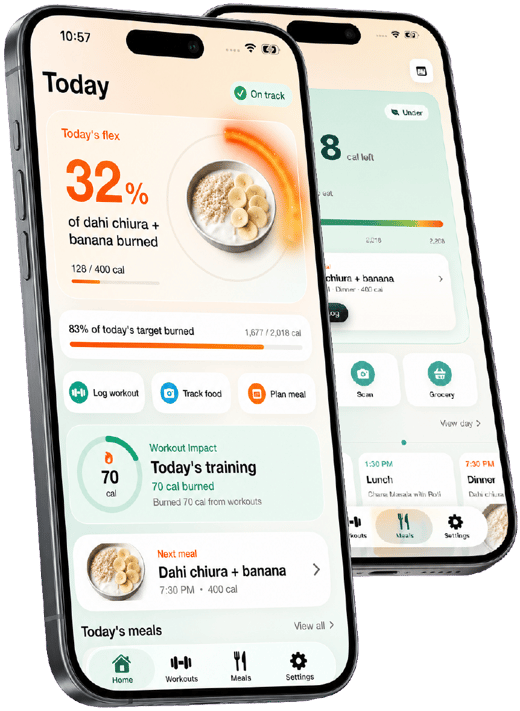
How Burnplate plans a basketball player's week
Burnplate fits strength and power training around your game schedule and scales fueling for game days.
A plan built around a 3x/week in-season schedule
Tell Burnplate your games and training days, and it structures strength and power sessions to maintain fitness without adding fatigue before tip-off.
Every lift and jump session logged
Log strength and power sessions, and Burnplate keeps a training history so progress is visible across a full season.
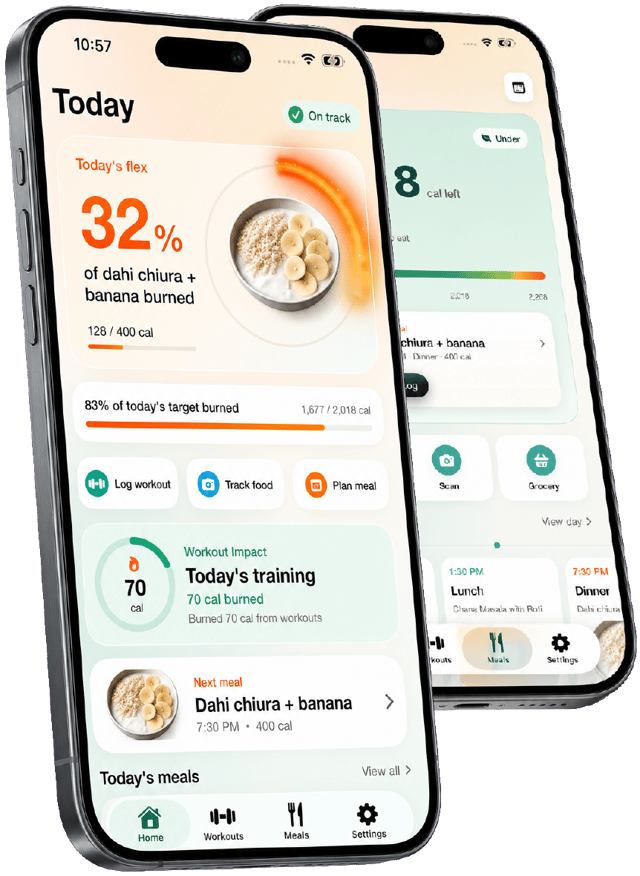
The burn bar after games and practice
After a game or hard practice, Burnplate shows how much of your next meal you've burned off, connecting a heavy basketball day to real recovery fuel.
Calorie and carb targets that flex on game days
Your daily targets adjust upward around games, supporting the carbohydrate needs of stop-start sprinting for a full 40-48 minutes.
Practical guidance
Training tips for basketball players
Habits that keep your legs explosive from tip-off to the final buzzer.
- 01 Fuel up before game day
Extra carbohydrate the day before and morning of a game supports the repeated sprinting and jumping a full game demands.
- 02 Practice landing mechanics directly
Deliberately training how you land from a jump — knees tracking over toes, controlled deceleration — is one of the best-supported ways to protect against ACL injury.
- 03 Keep in-season lifting brief and heavy
Long, exhausting lifting sessions during the season cost you more in game-day soreness than they add in strength.
- 04 Hydrate through back-to-back games
Tournament weekends and back-to-backs add up fast — plan fluid and electrolyte intake around the schedule, not just the game itself.
- 05 Build your strength base in the off-season
The off-season is when you can add real training volume without games draining recovery — that's when the biggest athletic gains happen.

Build the plan around your week
Build my workout plan Tell Burnplate your days, equipment and level and it builds a progressive workout plan, logs every session, and connects what you burn to what you eat.
Questions
Workout planner for basketball players: FAQ
What is a good workout plan for basketball players?
A good basketball workout plan for basketball players combines 2-3 strength and power sessions a week — trap bar lifts, jumps, single-leg work — with skill and conditioning work, adjusted for whether you're in-season or off-season.
How many calories does playing basketball burn?
A competitive full-length game commonly burns 600-1,000 calories for many players, depending on minutes played, position and intensity, with stop-start sprinting driving much of that cost.
How can basketball players jump higher?
Vertical jump improves most reliably through a combination of lower-body strength training (squats, deadlifts) and plyometric power work (box jumps, depth jumps), built progressively over an off-season rather than crammed in before tryouts.
Should basketball players lift weights in season?
Yes, but in-season lifting should be lower volume and focused on maintaining strength, not building new fitness — heavy, brief sessions two to three times a week without excess soreness before games.
What should basketball players eat before a game?
A carbohydrate-forward meal 3-4 hours before tip-off, with a light carb snack closer to game time if needed, supports the glycogen stores that repeated sprinting and jumping burn through over a full game.
