The hormone relaxin increases ligament laxity to prepare your pelvis for birth, but it loosens every joint, not just the ones that need it. Deep lunges, heavy overhead work and anything that relies on joint stability need lighter loads and more control.
Why it's different
Why a pregnancy workout plan is different
Your center of gravity, joint laxity, blood volume and core mechanics all change over 40 weeks. A plan that ignores that isn't a pregnancy plan — it's a regular plan you're trying to survive.
150 min moderate-intensity activity per week is the general guideline for most pregnancies
RPE 5–6 a 'somewhat hard' effort out of 10 is the usual ceiling once you're breathing hard but can still talk
2–3×/week strength sessions most obstetric guidelines consider safe to continue throughout pregnancy
As the uterus grows, the abdominal wall stretches and can separate at the midline (diastasis recti). Traditional crunches and full sit-ups can worsen this; pregnancy plans swap in breath-led core work like bird dogs and pelvic tilts instead.
From roughly week 16 on, lying flat on your back can compress a major vein and reduce blood flow to you and the baby. Supine exercises get modified to incline, side-lying or standing versions.
Heart-rate zones get unreliable in pregnancy because resting heart rate rises on its own. Rate of perceived exertion — can you hold a conversation — is the guidance most obstetric bodies actually recommend using instead.
What it looks like
A sample second-trimester week
Three strength sessions and light daily walking, all at a conversational effort. This is a second-trimester week — first and third trimester plans in Burnplate look different.
Example week
3 strength + daily walks Days/week30–40 min Session lengthPreviously active LevelDumbbells, bench Equipment
Monday Full body, moderate load Goblet squat 3×10 · Incline dumbbell press 3×10 · Seated row 3×12 · Bird dog 3×8/side
Tuesday Walk + mobility 30 min brisk walk · hip circles · cat-cow · ankle mobility
Wednesday Full body, moderate load Step-up 3×8/side · Dumbbell row 3×10 · Standing shoulder press 3×10 · Side-lying leg raise 3×12
Thursday Walk + pelvic floor 25–30 min easy walk · guided pelvic floor breathing
Friday Full body, lighter load Sumo squat 3×12 · Chest-supported row 3×12 · Glute bridge 3×15 · Wall push-up 3×10
Saturday Active rest Prenatal yoga or 20–30 min swim/water walking
Sunday Rest Full rest or a gentle stroll
How Burnplate handles it
How Burnplate supports a pregnancy plan
Burnplate isn't a medical device and doesn't replace your OB or midwife's clearance and guidance. It gives you a structured, adjustable plan and an easy way to log how each session actually felt.
A plan built around your days and equipment
Tell Burnplate how many days you can train and what equipment you have, and it builds a progressive plan — then you or your provider can flag moves to swap out.
Session and rep logging without the guesswork
Log sets, reps and how a session felt so you and your provider can see the trend, not just one workout.
Calories and protein that adjust with you
Your target calories and protein update from your body and activity, since pregnancy needs typically shift by trimester.
See training and food on one screen
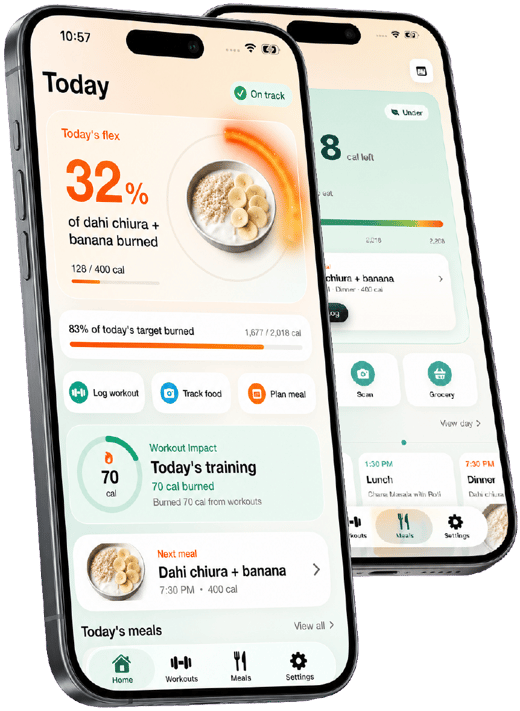
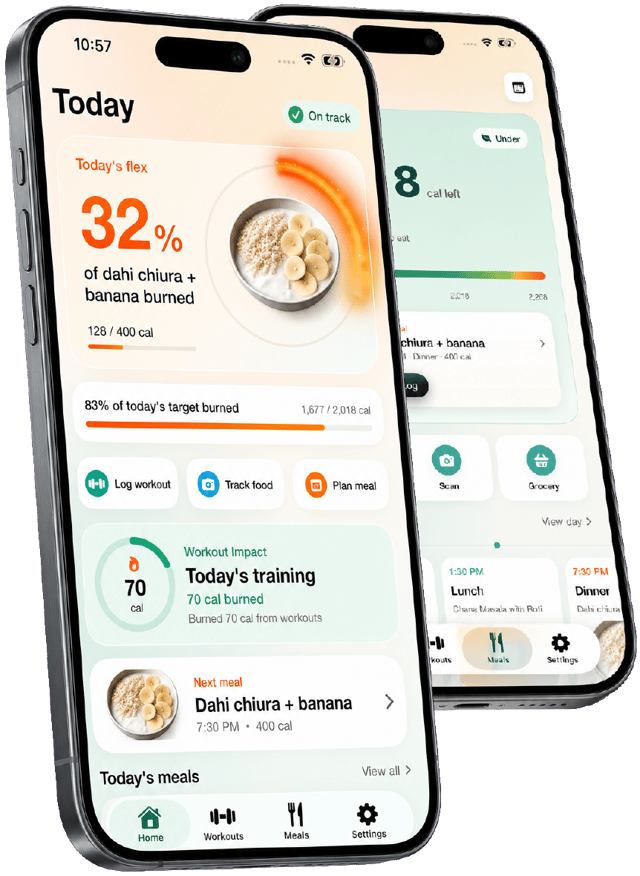
The burn bar shows how a walk or session stacks up against a meal — a simple way to stay aware of your energy balance without obsessing over a deficit, which isn't the goal in pregnancy.
Practical guidance
Practical tips for training through pregnancy
Small adjustments that keep a pregnancy workout plan comfortable and sustainable week to week.
- 01 Get cleared first
If you're new to exercise or have a pregnancy complication, get your provider's sign-off on intensity and specific movements before starting.
- 02 Ditch anything that hurts your pelvis
Sharp pubic or lower-back pain during a move (not just general fatigue) means stop and modify — it's a mechanics problem, not a toughness test.
- 03 Widen your base as you go
A wider stance on squats and lunges compensates for the shifting center of gravity and feels far more stable in the third trimester.
- 04 Hydrate and don't overheat
Blood volume is up and heat dissipation changes in pregnancy — skip hot rooms and keep water nearby.
- 05 Keep the pelvic floor in the loop
Exhale on exertion and avoid holding your breath through heavy lifts; this protects the pelvic floor as much as the core does.
- 06 Walking still counts
On low-energy days, a 20-minute walk is a complete session. Consistency across nine months beats any single hard workout.

Build the plan around your week
Build my workout plan Tell Burnplate your days, equipment and level and it builds a progressive workout plan, logs every session, and connects what you burn to what you eat.
Questions
Workout planner for pregnancy: FAQ
What is the best workout for pregnancy?
There isn't one universal routine — the best workout for pregnant women is whatever combines moderate cardio (like walking or swimming) with light-to-moderate strength training, adjusted each trimester, at an effort where you can still hold a conversation. Consistency matters more than intensity.
Is it safe to lift weights while pregnant?
For most uncomplicated pregnancies, yes — continuing a strength routine you're already used to is generally considered safe, with lighter loads, more control and breathing out on the effort. New, very heavy or high-risk lifting isn't the time to start; check with your provider if you're unsure.
What exercises should I avoid during pregnancy?
After the first trimester, avoid exercises lying flat on your back, activities with a high fall or contact risk (skiing, contact sports), and anything that causes sharp pelvic or abdominal pain. Traditional sit-ups are usually swapped for breath-led core work to protect the midline.
How many days a week should a pregnant woman work out?
Most healthy pregnancies can support 150 minutes of moderate activity weekly, often split into 3–5 sessions, plus daily light walking. Fewer, shorter sessions on low-energy days are completely fine — the target is consistency, not volume.
Can Burnplate build a pregnancy-safe workout plan?
Burnplate builds a progressive plan around your days per week, equipment and level, and lets you log sessions as you go. It doesn't provide medical clearance — pair it with your OB or midwife's guidance on which movements to modify each trimester.
When should I stop exercising during pregnancy?
Stop a session and contact your provider for dizziness, chest pain, calf pain or swelling, vaginal bleeding, fluid leaking, contractions, or unusual shortness of breath before you've even started exerting. These are medical signals, not something to train through.
