
Beginners, people returning to training after a long break, and people carrying more body fat have the most 'headroom' for recomposition — their bodies can build muscle and lose fat at the same time far more easily than a lean, experienced lifter can.
Why it's different
Why recomposition works for some people and not others
Simultaneously losing fat and building muscle isn't the norm — it requires specific conditions. Understanding whether those conditions apply to you is the difference between recomposition being the right strategy or a slow waste of months.
±150 kcal the narrow band around maintenance where recomposition tends to happen
1.8–2.2g protein per kg bodyweight — high enough to build muscle without a surplus
3–4×/wk resistance sessions a week — the real driver of recomposition, not the calorie number
If fat and muscle are trading places at similar rates, total weight barely moves for weeks. That's the mechanism working — but it's also why so many people abandon recomposition, mistaking a flat scale for no progress.
Without a surplus to build with or a deficit forcing fat loss, protein at the high end of the range (1.8–2.2 g/kg) becomes the main lever driving muscle gain while calories sit still.
A focused bulk builds muscle faster; a focused cut loses fat faster. Recomposition trades speed on both fronts for doing both simultaneously — a reasonable trade for someone not in a hurry.
What it looks like
A sample day for body recomposition
Built around a maintenance estimate of roughly 2,000 calories with protein held high and four resistance sessions a week.
Example day
Daily targets
Calories 2,000 kcal held close to maintenance — the number that should barely move
Protein 150 g about 2 g/kg, the main driver of the muscle side of the equation
Carbs 190 g fuels training sessions without pushing calories into a surplus
Fat 65 g kept moderate to leave room for protein and training carbs
A logged day
7:00 AM Greek yogurt, oats, berriesprotein-forward start, sets the tone for the day 420 kcal
12:00 PM Chicken, quinoa, roasted vegsteady protein and carbs, nothing excessive 520 kcal
3:30 PM Protein shake, applecloses toward the protein target without much volume 220 kcal
6:00 PM (lift session) —training logged; the point isn't to 'earn' extra food today —
7:30 PM Salmon, rice, saladthe day's main meal, still landing right at maintenance 560 kcal
9:00 PM Cottage cheesefinal protein hit, rounds the day to 2,000 total 130 kcal
How Burnplate handles it
How Burnplate handles recomposition
Recomposition depends on consistency over months, which means the tools need to make that easy to sustain, not just easy to start.
A target centered on maintenance with elevated protein
Burnplate calculates your maintenance calories and sets protein at the high end of the range, the combination recomposition depends on.
A workout planner supplying the resistance training
Recomposition is driven far more by training than by the calorie number. Burnplate's workout planner builds the progressive program that does the actual work.
Photo logging that keeps the maintenance band accurate
Because the target is a narrow band around maintenance, drift matters more here than in a bulk or cut. Fast photo logging keeps weeks of data reliable.
The burn bar keeps activity from quietly creating a deficit
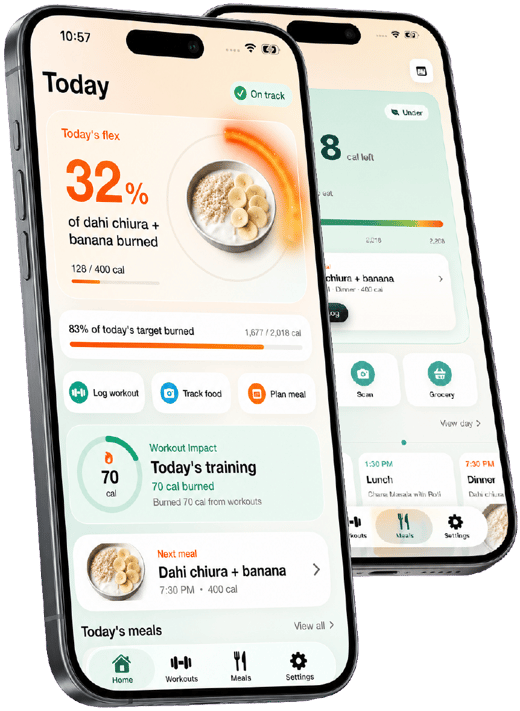
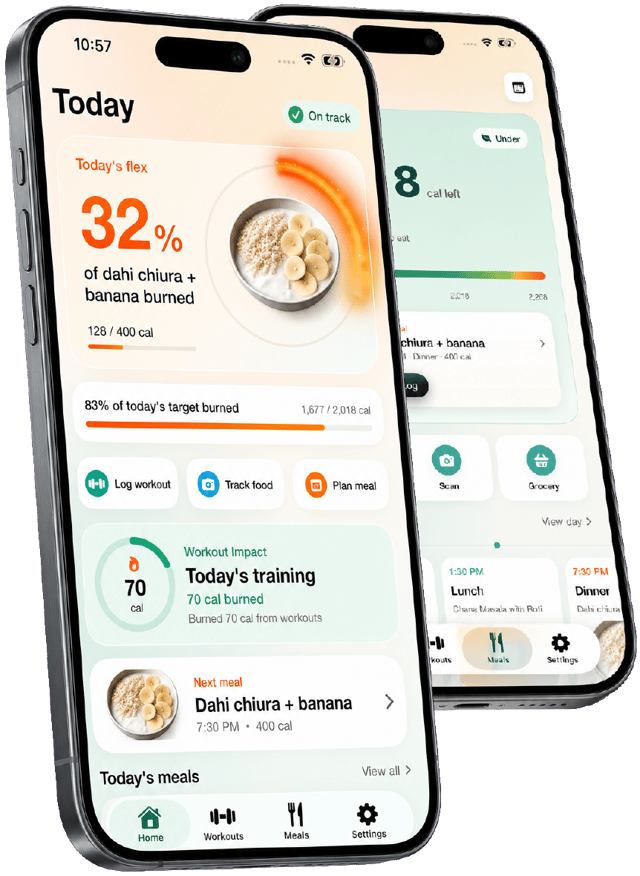
Extra steps or cardio can accidentally turn 'maintenance' into a mild deficit. Seeing the day's real balance keeps the target where it's supposed to be.
Practical guidance
Tips for a recomposition phase that doesn't stall out
Practical ways to stay the course through the part where the scale isn't telling you much.
- 01 Track measurements, not just weight
Waist, hip or progress photos every few weeks often show the change the scale is hiding — use them alongside weight, not instead of it.
- 02 Prioritize progressive overload
If lifts aren't trending up over 6–8 weeks, recomposition likely isn't happening yet, regardless of how the diet looks.
- 03 Give it 8–12 weeks before judging
Recomposition is slow by nature. A few weeks of a flat scale is expected, not a sign to change the plan.
- 04 Reassess if you're already lean
Recomposition works best with some fat to lose. Very lean, experienced lifters usually get faster results from a dedicated bulk or cut instead.
- 05 Keep protein non-negotiable
Of the three macros, protein is the one recomposition can't compromise on — it's doing double duty with no surplus or deficit to lean on.

Track it with a photo, not a search bar
Start tracking free Burnplate sets your calorie and macro targets, logs meals from a photo, and shows how much of each meal your workouts and steps have burned off.
Questions
Calorie tracker for body recomposition: FAQ
What is body recomposition and does it actually work?
Body recomposition is losing fat and gaining muscle at the same time, typically while eating near maintenance calories with high protein and consistent resistance training. It's a real, supported outcome — most reliable for beginners, returning lifters, or people with more body fat to lose.
How many calories should I eat for body recomposition?
Most people run it close to maintenance, sometimes within a couple hundred calories in either direction, rather than a dedicated surplus or deficit. Protein stays high (1.8–2.2 g/kg) regardless of which side of maintenance you land on.
Who is body recomposition best for?
It works best for beginners, people returning to training after time off, and people carrying more body fat — all groups whose bodies can build muscle and lose fat simultaneously more easily than a lean, experienced lifter.
How long does body recomposition take?
Visible change typically takes 8–12 weeks or longer, since both fat loss and muscle gain happen more slowly than in a dedicated cut or bulk. The scale often shows very little movement even as body composition shifts underneath it.
Do I need to track macros for recomposition, or just calories?
Protein specifically matters more here than in a straightforward diet, since it's doing the work a surplus or deficit would normally help with. Tracking protein alongside total calories is worth the extra effort during a recomposition phase.
