Total weekly sets per muscle group is one of the most consistent predictors of hypertrophy in training research. Two or three sets a week maintains muscle; meaningfully building it usually takes 10–20 quality sets per group, split across sessions.
Why it's different
Why generic full-body plans stall out for muscle gain
A plan built for general fitness gives each muscle group enough stimulus to maintain it. Building new muscle takes more — a deliberate combination of volume, tension and food.
6–12 reps per set is the range most associated with hypertrophy, though growth happens across a wider range too
10–20 sets per muscle group per week is the volume range associated with meaningful muscle growth for most lifters
1.6–2.2g protein per kg of body weight supports muscle growth; more than this shows diminishing returns for most people
Muscle adapts to a demand that's slightly harder than what it's already handling. Without tracking and gradually increasing weight, reps or sets over time, sessions stay the same difficulty and growth stalls even with good volume.
Building muscle requires extra calories, but an aggressive surplus mostly adds fat, not muscle, since the body can only build tissue so fast. A modest surplus — a few hundred calories above maintenance — is enough for most training paces.
Natural muscle growth for someone with training experience runs roughly 0.25–0.5% of body weight per week at best, slower for advanced lifters. Expecting visible change in two weeks sets up a plan to get abandoned before it works.
What it looks like
A sample muscle-gain week
An upper/lower split hitting each muscle group twice a week, which fits well inside the 10–20 weekly set range per group.
Example week
4–5 Days/week60 min Session lengthIntermediate LevelGym Equipment
Monday Upper (push focus) Bench press 4x8 · Overhead press 3x10 · Incline dumbbell press 3x10 · Tricep pushdown 3x12
Tuesday Lower body Squat 4x8 · Romanian deadlift 3x10 · Leg press 3x12 · Calf raise 3x15
Wednesday Rest or light cardio 20–30 min easy cardio or full rest
Thursday Upper (pull focus) Row 4x8 · Lat pulldown 3x10 · Rear delt fly 3x15 · Bicep curl 3x12
Friday Lower body Deadlift 4x6 · Bulgarian split squat 3x10/leg · Leg curl 3x12 · Calf raise 3x15
Saturday Arms and weak points Close-grip bench 3x10 · Hammer curl 3x12 · Lateral raise 3x15 · Face pull 3x15
Sunday Rest Full rest
How Burnplate handles it
How Burnplate supports a muscle-gain plan
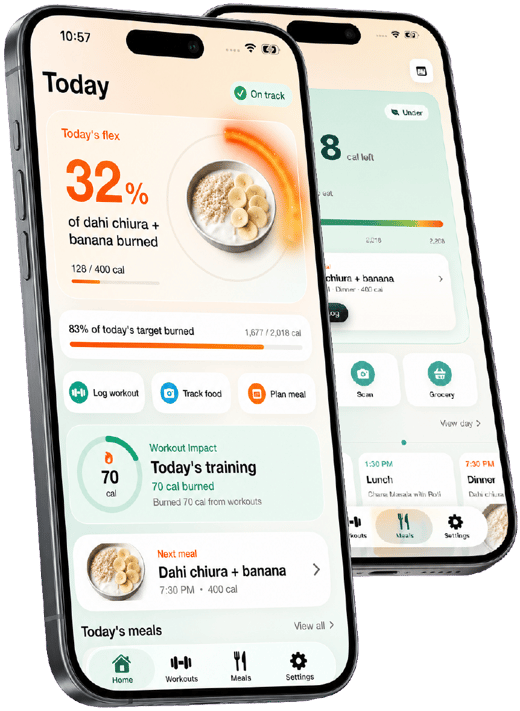
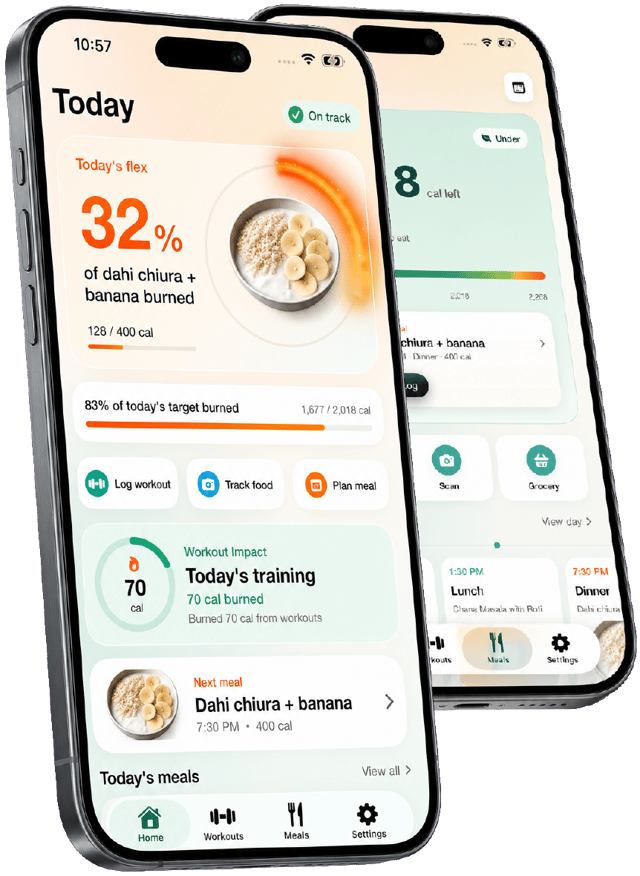
Burnplate tracks the two sides that determine whether muscle actually gets built — the training and the food.
A progressive plan around your days and equipment
Burnplate's workout builder creates a split that fits your schedule and equipment, structured to hit each muscle group with enough frequency to support growth.
Workout history that shows overload happening
Every set and rep gets logged, and workout history makes it visible whether loads are actually climbing over weeks — the clearest sign the plan is working.
Calorie and protein targets built for a surplus
Burnplate sets a calorie target with a modest surplus and a protein target from your body and goal, so you're not guessing whether you're eating enough to grow.
One-tap food logging so the surplus stays honest
Logging meals from a photo or search keeps the surplus from drifting up or down unnoticed — the easiest way a muscle-gain phase quietly turns into a fat-gain phase.
Practical guidance
Tips for building muscle efficiently
The habits that separate steady, visible gains from a lot of training with little to show for it.
- 01 Eat enough — track it, don't eyeball it
Most people underestimate intake without tracking; a slight surplus that doesn't get eaten is a slight surplus that doesn't build muscle.
- 02 Spread protein across the day
Roughly 3–4 protein-containing meals spaced through the day supports muscle building better than one large protein hit.
- 03 Sleep 7–9 hours
Muscle repair and growth hormone release happen largely during sleep — under-sleeping blunts the return on hard training sessions.
- 04 Keep some cardio in the plan
A small amount of cardio supports recovery and cardiovascular health without meaningfully interfering with muscle gain.
- 05 Log every session honestly
The point of the log isn't just history — it's the only reliable way to know whether to add weight next time.
- 06 Give a program at least 8–12 weeks
Switching plans every couple of weeks resets the progressive-overload tracking that muscle growth actually depends on.

Build the plan around your week
Build my workout plan Tell Burnplate your days, equipment and level and it builds a progressive workout plan, logs every session, and connects what you burn to what you eat.
Questions
Workout planner for building muscle: FAQ
How many days a week should I lift to build muscle?
Four to five days a week, structured so each muscle group is trained roughly twice, works well for most people building muscle. Three full-body days can also work for beginners; the key variable is total weekly volume per muscle group, not the exact day count.
How much protein do I need to build muscle?
Most research supports roughly 1.6–2.2 g of protein per kg of body weight for building muscle, spread across several meals. Intake above this range shows little additional benefit for most people.
Can I build muscle in a calorie deficit?
It's possible in some cases — beginners, people returning from a layoff, or those carrying more body fat — through a process sometimes called body recomposition. It's slower and less reliable than building in a slight surplus, which is why most dedicated muscle-gain phases use one.
What is the best rep range for muscle growth?
6–12 reps per set is the range most commonly associated with hypertrophy, but research shows meaningful growth can happen anywhere from about 5 to 30 reps per set, as long as the sets are taken close to muscular fatigue.
How long does it take to see muscle gains?
Strength gains show up within a few weeks, largely from neural adaptation. Visible muscle size typically takes 8–12 weeks of consistent training, adequate protein and a slight surplus to become noticeable, and longer for more experienced lifters.
